

Court unbans Temple Mount activist penalized for pig picture
Haim Brosh’s lawyer says he created image but didn’t post it on Facebook, argues that free speech permits mockery of holy sites
 Add ToI as a Preferred Source on Google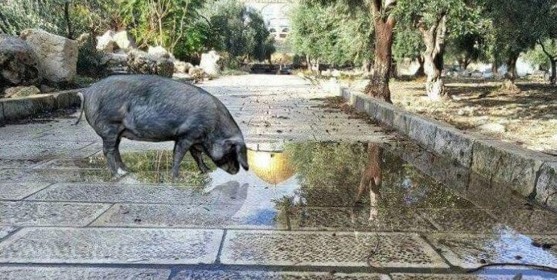
Jerusalem District Court on Tuesday overturned a ban on visiting the Temple Mount imposed upon a right-wing activist for disseminating an image of a pig superimposed on the Old City holy site.
Haim Brosh, 30, from the West Bank settlement of Tekoa was arrested Wednesday for incitement after calling Muslims “pigs” on social media. He subsequently received a 10-day ban on visiting the Temple Mount because of the digitally altered image of the pig drinking from a puddle on the Temple Mount, which was posted on Facebook.
In the picture, the golden-capped Dome of the Rock can be seen reflected in the water of the puddle, and the accompanying caption reads: “The Israeli government lets live pigs rule the holiest site for the Jewish people, and everyone is crying out over a [dead] pig’s head at the tomb of a righteous man in anti-Semitic Europe?”
His comparison was a reference to an attack early Wednesday morning in the Ukrainian town of Uman, during which a number of assailants threw a pig’s head into a building at the gravesite of Rabbi Nachman, founder of the Breslov Hasidic movement, and daubed fake blood on the walls and floor of a synagogue at the site. Some Jewish worshipers present were attacked with pepper spray.
Although Brosh did remove the image from the timeline of his Facebook account, he didn’t actually delete it, and it was still being shared by other users a day later in protest of his arrest.
https://twitter.com/TheYiddishWorld/status/811419559613886464
Far-right lawyer Itamar Ben Gvir, who is representing Brosh, claimed that he was charged with the wrong offense. According to Ben Gvir, while Brosh did create the image it was others who uploaded it to his Facebook page. Ben Gvir argued that the creation of such an image is covered by freedom of speech, and is no worse than other artistic images that mock Jewish holy sites.
In upholding the appeal, judge Carmi Mossek berated police for falsely charging Brosh, telling them that he failed to see why the alleged crime should cause him to be barred from the Temple Mount itself.
Brosh’s Facebook feed includes pictures of previous visits he made to the holy site, as well as other references to Jewish right of access to the compound.
https://www.facebook.com/photo.php?fbid=10154387954967556&set=a.405047567555.179167.760597555&type=3&theater
Brosh said that in creating the image, he intended to protest the fact that “the Israeli government is letting a foreign body — the Waqf [Jordan-based Islamic trust administering the site] — control and act in an aggressive manner and harm the basic democratic rights of Jews who only want to go up and pray without any provocation.”
“I go up to the Temple Mount and they harass me, curse me, and call me a pig,” Brosh said. “In every mosque they call Jews monkeys and pigs and they haven’t arrested anyone for offending [my] religion.”
Jewish activists have advocated going up onto the Mount and praying on it to establish a Jewish presence on the site, on which the third-most important holy site in Islam — the Al-Aqsa Mosque — rests. The Mount itself and the area under the Dome of the Rock are the holiest sites in Judaism and the locations of both the ancient Jewish temples.
Under Israeli law, Jews are allowed to visit the Mount but not to pray there, as part of a “status quo” agreement put in place by Israel after it captured the site from Jordan in 1967.
Stuart WIner contributed to this report.




The Times of Israel Community.