

El Al plaintiff, 81, sees discrimination lawsuit as chance ‘to do some good’
Meet Renee Rabinowitz, grandmother, litigant, and ‘flavor of the month’ at Israel Religious Action Center
 Add ToI as a Preferred Source on Google
Jessica Steinberg, The Times of Israel's culture and lifestyles editor, covers the Sabra scene from south to north and back to the center
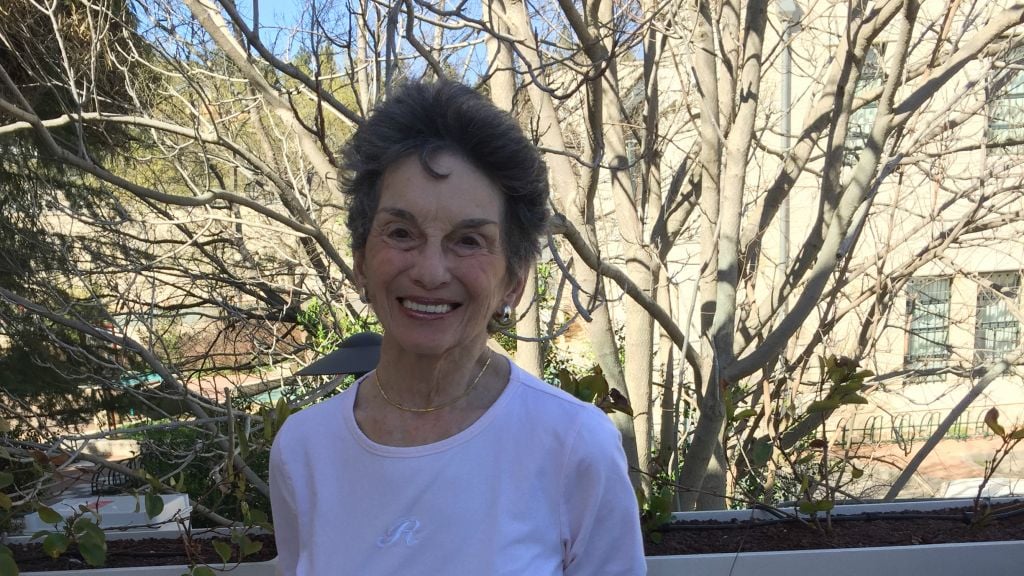
It’s been an unusual week for Renee Rabinowitz, the 81-year-old retired lawyer currently in the limelight as a plaintiff in a religious discrimination lawsuit against national airline El Al.
First, there was the story in The New York Times. (“To put my picture on the front page? The Sunday New York Times?” marveled Rabinowitz.)
“I don’t understand it — but if it helps to draw attention to the issue, I’m thrilled,” she told The Times of Israel.
Next, it’s been a whirlwind of interviews (including an upcoming, in-depth conversation with National Public Radio), emails from friends, even a caricature of Rabinowitz being parachuted out of the plane by Haaretz’s Amos Biderman.
“I may have to frame this,” she said, holding up the cartoon.
The media attention wasn’t what Rabinowitz expected when she agreed to change seats on an El Al plane back to Israel from Newark.
Belgium-born Rabinowitz, whose family fled the Nazi occupation in 1941 and who grew up Orthodox in New York and now lives in Jerusalem, had gone to visit family in the US. On the flight back home to Israel she was asked by an El Al flight attendant to move seats at the request of the ultra-Orthodox man in the window seat, next to the seat she had been assigned.
She moved without a fuss — “I had never been on a trip where a whole hullabaloo happened” — but then thought about it again at the end of the flight, when she happened to speak to the pilot.
Rabinowitz, who has bad knees, was waiting for all the passengers to disembark after which she would be taken by wheelchair through the airport. When the pilot emerged from the cabin, she started a conversation with him.
“I said, ‘Why do you do this, it’s not right,’ and he said, ‘It’s not the staff, it’s not us, it’s the board of directors.’ Meaning, if he’s correct, it’s apparently a practice they’ve decided on,” said Rabinowitz.

About ten days later she related her experience to Anat Hoffman, executive director at IRAC, the Israel Religious Action Center, the legal advocacy arm of the Reform Movement in Israel.
Rabinowitz had gone to the Pardes Institute, a Jerusalem institute of Jewish learning, to hear Hoffman speak. She was reminded of her own recent El Al story when Hoffman mentioned the advocacy center’s efforts to combat that kind of acts of religious discrimination in the sky.
After the lecture, Rabinowitz went up to Hoffman, and when she related her story — and the flight attendant’s role — Hoffman said, “Oh my gosh, you’re our plaintiff,” said Rabinowitz.
“I said, ‘Wait a minute!'” she added, laughing and putting her hands up in mock protest.
From that moment on, things moved quickly. Ricky Shapira Rosenberg, the center’s lawyer, asked Rabinowitz to come in and sign a sworn affidavit.
“She said I’m the flavor of the month” at IRAC, joked Rabinowitz.
The next step will be recounting her story in court, in Tel Aviv. According to the IRAC spokesperson, a date has not yet been set for the trial.
Meantime, Rabinowitz has time to ponder the series of events and her role in them. Between interviews, that is.
“I think this is more of a problem here than in the States,” she said. “I do not think this would happen if a Haredi man in the US were going from New York to LA. I think it’s more part of Israeli society and it’s part of our political situation in which the coalition gives a lot of weight to Haredi wishes, Haredi concerns, and this is part of it. I think it empowers individuals to act like this.”
Rabinowitz is pleased about the lawsuit, although her participation has received a mixed reaction from her family, which includes her rigorously observant son and daughter-in-law in Israel as well as their children.
“I think my son understands that there’s something ultimately problematic with this,” said Rabinowitz. “The kids think their bubbe is a feisty lady.”
But no matter what, she’s not sorry to be taking part in the advocacy battle. In fact, she sees it as a chance “to do some good.”
“I’m not a confrontational kind of person,” said Rabinowitz. “I think there are just times when I see something that’s problematic and if I can do something I’ll say, yup, I’m doing it.”










The Times of Israel Community.