

Israel and Hamas are plunging into an all-out war that neither side wants
Both are under intense pressure and are determined to deter each other, but there is yet hope they can come back from the brink

 Add ToI as a Preferred Source on Google
Avi Issacharoff, The Times of Israel's Middle East analyst, fills the same role for Walla, the leading portal in Israel. He is also a guest commentator on many different radio shows and current affairs programs on television. Until 2012, he was a reporter and commentator on Arab affairs for the Haaretz newspaper. He also lectures on modern Palestinian history at Tel Aviv University, and is currently writing a script for an action-drama series for the Israeli satellite Television "YES." Born in Jerusalem, he graduated cum laude from Ben Gurion University with a B.A. in Middle Eastern studies and then earned his M.A. from Tel Aviv University on the same subject, also cum laude. A fluent Arabic speaker, Avi was the Middle East Affairs correspondent for Israeli Public Radio covering the Israeli-Palestinian conflict, the war in Iraq and the Arab countries between the years 2003-2006. Avi directed and edited short documentary films on Israeli television programs dealing with the Middle East. In 2002 he won the "best reporter" award for the "Israel Radio” for his coverage of the second intifada. In 2004, together with Amos Harel, he wrote "The Seventh War - How we won and why we lost the war with the Palestinians." A year later the book won an award from the Institute for Strategic Studies for containing the best research on security affairs in Israel. In 2008, Issacharoff and Harel published their second book, entitled "34 Days - The Story of the Second Lebanon War," which won the same prize.
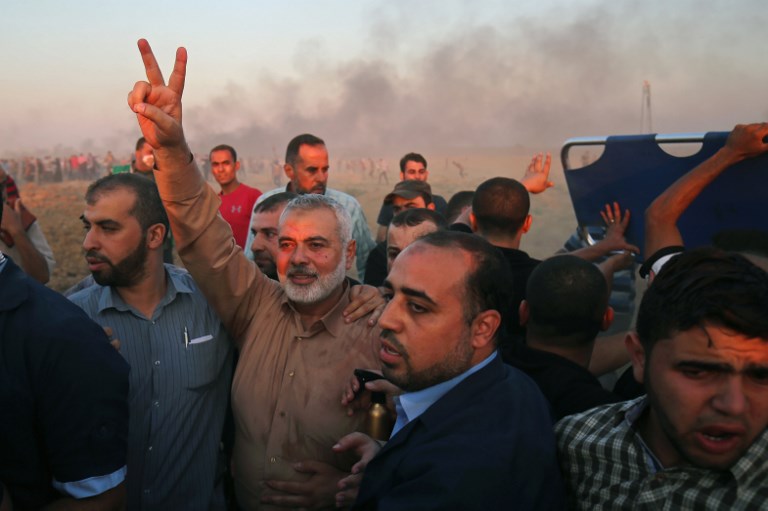
On Tuesday morning, Palestinian Islamic Jihad’s military wing, the al-Quds Brigades, announced that “Ashdod and Beersheba will soon enter the line of fire.” And indeed, it currently looks like there is nothing stopping Israel and the Gaza-ruling Palestinian terrorist groups from continuing the escalation toward a full-blown war.
The traditional brokers of ceasefires between both sides, Egypt and the United Nations, seem to have put aside their efforts to calm the situation, and the pessimism is evident in their statements.
But while Israel and the Hamas terror group both appear ready, even eager, for deeper battle, that is mostly a facade. The two sides are engaged in a game of brinkmanship in a bid to demonstrate their superiority and create deterrence. The problem is that it is highly doubtful that either Hamas or Israel have the ability to achieve those goals without taking steps that will inevitably plunge the area into war.
At least for now, Hamas and Israel look like two trains reluctantly speeding toward a chasm.
In attempting to understand what exactly went wrong over the past few days, it is hard to point to a clear strategic decision. Hamas and Israel had already entered a truce. The Gazan organization’s leadership had invested tremendous efforts in reaching the ceasefire, in which the Strip’s economy was to improve, the supply of electricity was to increase and even Hamas officials were to receive payments using cash suitcases transferred by Qatar with Israel’s approval.

Prime Minister Benjamin Netanyahu’s government had similarly gone to great lengths to clarify that it wasn’t interested in escalation, even essentially agreeing to pay protection money to a terror group that openly declares that it seeks to destroy the Jewish state.
Still, Sunday night’s incident in Khan Younis, in which an Israeli special operations officer was killed along with seven Palestinian terror group members, has changed the situation and led the region to the brink of war. The elite unit’s operation deep inside Gazan territory put Hamas in a difficult position: respond and risk a war, or contain the incident and risk being portrayed as having capitulated to Israel in exchange for money.
At first, it looked like Hamas was leaning toward containing the incident, but the pressure on its leaders ultimately proved to be too strong. As far as they are concerned, an Israeli operation like Sunday night’s and the killing of seven operatives was a distinct violation of sovereignty that crossed all red lines within the framework of a truce.
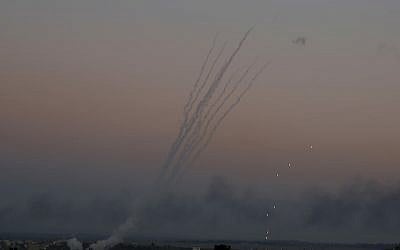
That act prompted Hamas to forgo its wins — salaries, increased electricity and humanitarian steps — by adopting the clear goal of deterring Israel and preventing its next incursion into Gaza.
Of course, that isn’t the only consideration. One has to consider Hamas’s political struggle with rival terror groups such as Islamic Jihad. Those factions have voiced strong criticism of Hamas’s perceived willingness to compromise by containing the Khan Younis incident. Islamic Jihad, in particular, has outflanked Hamas and demanded a far stronger response against Israel. Hamas this time has decided to preempt that by trying to prove it is still a “resistance” organization and fighting even at a high cost.
The sliver of hope at this time is the continued common interest of both the Netanyahu government and the Hamas leadership to stop the fighting. Perhaps the common desire on both sides will eventually calm the situation and cut short the spiraling violence.
The only alternative is an all-out war that will exact an extremely heavy cost from both sides.








The Times of Israel Community.