

German immigrant journalists turn hate mail into poetry
Sold-out show pokes fun at bigoted letters to the editor in an effort to confront prejudice with humor
 Add ToI as a Preferred Source on Google
Yassin Musharbash, a leading German journalist with Jordanian roots, pulls out some recent “fan mail” and starts reading on the stage.
“We want to be informed by knowledgeable compatriots, not by foreigners,” the 39-year-old quotes from a letter to the editor that landed at the prestigious Zeit newspaper.
Gasps turned to incredulous laughter as he continues: “Musharbash is an Islamist who is secretively involved in jihad. He is trying to weaken the defensive forces of the West from inside.”
Musharbash is among a troupe of German journalists with immigrant backgrounds who have been touring with a show called “Hate Poetry” that has sold out across the country. The show explores the growing rancor against Muslims in Germany by revealing hate mail filled with clichés and abuse — and seeks to combat it with humor.
The issue of racist hate mail has recently risen to the fore in Germany. Earlier this month Israel’s Ambassador to Germany Yakov Hadas-Handelsman said he receives about 20 such letters a day in a video (in produced and published by the German newspaper Berliner Morgenpost.
In the video, the ambassador read out a few of the more hateful messages, including: “The Jews milk the Holocaust and are too lazy to work.”
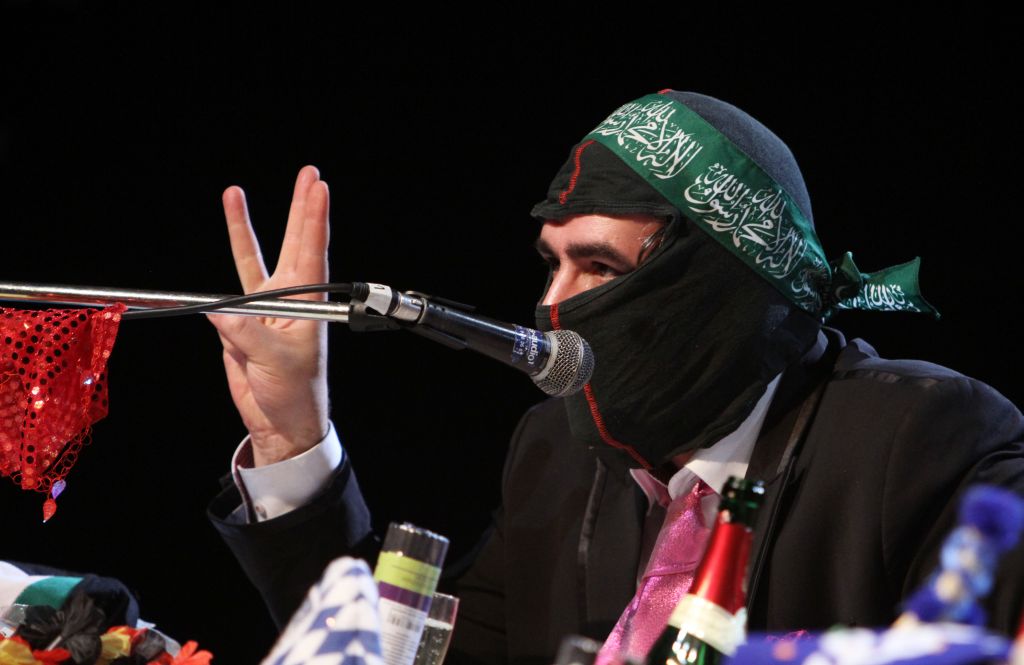
The journalists in the troupe, none of them professional actors, confront prejudice head-on in the show. But they also use irony, poking fun at the stereotypes by appearing on stage dressed like migrant workers from the 1960s or disguised as radical Islamists wearing caftans and face masks.
“We’re being abused not for what we are writing, but for who we are or for who these people think we are,” Musharbash told The Associated Press in an interview before the show. “Apparently there are some people out there who have a big problem that writers with Middle Eastern names work for serious German newspapers.”
The attempt to promote tolerance through theater appears to be working.
“I would have never expected anybody to write such things … I guess I was a bit naive,” said Ute Grave, a 55-year-old saleswoman who saw the show. “It’s is a great way of simply countering the hatred with laughter.”
There are an estimated four million Muslims living in Germany — a country of 80 million. Most are children or grandchildren of Turkish guest workers who came in the 1960s when Germany recruited foreign workers for the country’s booming postwar economy.
Most have found a place in society, speak German as their native language and contribute to society in myriad ways. But many ethnic Germans still have problems with the fact that Germany is increasingly diverse — a society where more than 15 million citizens claim foreign roots.
Despite achievements, immigrant communities themselves face problems — adding complexity to the tensions. Children of immigrants fare worse in school than their ethnic German counterparts, according to government statistics, and the overall unemployment rate is far higher. Immigrants are underrepresented in fields like teaching, academia or journalism. Unlike the United States, Germany does not have affirmative action programs. It is difficult to tell whether poor results are a result of prejudice, underperforming communities or a combination of both.
Many Germans say that Muslims simply refuse to integrate. And in the past few months, Germany has seen a backlash against Muslim immigrants, with tens of thousands of Germans marching in weekly rallies through Dresden and other cities protesting the perceived Islamization of Europe, though the numbers have waned recently.
Recent deadly terror attacks in Paris and Copenhagen add a further challenge — deepening suspicions against Muslims as a whole, even though the jihadists are only a tiny minority of Europe’s diverse Islamic population. In the wake of the terror, Musharbash and his colleagues have noticed a big increase in hate mail.
Journalist Ebru Tasdemir started the show three years ago after she saw a writer friend’s hate mail on Facebook: “We dissected it, marked the spelling mistakes with a virtual red pencil,” Tasdemir recalled. “And then I asked her: Why don’t we do this on stage?”
There is no clear profile for the readers who send hate mail, the journalists say. It comes from all over the country, from all kinds of people.
“We get mail from students, teachers and professors, Germans, German-Turks, Kurds, Nazis, people saying they’re leftists, Christians, atheists,” Musharbash said. “Anybody, really anybody.”
The journalists share the hate mail not only to shock the audience — but also to entertain.
The troupe sits on the stage behind a table overloaded with Turkish and German flags and items stereotypically associated with migrants — including plastic bags from discount market Aldi and bunches of garlic that immigrants smell of under the German stereotype. The troupe smoke and drink plenty of champagne during the long performance, further eroding Muslim stereotypes.
The entire ensemble is made up of seven writers or Turkish and Arab backgrounds and two moderators, although not all of them tour at the same time. In Bielefeld, a group of four was on stage, swinging to Middle Eastern pop tunes as a guest worker is heard rapping in broken German about his miserable life in Germany.
Throughout the show, the performers mingle with the audience. Getting down off the stage, they offer salted sun flower seeds — a popular snack brought to Germany by immigrants from the Middle East — and ask viewers to choose which journalists presented the most outrageous hate mail.
“Why is a foreigner allowed to write in Germany about Germans?” reads out Deniz Yucel, the son of Turkish immigrants who was born in Germany and writes for die tageszeitung newspaper. “This guy has no idea about soccer … Even Hitler knew more about soccer.”
Judging from the audience’s applause, Yucel’s hate mail scored high marks for the insult factor. But Mely Kiyak, a columnist and daughter of Kurdish immigrants, may have edged him.
“One should not be deceived by Western-clothed Muslims,” she reads, to howls from the crowd. “Just because they’re not wearing a headscarf, it doesn’t mean they’re not fanatics.”
By exposing the hatred, there’s a measure of liberation and catharsis: “We’re just throwing all the hatred back into orbit,” said Musharbash, the son of a Jordanian father and German mother.
“We’re having a lot of fun with this show,” he said. “And we’re experiencing a lot of solidarity, which is great.”
But that doesn’t mean the insults have lost their sting.
“For us, the best day will be when we no longer have to make hate poetry.”







The Times of Israel Community.