

German far-right AfD party’s projected win puts Jews between the left and a hard place
Populist Alternative for Germany faces accusations of antisemitism as it’s poised to win big in Sunday’s elections in state of Saxony-Anhalt. What does it bode for a beleaguered Jewish community?
 Add ToI as a Preferred Source on Google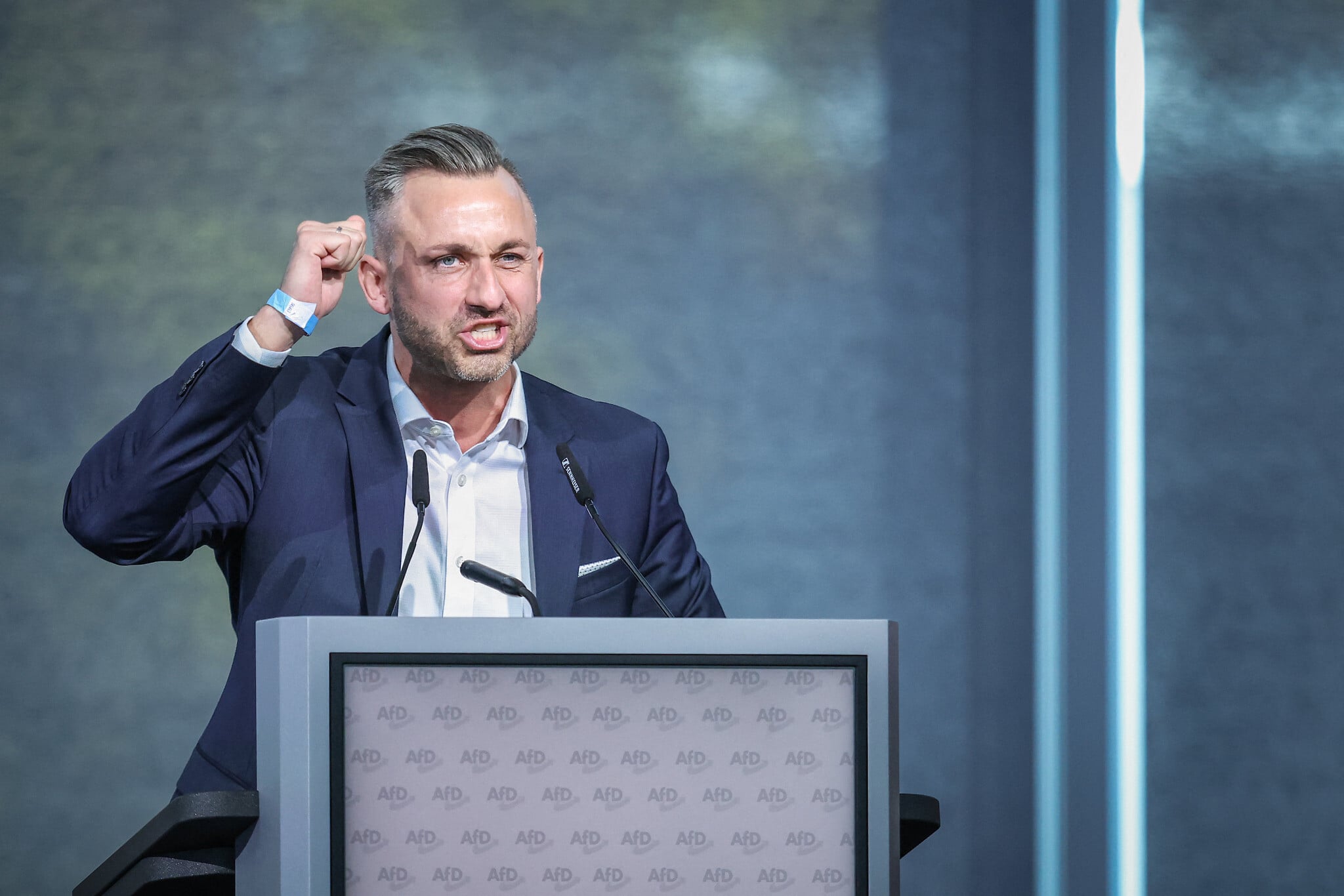
BERLIN — Ulrich Siegmund, the leading candidate for the far-right Alternative for Germany (AfD) party in the state of Saxony-Anhalt, has made a Simson moped the symbol of his election campaign.
The small Simson motorcycles are produced by a company originally founded by a Jewish family and now manufactured in East Germany. Today, they have a cult following and for many AfD supporters, Simson represents East German pride, individual freedom, and resistance to an establishment they see as predominantly West German and liberal.
Siegmund’s regular campaign events have featured dozens of vintage Simson mopeds and drawn large crowds of supporters. A rising star in his party, the 35-year-old was recently labeled “Germany’s most dangerous man” by Der Spiegel.
Should the AfD come out ahead in this Sunday’s election in Saxony-Anhalt, as polls predict, Siegmund could become the first far-right head of a German state government in the postwar era.
Among those watching the election with alarm is Dennis Baum, the US-based heir and spokesperson for the Simson family.
Baum’s uncles, Arthur and Julius Simson, were the last Jewish managing directors of Simson-Werke before the company was expropriated by the Nazis. The family won back exclusive rights to the Simson brand name as part of a partial restitution agreement they reached following German reunification.
In a recent interview with Tagesspiegel, Baum described the AfD as “antisemitic,” saying, “We find any association with the AfD repulsive and an insult to our family name.”

The Baum family’s concerns are not unique: Jewish organizations in Germany have warned for years about the danger the AfD poses to the country’s Jewish community, which has about 100,000 formally affiliated members. As early as 2017, around three dozen Jewish organizations published a statement describing the party as unacceptable to Jewish voters.
Since then, the AfD has become increasingly radicalized. In 2025, Germany’s domestic intelligence service classified the party as right-wing extremist, allowing for intelligence monitoring — a decision the AfD is currently challenging in court.
Despite this, the party has continued to gain support. Last year, it became the largest opposition party and the second-largest party in the German parliament.

The AfD has been particularly successful — and radical — in eastern Germany. Days before the Saxony-Anhalt elections, polls show the AfD holding a commanding lead of around 40%, while the governing CDU trails at just over 20% among the state’s over 2 million population.
No other party has said it would be willing to form a coalition with the AfD. But if several smaller parties fail to pass the 5% threshold required to enter the state parliament, 40% of the vote could potentially be enough to give the AfD an absolute majority.

Josef Schuster, president of the Central Council of Jews in Germany, told The Times of Israel that the election is a “litmus test for the democratic center” and called Siegmund a “declared enemy of our open society.”
Schuster urged the other parties to maintain their refusal to cooperate with the AfD.
For Saxony-Anhalt’s Jewish community, the stakes are particularly concrete: A state government has authority over funding for the police, school curricula and cultural institutions. The state’s small Jewish community, numbering around 1,100 members, relies heavily on the state for security and financial support.
State governments also hold seats in the Bundesrat, Germany’s upper house of parliament, whose approval is required for some federal legislation.
Nazi era ‘happened a long time ago’
The AfD’s election manifesto in Saxony-Anhalt is among the party’s most radical to date. It demands that children of asylum seekers be taught in “special classes” and refers to homosexuality as a “sexual deviation.”

The platform also criticizes German politicians for avoiding “any positive reference to our rich history prior to 1933,” claiming this “national masochism” prevents “stable national identity formation.” The party promises to “heal this identity disorder” through a new cultural policy and usher in a “patriotic turnaround.”
Across the manifesto’s 250 pages, there is no explicit reference to the Holocaust, Nazi crimes, or Jewish history.
The manifesto’s main author, Hans-Thomas Tillschneider, deputy chairman of the AfD in Saxony-Anhalt, told The Times of Israel that the Nazi era was “the darkest chapter in German history.” However, he added, “all of that happened a long time ago and no longer affects us in the here and now.”

Tillschneider has repeatedly been accused of antisemitic statements. In 2018, he said the Central Council of Jews was “using” Islam to “bring about the abolition of our people,” language critics said echoed conspiracy theories about Jews orchestrating Muslim migration.
He denied that the statement was antisemitic, arguing that “Islam in Germany is not only displacing German culture, it is also threatening Jewish life,” and suggested that the Central Council should “extend a hand to the AfD.”
Siegmund himself rarely draws attention for overtly extremist statements and is often described as the “friendly face” of the AfD. But media investigations have found that four former members of a banned neo-Nazi organization are among his close political associates.
Confronted with the findings, Siegmund defended the four to Die Welt as “outstanding people.”
He did not respond to a request for comment from The Times of Israel. In November 2025, however, he described allegations of antisemitism against his party as “completely absurd,” saying the AfD approaches Jews “with respect and appreciation.”

Among the relatively few Jews who publicly support Siegmund and the AfD in Saxony-Anhalt is Artur Abramovych, chairman of Jews in the AfD, which says it has about 25 members.
Abramovych believes Jews would benefit from an AfD government because it would end what he called “state funding of left-wing extremist nonsense,” pointing to anti-Israel actions by left-wing students. He also welcomed the AfD’s plan to cut funding for state broadcasting, which he called “anti-Israel reporting.”
Asked about the former neo-Nazis in Siegmund’s circle, Abramovych said, “As long as they do not introduce neo-Nazi ideology into the campaign, it is a secondary issue.”
He argued that Jewish organizations such as the Central Council face a choice over “which is the lesser evil” — a government that potentially includes either the AfD or the far-left party Die Linke, which is fiercely critical of Israel and has passed resolutions that one former party leader said were perilously close to questioning Israel’s right to exist.

Jewish groups aim for ‘pragmatism’
Max Privorozki, a board member of the state’s Jewish association and head of the Jewish Community of Halle, whose synagogue was targeted in a 2019 neo-Nazi terrorist attack, took a more cautious view.
Privorozki told The Times of Israel that he “personally doesn’t like” the AfD’s statements on Germany’s culture of Holocaust remembrance, but stopped short of saying that the Jewish community could not work with an AfD-led government.
“Regardless of who forms the government in the future, we must continue to represent the interests of the Jewish community,” Privorozki said.
He named two red lines: “The Jewish community must be able to continue existing and working, and Israel’s right to exist remains inviolable.”

Those concerns are not directed exclusively at the AfD. Die Linke and the populist BSW have taken strongly critical positions toward Israel and have also faced accusations of antisemitism.
Together with the AfD, the three parties currently account for up to 60% of the vote in some polls.
“The Jewish communities have little influence on the upcoming political situation, which is why pragmatism above all is required,” Privorozki said.
The Jewish community has taken some steps to protect itself against political uncertainty. Last December, the state government amended a law providing Jewish communities with increased security and funding.
The AfD has not said whether it will leave the law untouched if it comes to power, and its election manifesto says nothing about how the party would cooperate with the state’s Jewish community.
For Privorosky and other Jewish leaders in Saxony-Anhalt, that leaves a basic question unresolved just days before the vote: not only whether the AfD will take power under Siegmund, but what it will do with it.





The Times of Israel Community.