

Case pitting Indiana Jews against an abortion ban heads back to court
State Supreme Court begins hearing oral arguments in case sparked by local Jewish group’s religious freedom challenge to abortion ban, which was later rejected by lower court
 Add ToI as a Preferred Source on Google
JTA — A landmark legal battle to determine whether Jewish women have a religious right to an abortion entered a critical new stage in Indiana.
The state Supreme Court heard oral arguments on Thursday in a case that began with a local Jewish group’s 2022 religious freedom challenge to Indiana’s near-total abortion ban. The state is appealing a permanent blocking of the ban that a lower court imposed in March.
The arguments, held in Indianapolis, explored a legal theory that the state’s abortion ban impedes Jews’ religious freedom because many interpretations of Jewish law prioritize the life of the mother over that of the fetus.
The case, one of the recent major challenges based on Jewish law to an abortion ban, could carry significant ramifications for how the American legal system weighs Jewish religious rights against conservative Christian doctrine, which strongly opposes abortion.
Indiana was one of several states to pass severe abortion restrictions following the 2022 US Supreme Court ruling overturning its 1972 Roe v. Wade decision guaranteeing the right to an abortion. Separately, Christian groups and businesses have prevailed in national religious freedom cases determining whether they can be compelled to pay for contraception that can be used to perform abortions, arguing doing so violates their religious views.
But Kenneth Falk, legal director of the American Civil Liberties Union of Indiana, argued before the court Thursday that it was the abortion bans that curtailed the free exercise of religion. “Under Jewish law, the human life does not begin until the first breath,” said Falk, who argued the case on behalf of Hoosier Jews for Choice, a group formed explicitly to challenge the state’s abortion law, as well as two anonymous plaintiffs. While liberal Jewish denominations are generally permissive of abortion, Orthodox scholars offer more mixed interpretations.
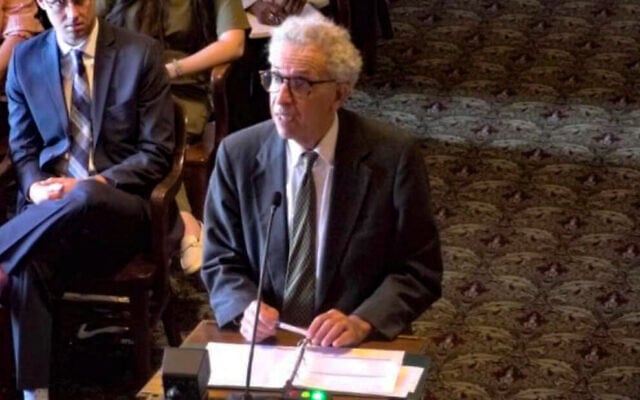
In response to a question by Chief Justice Loretta Rush about what the state should do “further along in a pregnancy,” Falk said, “I don’t think anyone is going to be advocating for abortions of a viable fetus.”
In his arguments, Falk compared the Jewish women’s standing to what he called “secular” exceptions to the abortion ban in cases of rape or incest.
“What is the reason for allowing these secular exceptions, but not a religious exception?” Falk asked the justices. He also referred to permitted religious exceptions to healthcare laws in other cases, including vaccine mandates.
In March, a judge in the Marion County Superior Court ruled in favor of Hoosier Jews for Choice, permanently blocking the state’s near-total abortion ban in cases where it would “substantially burden their religious exercise.”
That ruling prompted the appeal from the state now under consideration, as well as conservative backlash, with Republican Indiana Sen. Jim Banks calling for the judge’s impeachment.
“Our nation’s long tradition of respect for religious exercise has never been understood to encompass a right to intentionally destroy human life, any more than a right to abusively punish children,” Indiana Solicitor General James Barta argued before the state Supreme Court on Thursday.
Today, Solicitor General James Barta stood before the Indiana Supreme Court on behalf of our office to, once again, vigorously defend Indiana’s pro-life law. For four years we have fought an unprecedented and radical attempt to weaponize the state’s Religious Freedom Restoration… pic.twitter.com/5MLKomSQsY
— AG Todd Rokita (@AGToddRokita) September 11, 2026
Barta otherwise largely sidestepped the Jewish group’s religious arguments in his own presentation. Instead he insisted that the plaintiffs did not have proper standing because they were not actively seeking abortions themselves, though one is hoping to get pregnant but worried about getting proper care if an abortion were required.
Their case, Barta insisted, was “purely hypothetical.”
A similar argument briefly prevailed in Kentucky in 2024, when a judge threw out a religious freedom lawsuit brought by three Jewish mothers against that state’s abortion law. The plaintiffs, the judge said in that case, lacked standing because none of them were currently pregnant. One of the plaintiffs, who was considering a pregnancy via in vitro fertilization, was allowed to appeal the case, which resulted in a partial victory this May when a judge struck down part of Kentucky’s abortion ban — related to a definition of when human life begins — as unconstitutional.
Many mainstream and progressive-leaning Jewish organizations, including the National Council of Jewish Women, the Anti-Defamation League and representatives of the Reform, Conservative and Reconstructionist movements, are supporting Hoosier Jews for Choice and have signed onto briefs on the group’s behalf in court.
In a statement to the Jewish Telegraphic Agency, the NCJW noted that questioning from the justices Thursday “appeared to focus on more procedural matters,” rather than “the merits of the case.” Yet Darcy Hirsh, the group’s vice president of government relations and advocacy, said she was “hopeful” the court would rule in the Jewish groups’ favor.
“No individual should be forced to abandon their religious beliefs in order to comply with a narrow, Christian belief of when life begins,” Hirsh said.
A representative for the state of Indiana did not return a JTA request for comment following the oral arguments.
There are also Jews on the other side of the debate. The Jewish Coalition for Religious Liberty, a legal advocacy group, has filed amicus briefs in support of the state.
“From a theological perspective, it’s hard to say what is the single Jewish teaching on abortion,” Josh Blackman, an attorney with the coalition and professor at the South Texas College of Law, told JTA following the oral arguments.
Blackman added that, of all major religions, Judaism has “the strongest basis for the right to terminate a pregnancy.” But, he said, Jewish groups should be mindful of advocating for a system “where Jews in Indiana can have an abortion but Catholics cannot.”
“At a time when there’s growing hostility between people on the right and Jews, I”m not sure this is the best use of Jewish resources,” Blackman said. “This could actually backfire in significant ways.”
There is no timeline for when the state Supreme Court might issue a decision on the case.










The Times of Israel Community.