

Government to up funding for gender-segregated classrooms
Parents to choose which grades will be separate in religious schools; critics say policy discriminates against non-Orthodox
 Add ToI as a Preferred Source on Google
Haviv Rettig Gur is The Times of Israel's senior analyst.
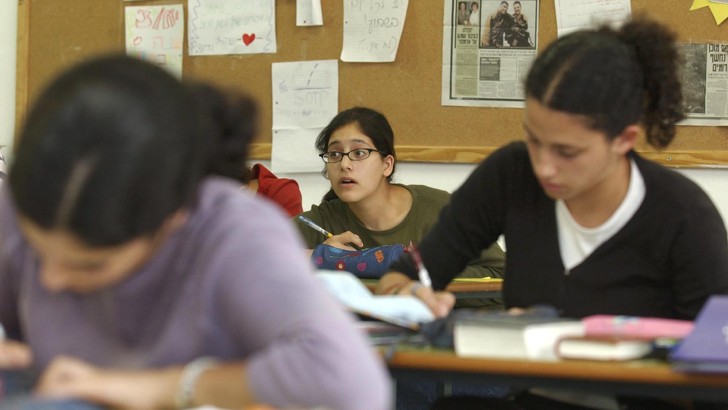
The Education Ministry will begin funding separate elementary school classes for boys and girls in the state religious school system.
Approximately 250 of the 400 schools in the state religious system already divide boys and girls, usually from the fourth grade onward. Funding for the additional classrooms and teachers required to implement the separation usually comes from fees the schools impose on parents. According to a 2011 Education Ministry study that examined state funding for the separation, the cost of maintaining separate classrooms amounts to some NIS 10 million annually, a paltry amount in the 1.4 million student, NIS 28 billion ($8 billion) education system.
The state religious school system is one of four tracks in the national education system, which also includes the “general” or secular state schools, the “independent” track of Haredi schools, and the Arab school system. Each track has a different curriculum, with the state religious system emphasizing Jewish studies alongside general studies.
The new policy will see mixed classes through third grade and separate classes starting in fourth grade in religious schools. Parents will be able to choose a different policy in their schools if they obtain the agreement of 60 percent of the school’s parents.
According to the Education Ministry, the policy brings clarity and order to a chaotic issue. Currently, schools are forced to raise the additional funds from the parents in order to separate the genders. In some schools, officials said, a small group of parents has been able to force separation without the agreement of other parents.
The new policy would offer the necessary funding to prevent some parents from forcing others to fund separate classrooms they don’t want, and would forbid the separation of classrooms if a majority of parents don’t want it.
Critics of the policy note that the state religious school system already has just 24.4 students in each classroom, compared to 28.5 in the general system. The new policy would shrink class sizes even further.
“The result will be that even schools that are not interested in separating boys and girls at this time will prefer the smaller, separate classes,” Shmuel Shattah, executive director of Ne’emanei Torah Va’avodah, an Orthodox group that opposes the separation, told the Haaretz daily.
But the Education Ministry’s director-general, Dalit Stauber, insisted to Maariv that the move would “put an end to the inappropriate and unfair situation in which parents are forced to fund the separate classrooms themselves… The new policy will bring order to the opening of new, formal classrooms, will lessen the burden on parents and will strengthen public education.”








The Times of Israel Community.