

Heartbroken Raqqa residents return to city in ruins
While celebrating Islamic State’s defeat, locals also mourn the destruction wrought on their homes, businesses
 Add ToI as a Preferred Source on Google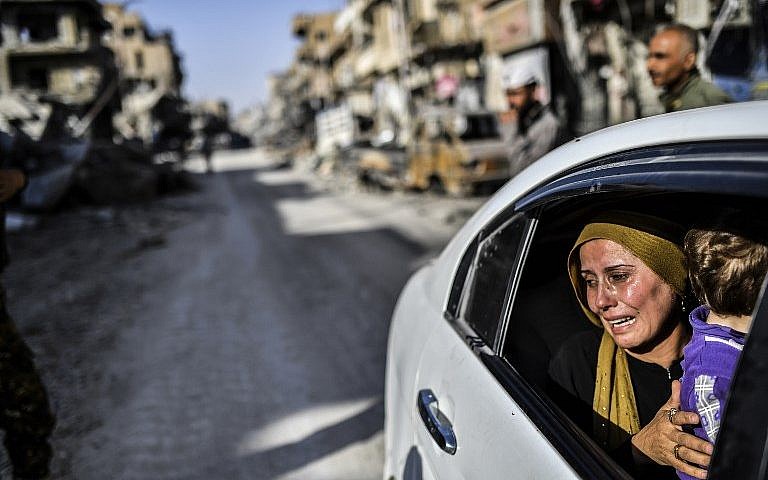
RAQQA, Syria (AFP) — Tears streaming down her freckled face, 35-year-old Asya took in the shattered glass, gutted storefronts and crumbling cafes — all that remain of her favorite shopping street in Syria’s Raqqa.
“This was once the most beautiful city, my God,” said the woman in a mustard-colored headscarf, gesturing out of the back seat of a car moving slowly down Raqqa’s once-bustling Tal Abyad boulevard.
“Now look around you. Look at our homes,” she wailed.
Asya was one of the only civilians to access central Raqa since the city was seized from the Islamic State terror group this week by the US-backed Syrian Democratic Forces.
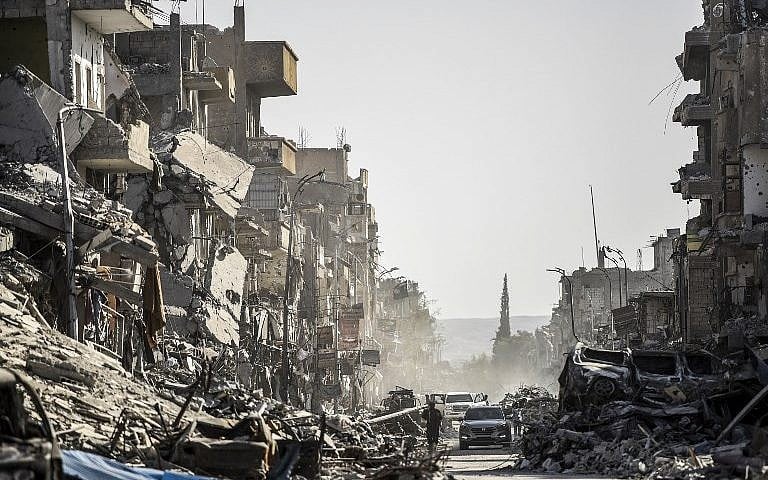
The SDF officially announced Raqqa’s capture at a ceremony in the city’s stadium on Friday but said mines left behind by IS made it too dangerous for residents to return home.
A handful of civilians — relatives of SDF fighters and displaced local officials — had been granted a one-day pass to access Raqqa for the ceremony and seized the chance to see what was left of their homes.
Asya’s husband, an SDF fighter, took his wife and four children in their rented car after the ceremony and drove to find their home in Raqqa’s eastern Al-Rumeilah district.
“I saw my house but wish I hadn’t. It’s been bombed — I only knew it from our personal items scattered outside,” Asya said.
“I would have rather had my things stolen but the walls still standing.”
‘Destruction, pain, sadness’
Asya and her family had considered moving back to their native Raqqa from the town of Tabqa, 70 kilometers (43 miles) west and also recaptured from IS earlier this year.
“But now I don’t even want to come back to Raqqa, because all our beautiful memories have been turned into tragedies,” Asya said, adding that she had fond recollections of the now-ravaged street around her.
Some storefronts are still identifiable: a tattered sign outside a children’s clinic, bare glass displays at a jewelry shop, and a tailor’s fabric and sewing machines.
But most of Raqqa has been left in unrecognizable ruin after the SDF’s nearly five-month offensive, backed by heavy US-led coalition air strikes.
For members of the Raqqa Civil Council — a provisional local administration set up by the SDF — Friday’s trip into Raqqa was bittersweet.
“Yes, we’re happy to be back, but there’s destruction, pain, and sadness,” said lawyer and RCC member Fadila Hamad al-Khalil, who fled IS-ruled Raqqa in April, before the SDF broke into the city.
“I wasn’t expecting the destruction to be this bad. It’s unreal — there are no buildings left, no infrastructure, no signs of life whatsoever.”
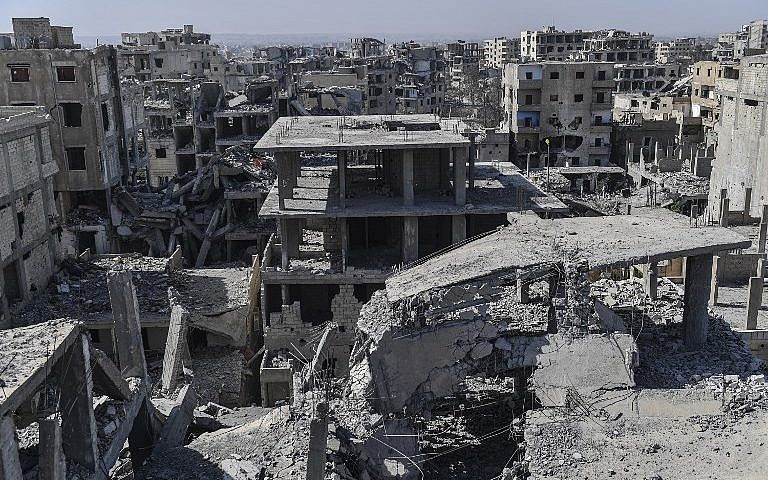
Khalil, too, was only able to catch a brief glimpse of her home from the outside before the SDF’s ceremony to hand over governance of Raqqa to the RCC.
She said she barely recognized her native city: “Everything is mashed together from the destruction.”
Her siblings and childhood friends would not be allowed to enter for days — perhaps even weeks or months — as de-mining teams worked to clear explosives.
“I wish we could have all come back to Raqqa together.”
‘Beyond what we imagined’
Even those with a one-day pass could only see their homes from the outside, afraid of the explosives that could lie in wait inside.
Mahmud Mohammed, an engineer and member of the RCC’s reconstruction committee, said the brief glimpse into Raqqa provided a rude wake-up call for rebuilding efforts.
Just weeks ago, he and fellow engineers were enthusiastically laying plans to clear the rubble out of Raqqa’s streets ahead of rehabilitating the city’s water and electricity networks.
But after seeing the devastation on Friday, they admitted they had been too optimistic.
“When we came into the city, the (reconstruction) plan changed completely,” said Mohammed, 27, as he halfheartedly took pictures of the damaged Tal Abyad street on his cell phone.
“We would see pictures, but we didn’t know and couldn’t expect that we would see Raqqa like this.”
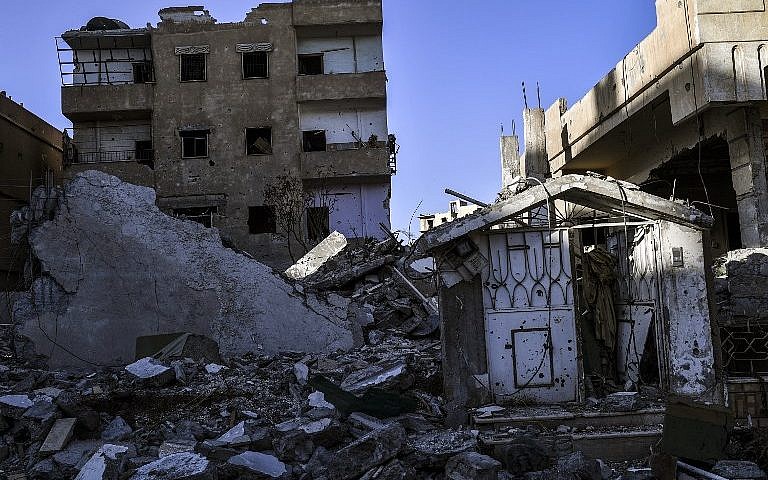
Mohammed pointed out a row of damaged storefronts and said his family had once owned them all, operating a relief center and a lingerie shop — even under IS.
“Massive destruction, above and beyond what we had imagined,” he muttered, shaking his head.
As he spoke, a white pickup truck barrelled past, playing a lively and trumpet-heavy tune while SDF fighters danced and flashed victory signs.
One elated militiaman held up his rifle and called out to a somber Mohammed: “Raqqa has been liberated, my brother!”




The Times of Israel Community.