

In Taiwan market, an Israeli expat hawks ‘exotic’ falafel balls
Ofer Avgil’s fast food stall stands out in Kaohsiung’s Ruifeng night market, where locals stuff themselves with the novel fare
 Add ToI as a Preferred Source on Google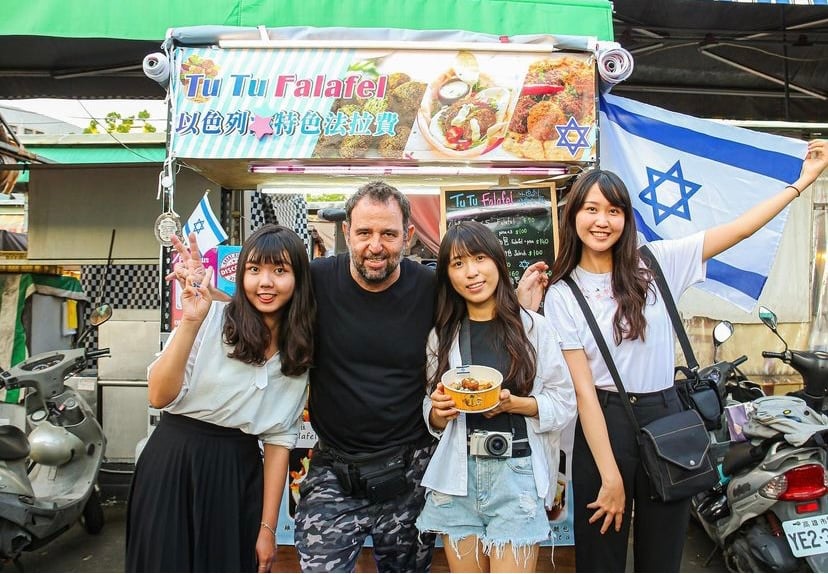
KAOHSIUNG, Taiwan — Bustling and chaotic, Taiwan’s Ruifeng night market is the go-to spot for browsing endless aisles of food, clothing, and carnival games in the southern city of Kaohsiung, far from the capital city of Taipei.
As the sun goes down, the market fills with high schoolers flooding in from across the street, crowded together, shoulder to shoulder. Many wear the legally required masks, but still feel plenty safe removing them to eat, as Taiwan has one of the lowest COVID transmission rates in the world.
Among vendors of milk tea, duck wraps and grilled sausage, an Israeli falafel stall is conspicuous.
As the market starts to fill with guests, Tutu Falafel owner Ofer Avgil is happy to chat warmly about his life and craft as he fries balls of fresh falafel (called falafei in Chinese) for customers.
“A lot of Taiwanese love to try it,” he says. “A lot of them want to come back. But they don’t know this food, so a lot of people won’t stop into my shop.”
While different geopolitically, Taiwan and Israel have some similarities that Avgil identifies with as an Israeli: They’re both small, disputed states with diasporic populations.
It’s not uncommon to hear Taiwanese sympathize with Israel or lump Israelis and Jews together as one identity. Likewise, upon mention of the Jews or Israel, Taiwanese often insist that Jews are smart and good at business. These stereotypes, also common in China, do not stem from antisemitism, says Avgil, a secular Sephardic Jew, rather a feeling of commonality.
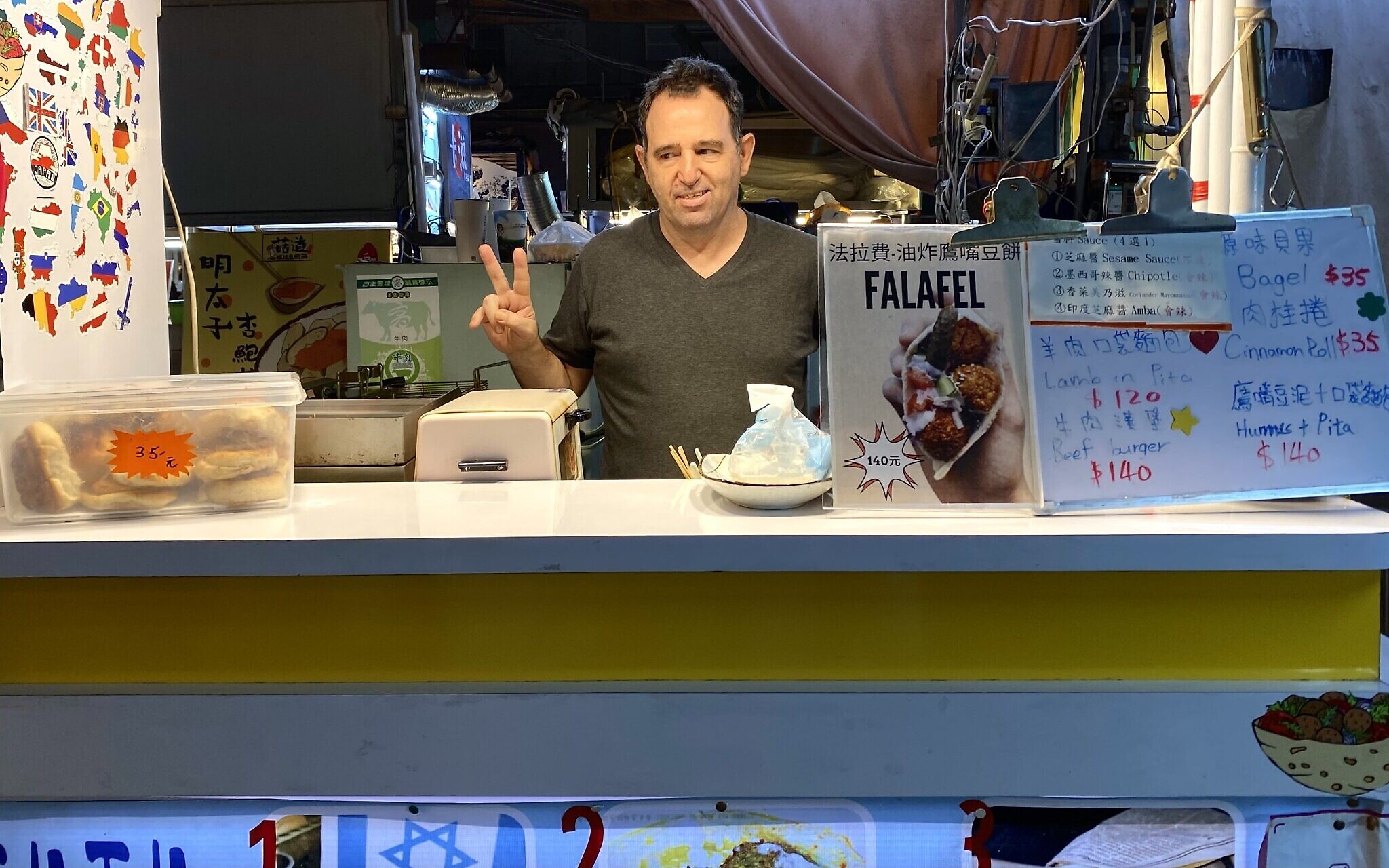
“I’m not young, I’m over 50, and I came to this country. I don’t think a lot of people my age would leave their country and travel like this. Only Jewish people can do this. It’s because of our nature,” he says.
Avgil’s considers his night market stall to be a better business model than his previous restaurants. Six years ago, Avgil opened an Israeli restaurant in Shanghai called Boya, which closed after two years. He returned to Israel shortly after that.
“But I fell in love with Asia,” he says. “And then I got an offer to join a business, an Israeli restaurant in Kaohsiung.”

That restaurant, called Imma, was also open in the city for two years. There, he met his fiance, Fabi, but soon the two left the business after a dispute with the partners. With the help of Fabi’s aunt and an Israeli friend, he set up shop in Ruifeng night market.
“The business is only me and my fiance. Before, I had more electricity to pay, more workers to pay, more goods to buy,” he said. “For sure, in a restaurant, sometimes it pays and you can make a lot of money. But other days it pays to be like my stall.”
Most of Avgil’s customers are Taiwanese, but the ones who are regulars, make large catering orders, and appreciate a taste of Israel are mostly foreigners, he says.
While the crowning jewel of Tutu Falafel is Avgil’s falafel pita pockets, stuffed with salad, hummus, and topped with tahini, he also offers other fillings for pita, including schnitzel, chicken, short ribs, and sabich — an Israeli sandwich starring fried eggplant — as well as couscous.
Unlike in Israel, where Middle Eastern spices are abundant, Avgil has had to improvise without access to some items.
“Spices are harder to find here. Like cardamom,” he says. As for his perfectly smooth and creamy tahini, “I roast the sesame, or buy it roasted already, and grind it by myself. I don’t have [pre-made] tahini here.”

It’s all made from scratch every day at his home and later sold at the night market. Falafel is made fresh with each order. Usually, the stall will open around four or five in the afternoon and close after midnight. But despite the late nights, the city is far slower than what Avgil is used to.
“In Israel we say ‘yalla yalla yalla!’ [hurry up]. In Taiwan they say ‘deng yixia‘ [wait a moment]. We don’t have deng yixia in Israel,” he says. “The first time I came to Kaohsiung I got very angry because nothing is moving.”
But it’s become much easier to adjust: Avgil has now spent a total of six years in Asia with his soon-to-be wife and newborn baby, and he says he has no plans of leaving Taiwan anytime soon. He hopes to keep the night market stall, but also open another small restaurant soon.
“I love it here. I want to stay,” he says, “But after one or two years [in Taiwan], I slowly feel my heart again begin to melt to Israel. Israel is my country.”








The Times of Israel Community.