

IS seizes part of ancient Palmyra, ‘pearl of the desert’
Extremist group steps up attacks in Syria, Iraq, raising fears that jihadists will expand their area of influence
 Add ToI as a Preferred Source on Google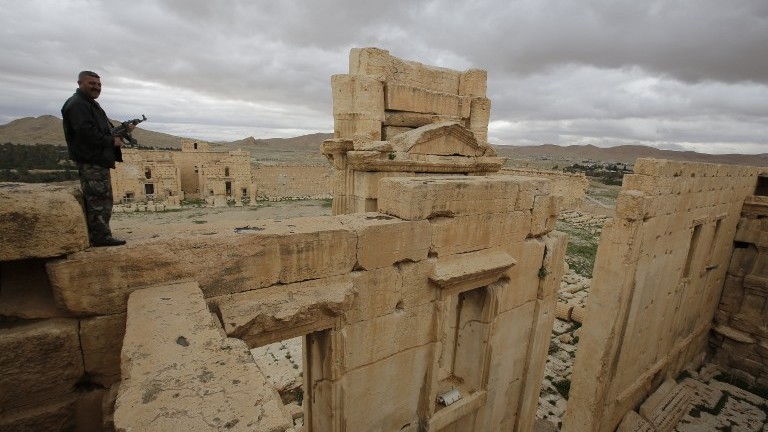
Jihadists from the Islamic State group seized control Saturday of the northern part of Syria’s ancient desert city of Palmyra after fierce clashes with government forces, a monitoring group said.
“IS advanced and took control of most of northern Palmyra, and there are fierce clashes happening now,” said Rami Abdel Rahman, director of the Syrian Observatory for Human Rights.
He said 13 jihadist fighters were killed in ongoing clashes near the Islamic citadel in the city’s west.
Abdel Rahman had no details on regime casualties.
Most of Palmyra’s renowned ruins, including colonnaded streets and elaborately decorated tombs, lie to the southwest of the city.
The official Syrian news agency SANA quoted a military source as saying that regime forces had prevented IS fighters from seizing a hilltop southwest of the Islamic citadel.
Fearing a similar fate for Palmyra, known as Syria’s “pearl of the desert,” UNESCO has called on the UN Security Council to act in order to save one of the Middle East’s historic treasures.
The head of Syria’s antiquities department, Mamoum Abdulkarim, meanwhile voice concern for the ancient site.
“I am living in a state of terror,” Abdulkarim told AFP in a telephone call.
He said IS “will blow everything up. They will destroy everything,” if the enter the site, adding that many of Palmyra’s artefacts, like elaborate tombs, could not be moved.
“If they enter the ancient ruins, it will be worse than when Palmyra was defeated in the time of Zenobia,” said Abdulkarim.
Zenobia ruled over Palmyra — a UNESCO world heritage site — as queen in the third century, but was dramatically defeated by the Romans.
IS began its offensive on Palmyra on Wednesday and inched closer to the ancient metropolis on Thursday and Friday, executing at least 49 civilians over those two days according to the Observatory.
In its brutal advance towards the city, IS executed at least 49 civilians over the course of two days, the Observatory said, including 26 on Thursday after accusing them of “collaborating with the regime.”
Ten people were beheaded, the monitor said.
IS executed another 23 civilians, among them nine children, on Friday northeast of Palmyra.
“Among the victims, there were displaced people from other parts of Syria who were seeking refuge in Palmyra, as well as the families of local servants, a caretaker and his wife,” Abdel Rahman said.
After a night of “very violent” clashes, IS made gains to the city’s east, bringing it ever closer to Palmyra’s treasured remains, many of which are housed in a museum.
“IS had advanced east of Palmyra after fierce fighting with regime troops,” the Britain-based Observatory said.
The monitoring group said both sides were intensely shelling each other, as Syria’s army bombarded the city’s outskirts from military aircraft.
IS positions to Palmyra’s southwest — where the artifacts and ruins are located — held firm at one kilometer (less than a mile) from the city’s old Islamic citadel.
Both Syria’s opposition and regime have demanded that the renowned site not fall to the jihadists.
In neighboring Iraq, IS fighters tightened their siege on the last government positions in Ramadi, west of Baghdad, a day after they seized the city’s government headquarters.
Taking control of Ramadi would constitute the group’s most important victory this year in Iraq, and would give the jihadists control of the capitals of two of its largest provinces.
Mosul, capital of Nineveh province, has been under IS control since it launched a lightning offensive in June 2014.
Anbar province, of which Ramadi is the capital, extends from the Syrian, Jordanian and Saudi borders to the gates of Baghdad.
Military reinforcements were dispatched to Ramadi and other parts of Anbar to support Iraqi troops, local officials said, as Iraq’s army and the US-led coalition struck IS positions in the area.
Most of the Iraqi government forces and Sunni tribesmen fighting alongside them are concentrated in a nearby military base and in the Anbar Operations Command across the Euphrates river.
But on Saturday, there was no sign of the Ramadi counteroffensive that had been announced by Iraqi authorities, although civilians were fleeing the city in droves.
“Security forces in Ramadi are taking position against the attacks of Daesh, mainly in the areas of Malaab and Operations Command,” Ramadi’s mayor said, using an Arabic acronym for IS.





The Times of Israel Community.