

Israeli teachers lag behind OECD peers in literacy, numeracy, problem-solving — study
Shoresh Institution highlights educators’ low skill level in science, technology, engineering, math; recommends teachers first get a degree in a discipline, then a teaching qualification
 Add ToI as a Preferred Source on Google
Sue Surkes is The Times of Israel's environment reporter
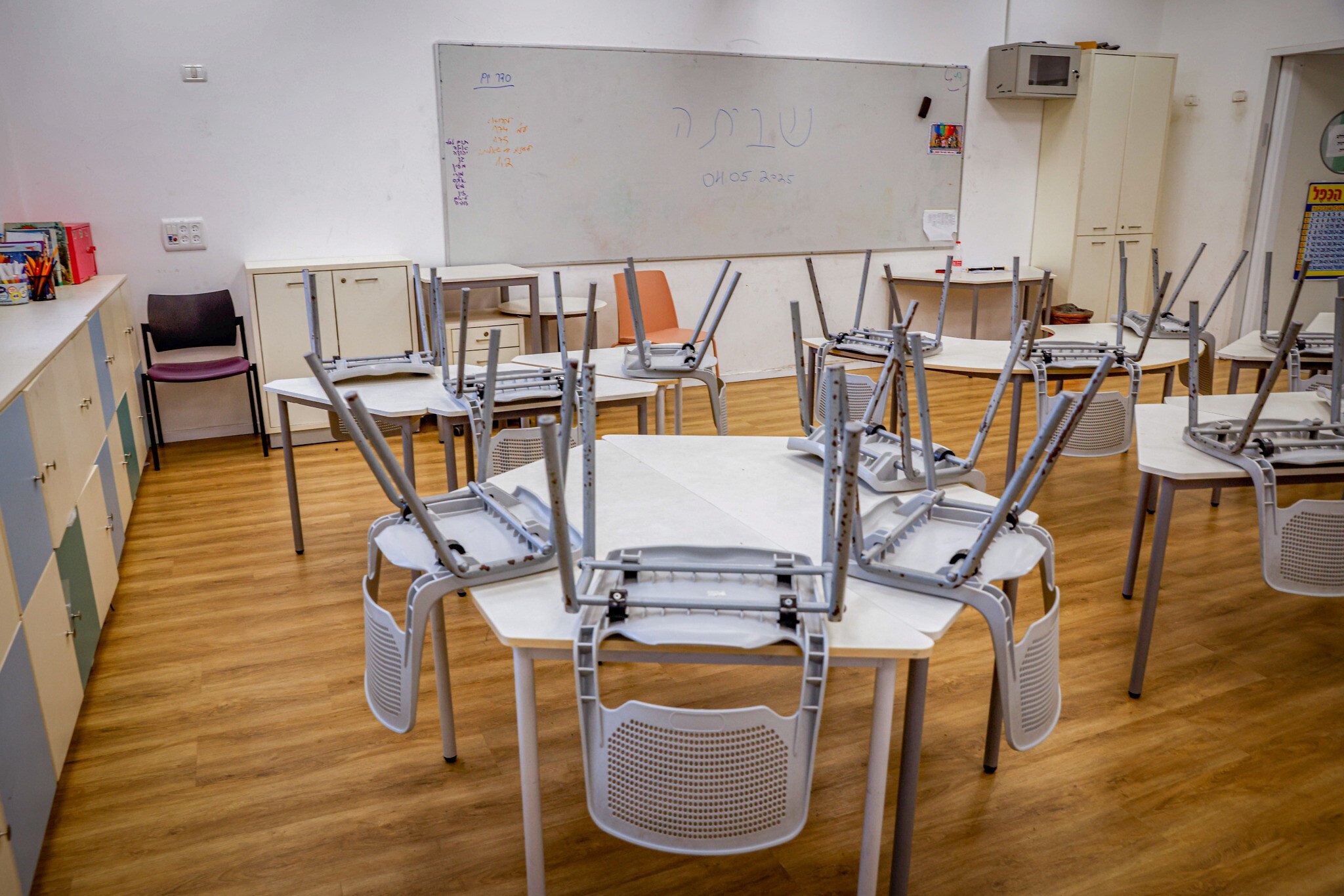
Israeli teachers lag significantly behind their OECD peers in literacy, numeracy, and problem-solving skills across every level of the education system, according to a new study released Wednesday.
Conducted by Yael Melzer at the Shoresh Institution for Socioeconomic Research, the study relies on questionnaire data gathered by the OECD’s Program for the International Assessment of Adult Competencies (PIAAC) between 2022 and 2023. Meltzer extracted the statistics to compare Israelis in and out of education with their counterparts in 18 other industrialized countries.
The findings, issued a week before the new school year begins, follow poor school test results in Israel in science and English reported earlier this year.
The research emphasized that teacher quality, far more than class size, is “a necessary condition for strengthening human capital and ensuring the competitiveness of an economy based on knowledge-intensive industry and on a high-tech sector that serves as a leading engine of growth.”
Melzer told The Times of Israel she was particularly surprised to discover that while overseas, skills levels match evenly between teachers and non-teachers with identical university qualifications, Israeli teachers lag noticeably behind their non-teaching peers.
She suggested that this gap stems partly from the private market selecting candidates rigorously on actual skills, whereas teaching relies heavily on formal academic credentials.
Furthermore, lucrative free-market alternatives attract talented men, leaving the education sector with weaker overall human capital. Highly skilled women are more likely to remain teachers because the convenient hours and vacations let them raise their children, Meltzer explained.
Looking at academic backgrounds, 37 percent of teachers in Israel hold a master’s degree, compared with an OECD average of 49%, though a higher percentage hold an undergraduate degree (41% versus 35%). A greater proportion of Israeli educators focus their degrees specifically on education (64% versus 54% internationally), while similar shares — 9% and 11% respectively — hold undergraduate degrees in STEM subjects—science, technology, engineering and math.
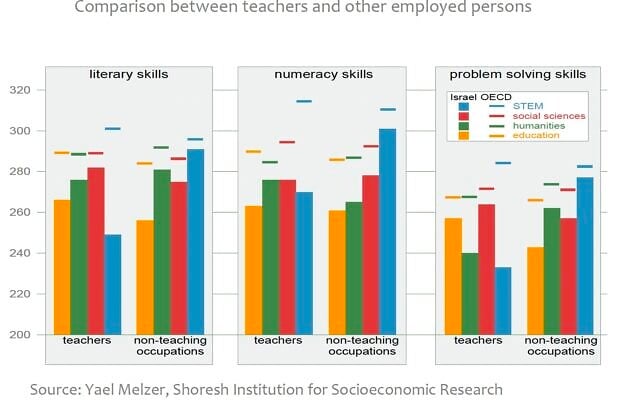
However, a troubling paradox emerges for those with STEM qualifications. Unlike in OECD countries where STEM teachers display the highest overall competencies, Israeli teachers with STEM degrees showed the lowest skills in literacy and problem-solving.
Furthermore, non-teachers with STEM qualifications in Israel had inferior skills compared with both teachers and non-teachers with degrees in these fields overseas.
Melzer noted a stark mismatch, pointing out that the high-tech sector constantly complains about finding too few skilled workers.
“We won’t manage to survive here if our skills aren’t good enough,” she warned.

In Israel, the educators with the highest skill levels were the ones with degrees in social sciences.
The study also underscored deep disparities across Israel’s school system, which divides between secular, religious, ultra-Orthodox and Arab pupils.
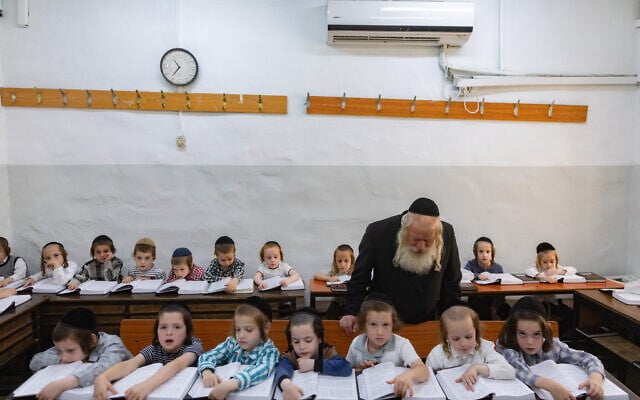
Haredi teachers scored lower in literacy and numeracy than their secular and religious counterparts. Yet within the Haredi sector, those who graduated from full-time kollels (institutes of Torah studies for married men) and went on to teach had higher skills than non-teachers.
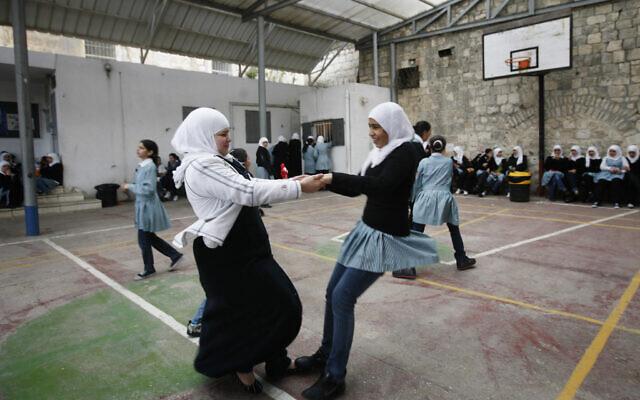
Arab Israeli teachers recorded scores markedly lower than all other streams, driven by historical resource shortages and chronic underinvestment, the report said.
Melzer added that lower results in Arab schools, combined with difficulties in removing older, lower-skilled teachers, were probably among the reasons for lower overall median results.
To address these systemic shortcomings, the study recommends raising admission requirements and encouraging people who want to teach in middle and high schools to earn a full academic degree in the specific discipline they intend to teach, followed by a short certification track.
This, Meltzer told The Times of Israel, would result in a higher level of teacher than one who studied education and specialized in a particular subject within the education degree.
The study also called for tying financial rewards directly to demonstrated skills, alongside targeted investments to close persistent gaps in early-childhood education and the Arab school stream.
Israel faces a huge shortage of 30,871 teachers ahead of the 2026-27 school year, set to begin on September 1, according to the Central Bureau of Statistics (CBS), as reported in The Marker on Sunday.
CBS and Knesset Research and Information Center data reveal that teacher training programs graduated just 8,461 students in 2025, marking a ten-year low. Retention is also a major challenge, with 20% of new educators exiting the profession within five years and 10% dropping out after only their first year.
A recent National Union of Israeli Students survey indicated that less than half (43%) of education graduates planned to pursue teaching careers, according to Ynet. Almost a third were unsure, nearly another third intended to leave entirely, and nearly a third have contemplated switching academic majors.
The drain doubtless reflects not only salary — Shoresh Institution data from 2022 showed that Israeli elementary school teachers earned 22% less than the OECD average. The respective figures for middle school and high school teachers were 14% and 9% less. Teachers also face an ongoing decline in pupil discipline, extending to physical and emotional violence against staff, as well as substantial parental interference.
As reported by the Times of Israel’s Hebrew-language sister site, Zman Israel, last week, part of the Education Ministry’s strategy is to hire people with expertise in their subject but no teaching experience on personal contracts (rather than the usual contracts determined through collective bargaining by unions), and pay them more than double what a normal starting teacher receives — up to NIS 19,500 ($6,500) compared to around NIS 9,000 ($3,000). National Insurance Institute data from January showed that average salaries in Israel were then over NIS 13,500 ($4,500).

In the 2025-2026 school year, 14,283 teaching staff taught in schools without proper training or certification.
Writing in the Hebrew-language Maariv news outlet this month, Prof. Arnon Hershkovitz of Tel Aviv University’s School of Education likened this situation to the Transportation Ministry recruiting pilots with no other experience than an academic degree in aeronautics and proven experience building airplane models.






The Times of Israel Community.