

Live updates (closed)
 Add ToI as a Preferred Source on Google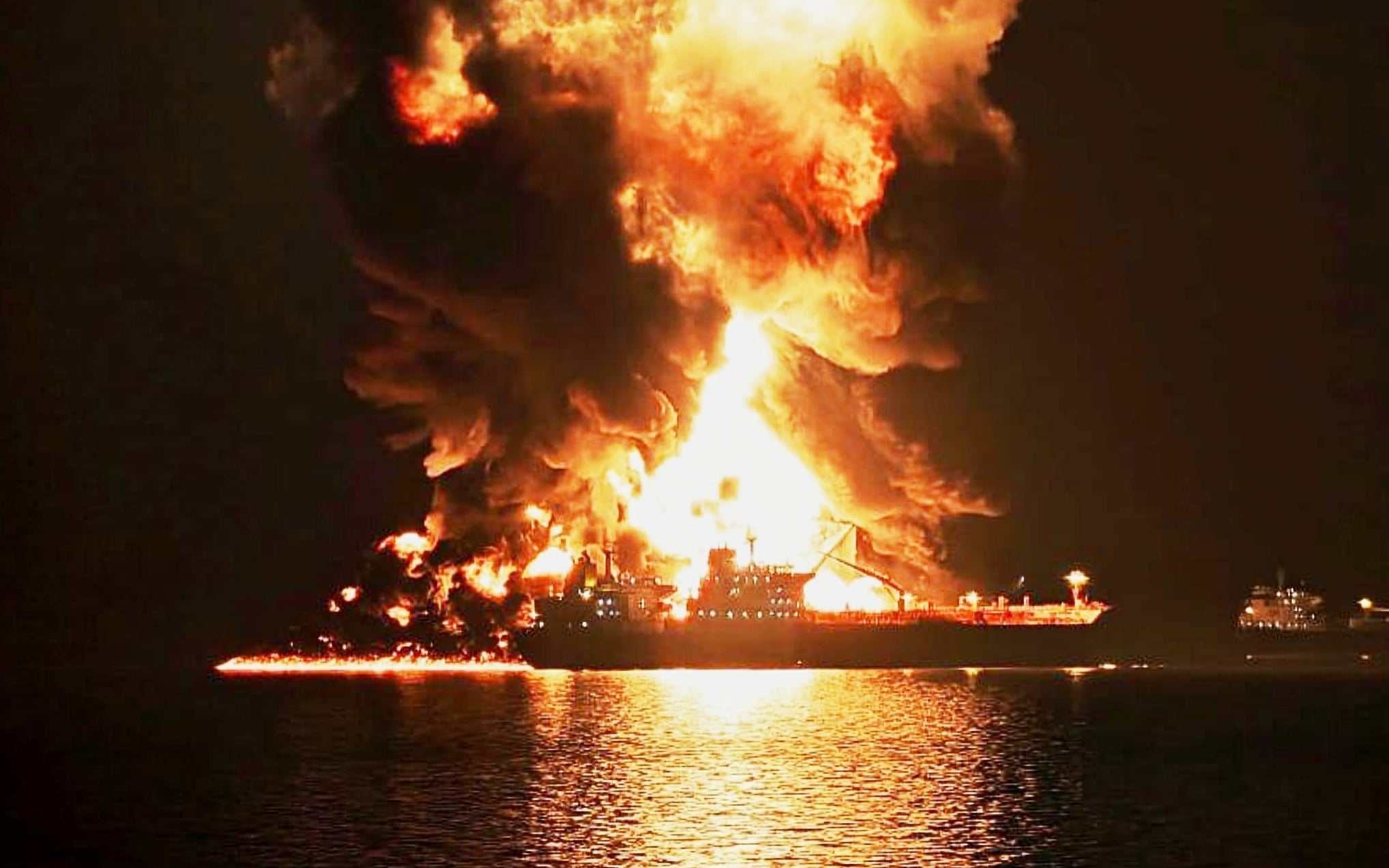

The Times of Israel liveblogged Thursday’s events as they unfolded.
Hezbollah fires long-range rockets at central Israel, triggering sirens in Tel Aviv area
Sirens sound in central Israel following long-range rocket fire by Hezbollah from Lebanon.
The alerts are activated in Tel Aviv and surrounding towns.
IDF detects ballistic missile launch from Iran amid Hezbollah rocket attack on central Israel
As sirens sound in central Israel amid a Hezbollah rocket attack from Lebanon, the IDF says it had detected a ballistic missile attack from Iran.
Additional sirens sounded in central as well as in the Jerusalem area and parts of southern Israel.
No injuries after concurrent Iranian and Hezbollah attacks; damage caused from impact in central Israel
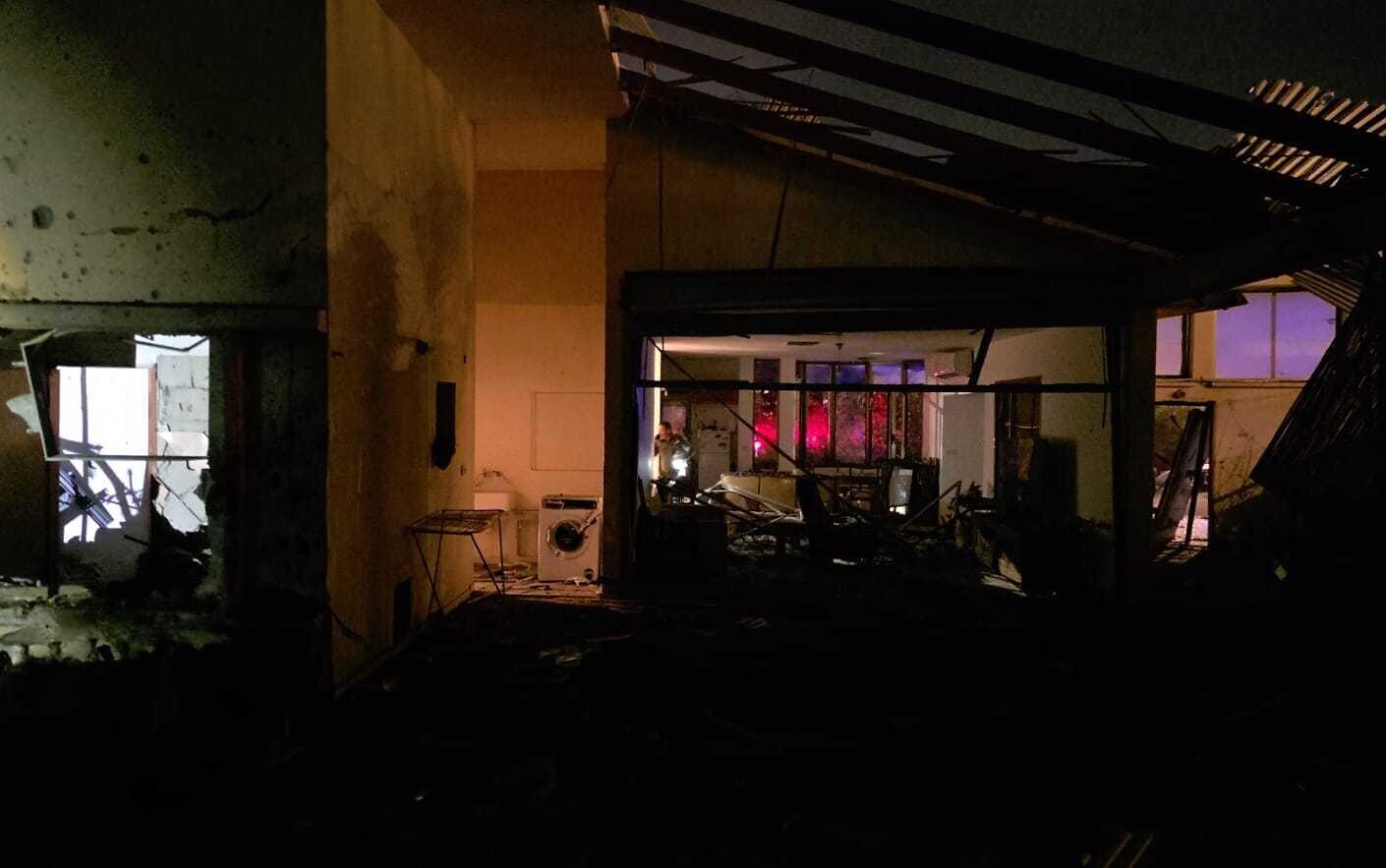
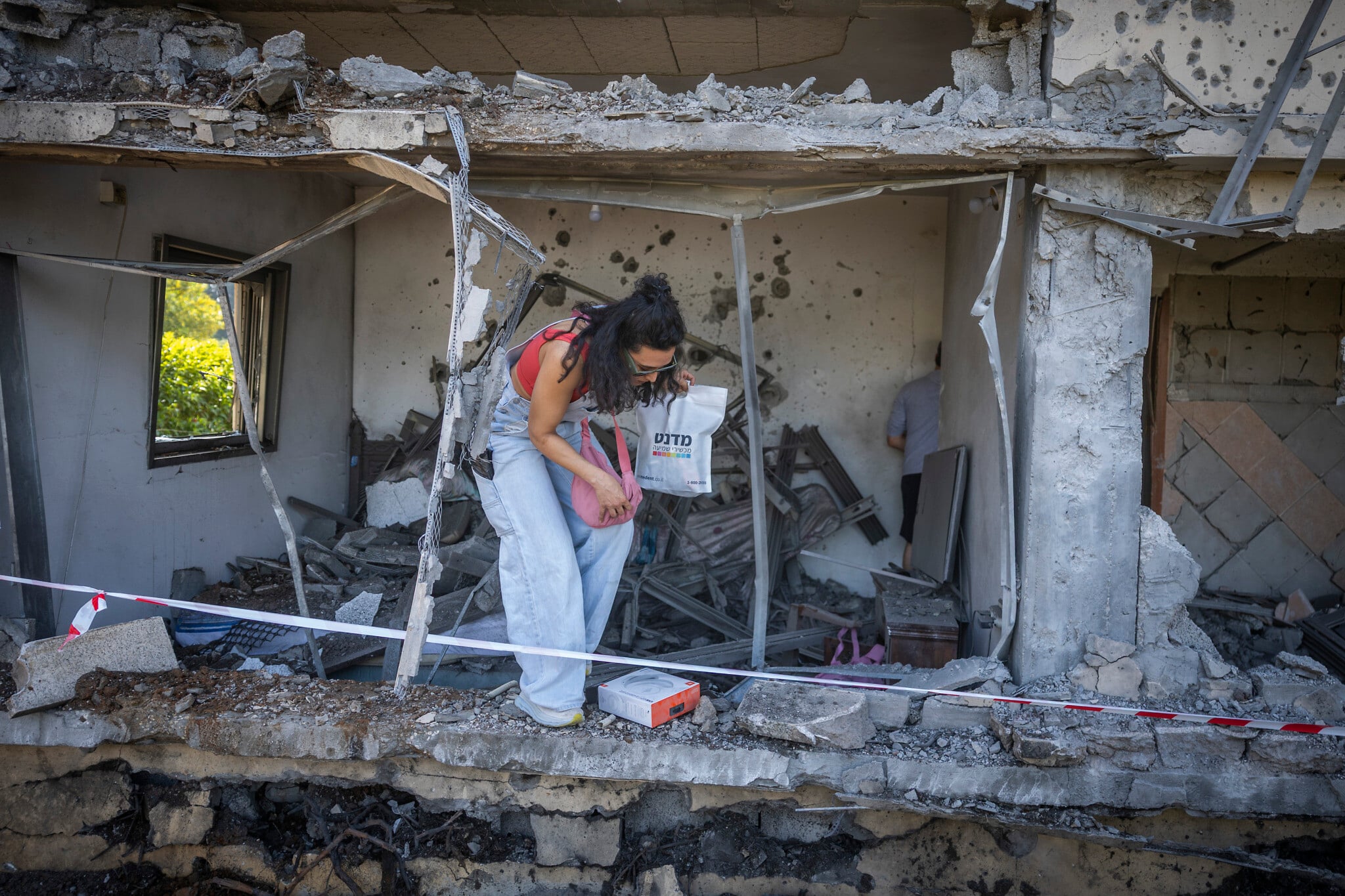
Damage caused by a rocket impact in central Israel, early March 12, 2026. (Magen David Adom)
No injuries are reported following the concurrent Iranian ballistic missile and Hezbollah rocket fire on central Israel.
Some of projectiles were intercepted, according to initial military assessments. Police say damage was caused by an impact in central Israel.
Fragments following the interceptions also reportedly fell in several areas.
Sirens had sounded across central Israel and the Jerusalem area, as well as parts of the south.
IDF says air force launching new wave of ‘extensive’ strikes on regime sites in Tehran
The Israeli Air Force has launched a new wave of “extensive” airstrikes in Tehran, the IDF announces.
The military says the strikes are targeting Iranian regime sites.
Rocket sirens activated in Acre, northern suburbs of Haifa
Rocket alerts sound in the coastal city of Acre, some of Haifa’s northern suburbs and nearby communities amid rocket fire by Hezbollah in Lebanon.
Sirens are also heard in communities closer to the border, including Nahariya, as well as in the Golan Heights and other northern towns.
Parts of Beirut will ‘look like Gaza’ if Lebanese government doesn’t rein in Hezbollah — senior official
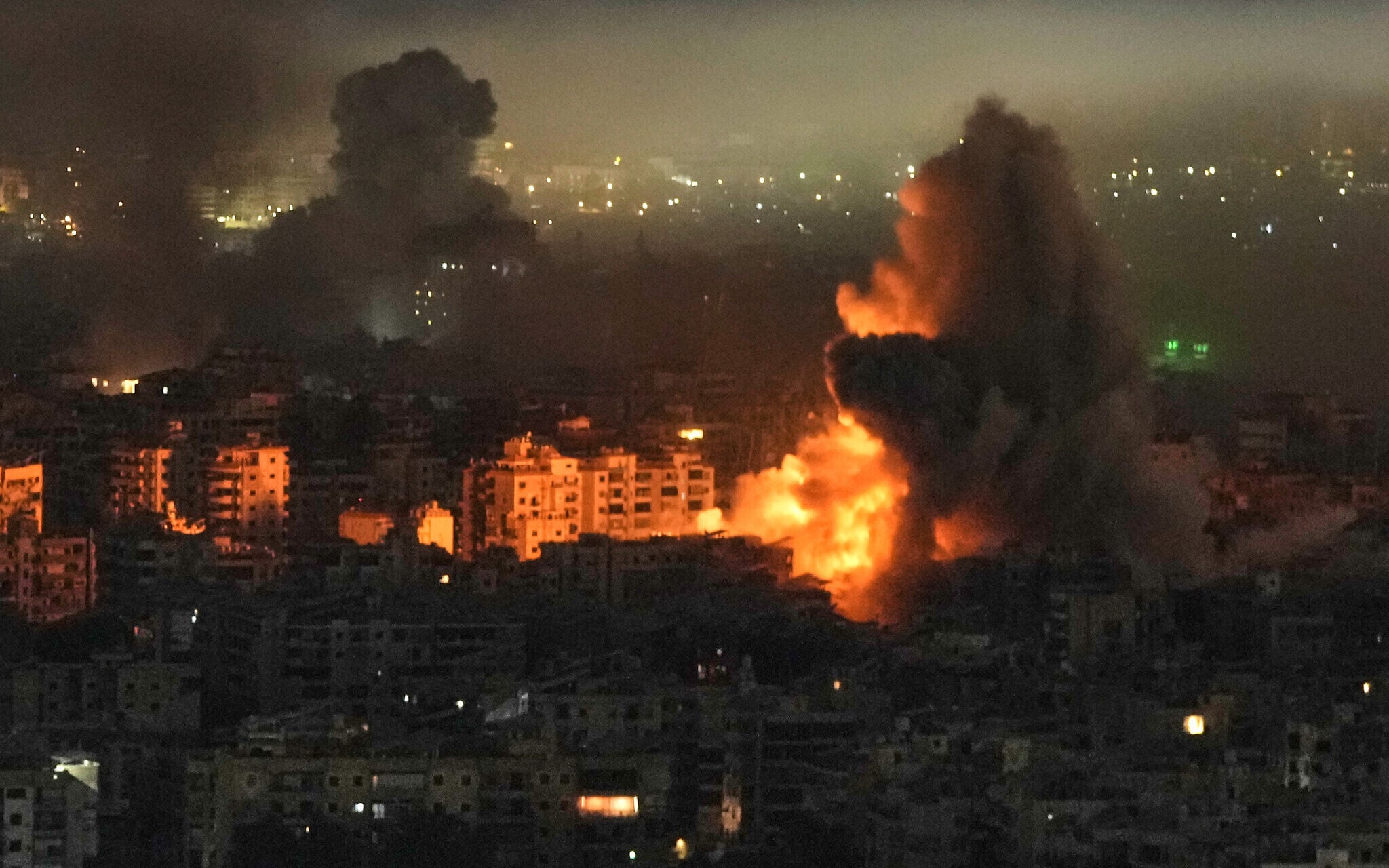
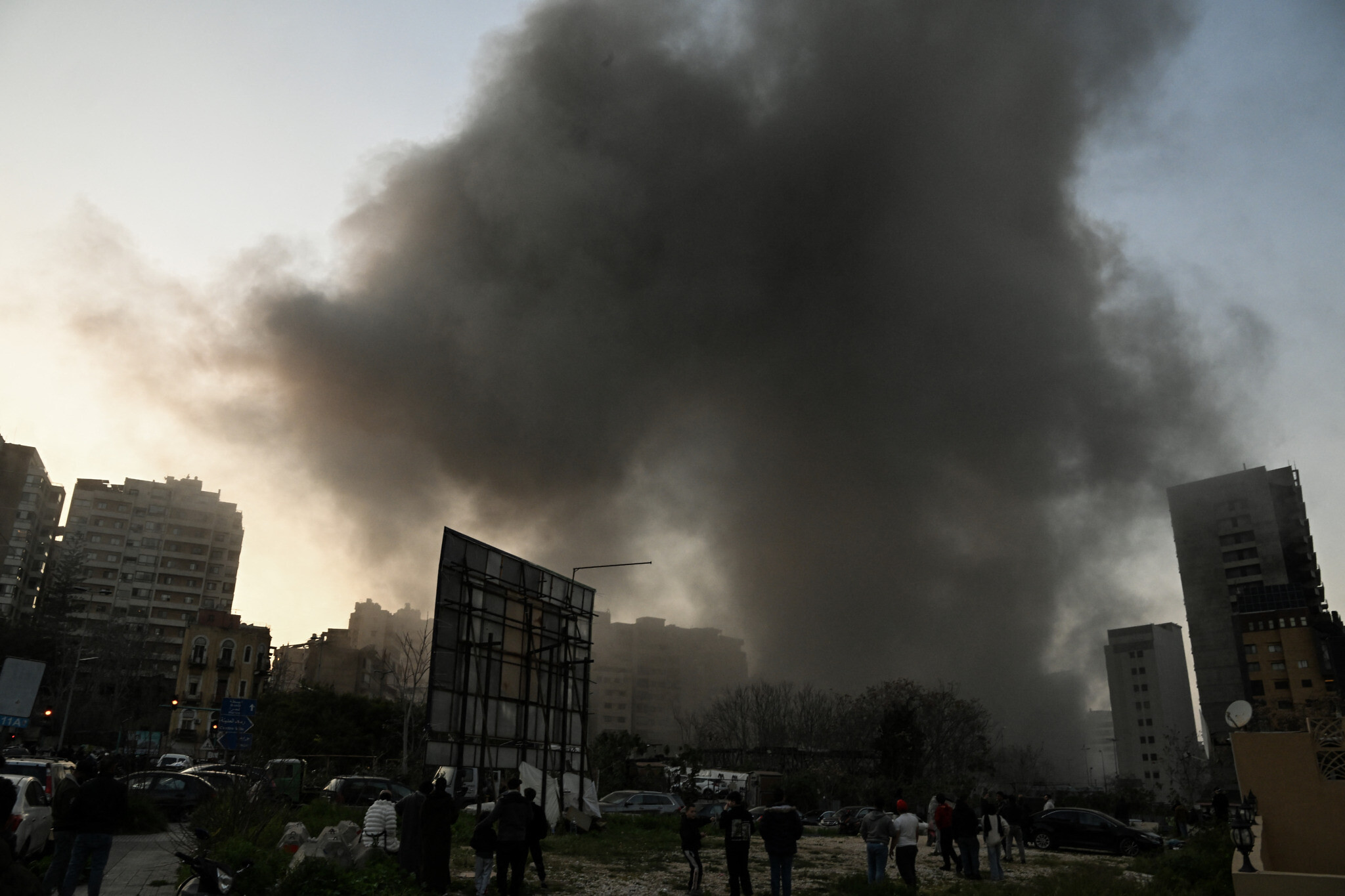
Smoke and flames rise from buildings following an Israeli airstrike on a Hezbollah target in Dahiyeh, Beirut's southern suburbs, Lebanon, March 11, 2026. (AP Photo/Bilal Hussein)
As Hezbollah continues its rocket fire on Israel, a senior Israeli official tells The Times of Israel that Hezbollah strongholds will be destroyed unless Lebanon’s government acts.
“The Lebanese government needs to get a grip on their country,” says the official, “or Hezbollah parts of Beirut will soon look like Gaza.”
Iran says several Basij force members killed in Tehran by Israeli drones, in first of war
Israeli drones carried out attacks on several Tehran neighborhoods on Wednesday evening, killing members of the security forces, Iran’s Fars news agency reports.
It’s the first time since the outbreak of the Middle East war on February 28 that drone attacks have been reported in the Iranian capital.
Fars says the drones flew over southern and northern districts of Tehran, adding that “several members of the security force and the (volunteer) Basij force stationed at checkpoints were martyred.”
An AFP journalist in the northern part of the city heard the loud noise of a drone flying over the area.
There were several blasts, including one more powerful than the rest.
It’s unclear whether the blasts were connected to the air defense system or to strikes.
US Energy Department says it will release 172M barrels of oil from strategic reserve
The United States Department of Energy says it will release 172 million barrels from the strategic petroleum reserve “beginning next week,” as the Middle East war disrupts oil prices.
The release will “take approximately 120 days to deliver based on planned discharge rates,” the agency says in a post to X.
The post also accuses Iran of manipulating and threatening “the energy security of America and its allies.”
House in central moshav directly hit during latest Iran-Hezbollah attack; no one injured
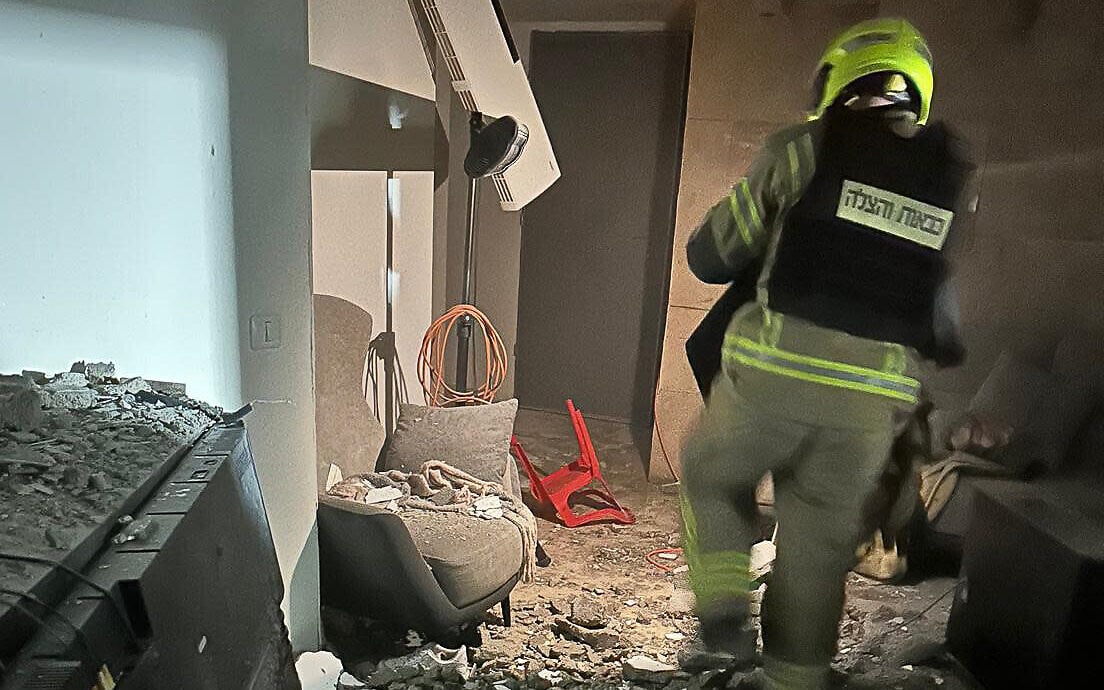
A firefighter is seen inside a house in Moshav Haniel in central Israel, after it was directly struck amid an Iranian-Hezbollah attack, early March 12, 2026. (Israel Fire and Rescue Service)
A house in the central moshav of Haniel was directly hit during the latest concurrent Hezbollah and Iranian missile attack, says the Israel Fire and Rescue Services, with no one injured in the strike.
Firefighters searched the area to ensure no one was trapped.
????Reports of a direct hit in a moshav in central Israel. Three homes were heavily damaged.
No reports of anyone being physically injured, though several people are suffering from anxiety. pic.twitter.com/LqkE6XSKdp
— Israel War Room (@IsraelWarRoom) March 11, 2026
IDF says Hezbollah command posts, dozens of rocket launchers hit in recent Lebanon strikes
The IDF says it destroyed 10 Hezbollah command posts in Beirut’s southern suburbs and dozens of rocket launchers across Lebanon during a 30-minute span.
According to the military, the strikes took out launchers and Hezbollah operatives planning to fire rockets at Israel, as well as the command posts in Dayiheh, which among others were used by Hezbollah’s intelligence unit and elite Radwan force.
Trump: Iran ‘pretty much at the end of the line’ though US may not ‘end it immediately’
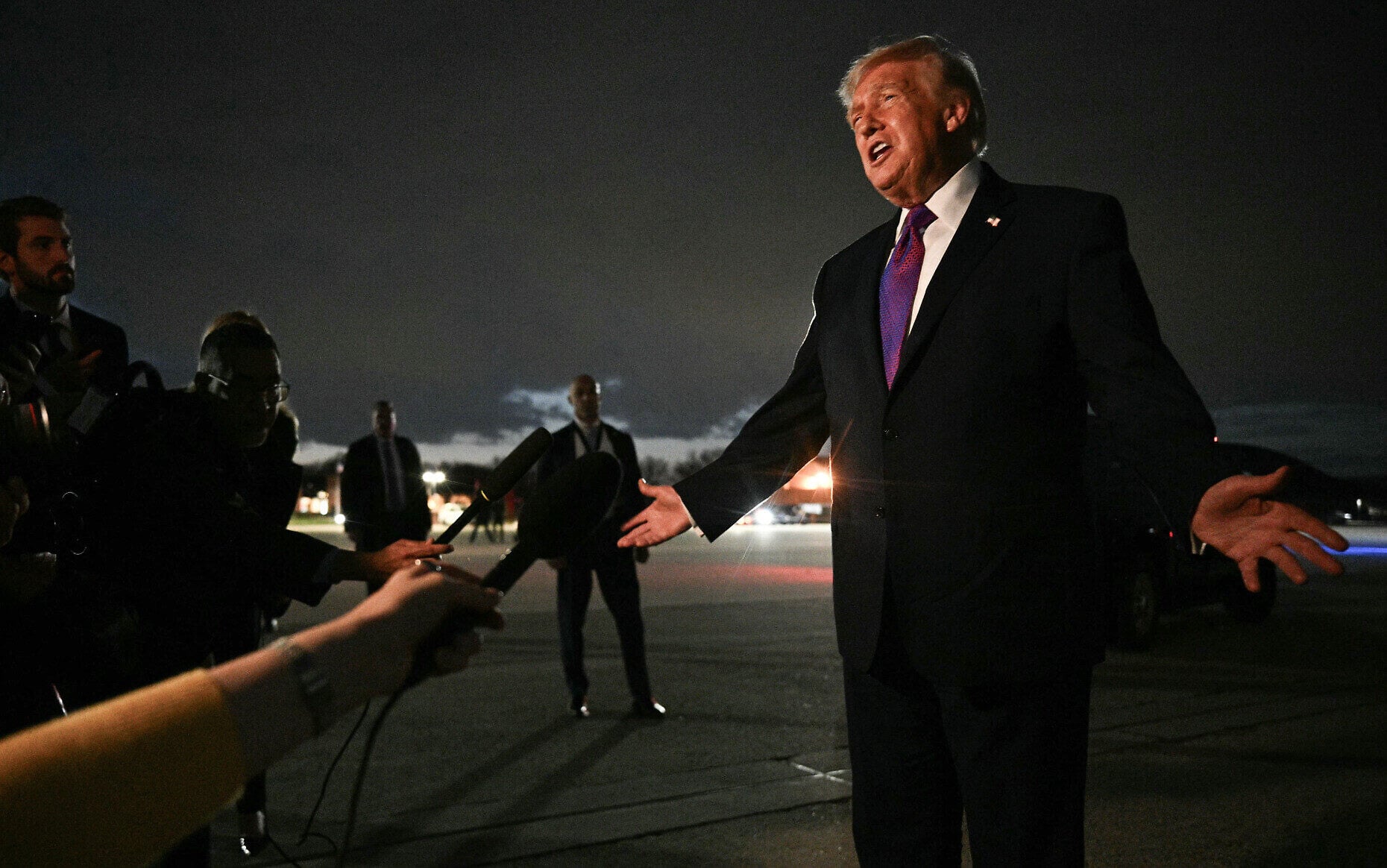
US President Donald Trump speaks to journalists upon returning to Joint Base Andrews, Maryland, on March 11, 2026. (Jim Watson/AFP)
US President Donald Trump claims that while Iran is “pretty much at the end of the line,” that “doesn’t mean we’re going to end it immediately.”
He tells reporters “the straits are in great shape,” apparently referring to the Strait of Hormuz, which Iran has largely shut down to global oil transport in retaliation for US and Israeli strikes.
Asked about a report that Iran is trying to carry out an attack in California, Trump says it’s being investigated, without offering more detail.
“You have a lot of things happening, and all we can do is take them as they come,” he adds.
Trump adds that American law enforcement has eyes on “all” Iranian-linked terror sleeper cells in the US.
He repeats that the US would like to see a new leader in Iran who “knows what they’re doing… [and] can build a country.”
He reiterates his threat that the US has the capacity to “hit sections of Tehran and other places” that would make it impossible for Iran to ever rebuild. “We don’t want that.”
“We could take apart their electric capacity within one hour,” he insists.
“Many people are saying that [the war] has already been won,” Trump claims.
Hezbollah claims rocket fire at central Israel targeted base housing Unit 8200
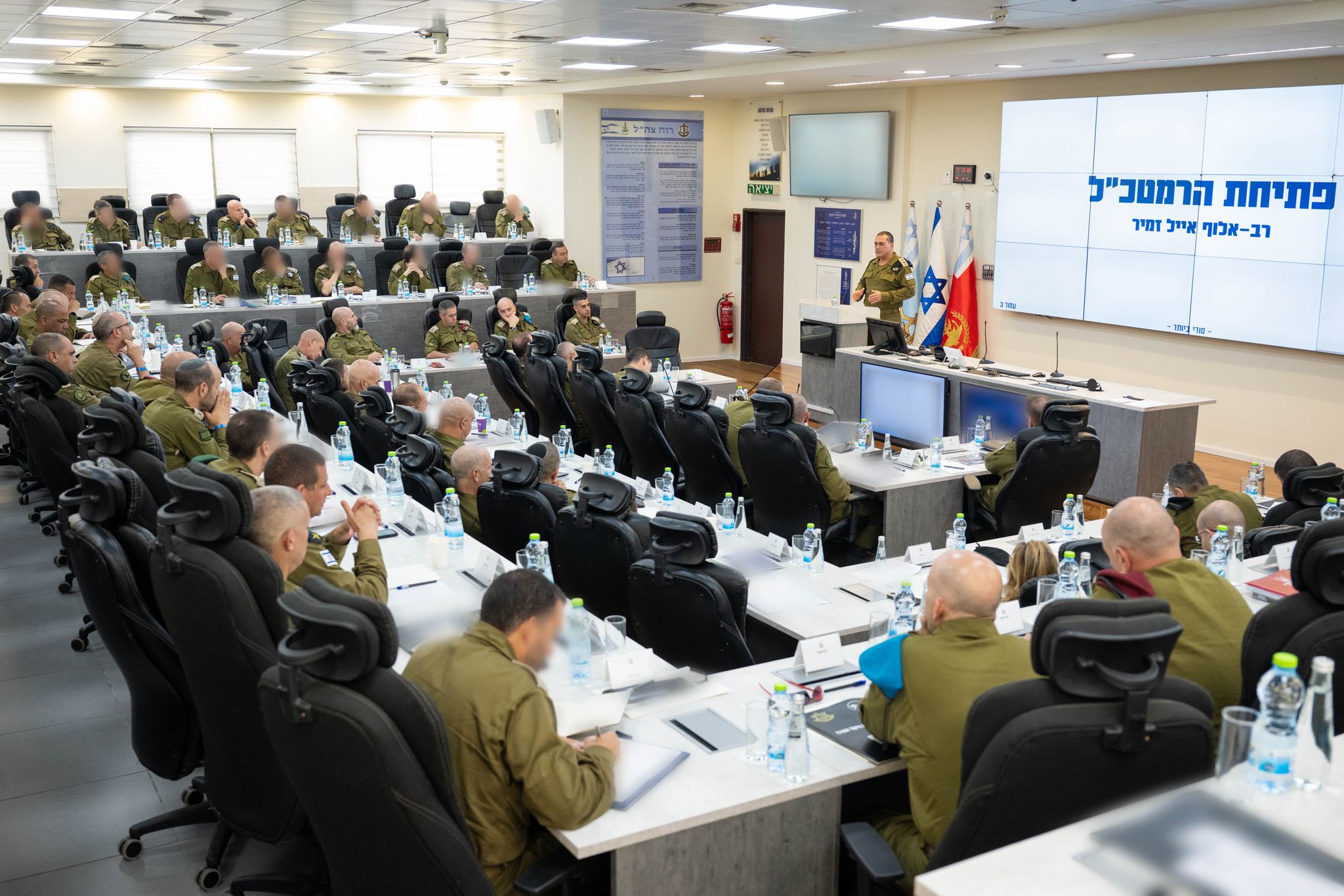
Illustrative: IDF Chief of Staff Lt. Gen. Eyal Zamir speaks at a multi-front situational assessment at the Glilot base near Herzliya, July 21, 2025. (Israel Defense Forces)
Lebanon’s Hezbollah says it launched missiles at a Military Intelligence base in the suburbs of Tel Aviv early Thursday, the Iran-backed terror group’s latest claim in a major operation against Israel it announced hours earlier.
Hezbollah operatives “targeted the Glilot base (the headquarters of the 8200 Military Intelligence unit)… in the Tel Aviv suburbs with a barrage of advance missiles,” the terror group says in a statement.
Iran’s Revolutionary Guards said earlier that they had carried out a joint missile operation with ally Hezbollah against targets in Israel.
Lebanon says 7 killed in Israeli strike on car in seaside area of Beirut
An Israeli strike hit a car in the coastal area of Ramlet al-Bayda on the eastern side of the city, according to local media. The seaside area is popular with tourists and is where dozens of displaced people have been sheltering.
The Lebanese health ministry reports seven people were killed, without identifying them.
“The Israeli enemy strike… led to an initial toll of seven dead and 21 wounded,” the ministry says in a statement.
The strike, which came without warning, occurred in an area with no notable Hezbollah presence that is far from Beirut’s southern suburbs, where the Israeli military has issued evacuation notices and said it is targeting Hezbollah positions overnight.
Israel’s military doesn’t immediately comment on the strike.
Videos circulating from the strike site showed smoke rising from the seaside. The strike came near the site of a recent Israeli attack on a tourist hotel, where the Israeli military said it killed four members of Iran’s Islamic Revolutionary Guard Corps.
Sirens sound in Eilat, Arava region as IDF detects more Iran missile fire
Warning sirens sound in the Red Sea coastal city of Eilat and nearby Arava region as the IDF says it detected another launch of missiles from Iran.
Amid attack on south, rocket warning sirens also activated in central Israel and north
As sirens blare in the south of the country, rocket warnings alerts are also activated in central Israel and the north.
Iran attack sparks major fire in neighborhood housing Bahrain International Airport
A major fire strikes a neighborhood in Bahrain’s capital home to the island kingdom’s international airport early Thursday after an Iranian attack, with authorities urging people in the surrounding area to close their windows due to the fumes.
The fire began in Bahrain’s Muharraq Island, which is home to Bahrain International Airport. Bahrain’s Interior Ministry describes it as a blaze affecting oil tanks in the area. The airport has jet fuel tanks, while there’s also other tanks in the area for the kingdom’s oil industry.
Bahrain’s Interior Ministry put out an alert for people in surrounding neighborhoods “to remain in their homes, close windows and ventilation openings, as a precautionary measure against possible exposure to smoke from the ongoing fire being combated.”
Bahrain moved some aircraft out of the area of the airport early Wednesday.
Iraq shuts oil terminals after deadly strike hits Basra port
An attack on Iraq’s Basra port early Thursday has killed at least one person and forced authorities to halt operations at all the country’s oil terminals, officials say.
Farhan al-Fartousi, the director-general of the General Company for Ports of Iraq, makes the announcement in a statement carried by the state-run Iraqi News Agency. Al-Fartousi says the attack targeted a ship engaged in a ship-to-ship transfer of oil in the Basra port on the Persian Gulf. He says it remained unclear if the ship was targeted by a flying or seaborne drone or a missile.
Rescuers recovered one dead body and helped 38 others after the attack. He says commercial ports in Iraq remained open, though the oil terminals have been shut.
No injuries reported in latest apparent coordinated Iran-Hezbollah attack
The Magen David Adom ambulance service says it has received no reports of injuries following the latest attacks on Israel, which appeared to be another round of coordinated launches by Iran and its Lebanese proxy Hezbollah.
Oman reportedly moves ships from its main oil export terminal outside Strait of Hormuz
Oman has shifted all vessels out of its main oil export terminal at Mina Al Fahal outside the Strait of Hormuz in a precautionary move, Bloomberg News says, citing direct recipients of a port agent’s notice.
Saudi Arabia says it downed drone approaching foreign embassy district
Saudi Arabia has shot down a drone approaching a district housing foreign embassies, the country’s defense ministry says.
“An enemy drone was shot down while attempting to approach the embassies district,” a defense ministry spokesperson posts on X, after confirming Saudi Arabia also intercepted a drone in the east of the country.
Kuwait’s ministry of defense also said its air defenses intercepted several drones as Iran carries out strikes on oil-rich Gulf countries, vowing to target global energy markets in response to US-Israeli strikes.
Lebanese health ministry says 3 killed in Israeli strike on town overlooking Beirut
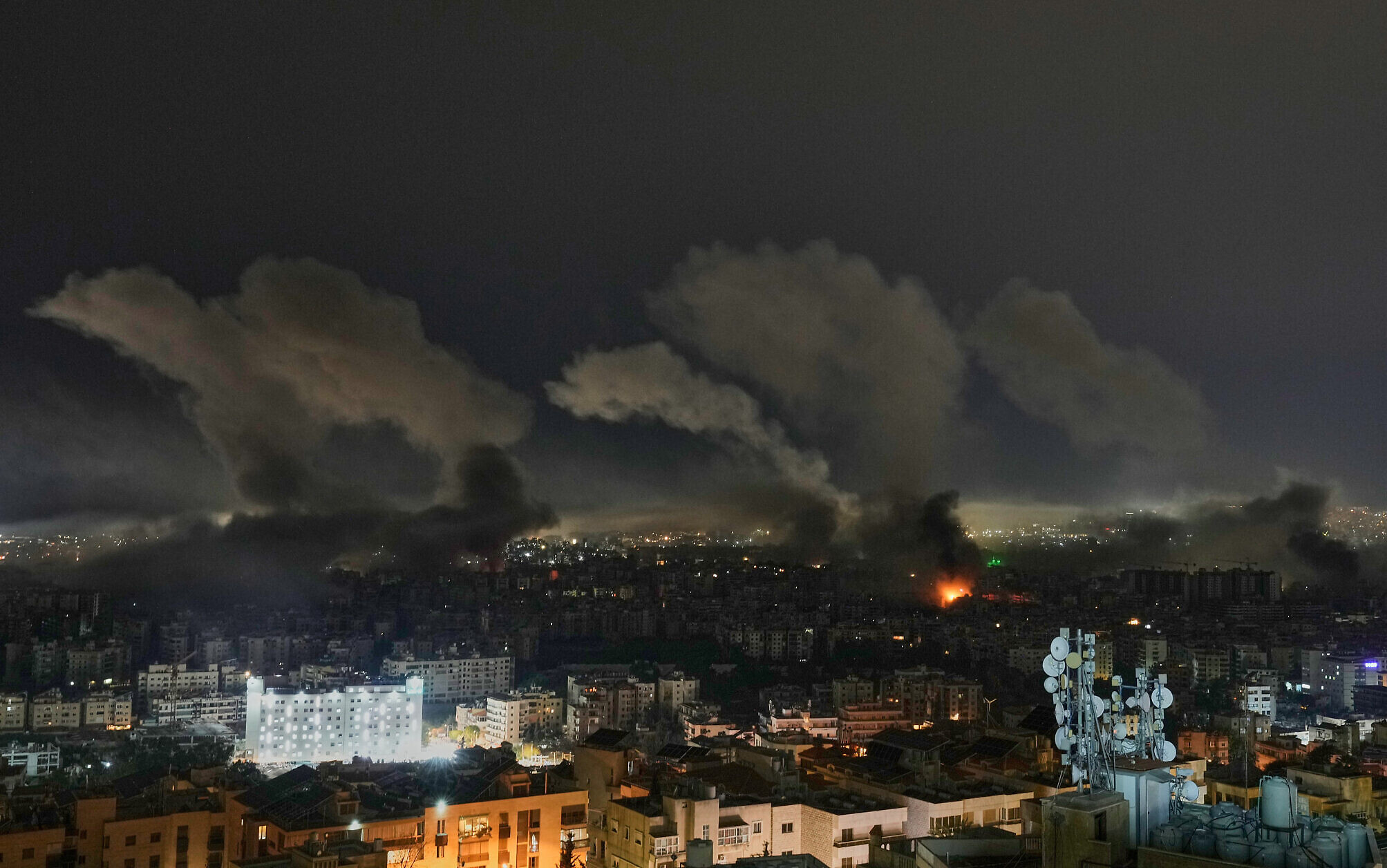
Smoke rises from buildings following an Israeli airstrike in Dahiyeh, Beirut's southern suburbs, Lebanon, March 11, 2026. (AP Photo/Bilal Hussein)
Lebanon’s health ministry says Israeli strikes early Thursday on a town in the hills overlooking Beirut killed three people and wounded a child.
Aramoun, a town about 10 kilometers (6 miles) south of Beirut where dozens of displaced families have found shelter, has been targeted twice since the conflict between Hezbollah and Israel renewed after Hezbollah fired rockets into northern Israel on March 2.
The health ministry also says the death toll from an earlier Israeli strike on central Beirut had risen to eight people, with 31 wounded.
Brent crude oil again tops $100 a barrel as Iran attacks on shipping worsen supply concerns
The price of a barrel of Brent crude oil, the international standard, tops $100 a barrel early Thursday, just days after it spiked near $120.
Oil prices shoot more than 9% higher as supply concerns worsen with Iranian attacks on commercial shipping around the Strait of Hormuz.
US benchmark crude oil jump to about $95 a barrel.
Iran threatens Israel and Gulf offices of US tech giants Amazon, Google, Microsoft and Nvidia
Iran’s Tasnim news agency publishes a list of potential targets for Iran, including the offices of tech giants such as Amazon, Google, Microsoft and Nvidia in Gulf countries and Israel.
“With the expansion of regional war into infrastructure warfare, the scope of Iran’s potential targets are gradually expanding,” Tasnim writes, without citing a source for the possible development.
Indonesia lowers number of troops it will contribute to Gaza security force to 8,000
Indonesia’s deployments for the international security force in Gaza will depend on the current dynamic of the Board of Peace, its defense minister says.
Sjafrie Sjamsoeddin tells reporters Indonesia had been prepared to send 20,000 troops for the force but is now ready to deploy 8,000, introduced gradually, adding that other countries pledged to send lower numbers.
Sirens sound in north as Iran launches fresh missile volley at Israel
The IDF Home Front Command issues an alert for parts of northern Israel, where warning sirens are sounding due to another Iranian missile attack that the military says it’s working to intercept.
Projectile hits container ship off UAE’s Jebel Ali, no injuries – maritime agency
An unidentified projectile struck a container ship, causing a small fire, 35 nautical miles north of Jebel Ali in the United Arab Emirates, the United Kingdom Maritime Trade Operations (UKMTO) says.
“All crew are reported safe,” the agency says in an advisory. “No environmental impact has been reported at this time.”
Lebanon says 7 killed in IDF strike targeting vehicle on Beirut seafront
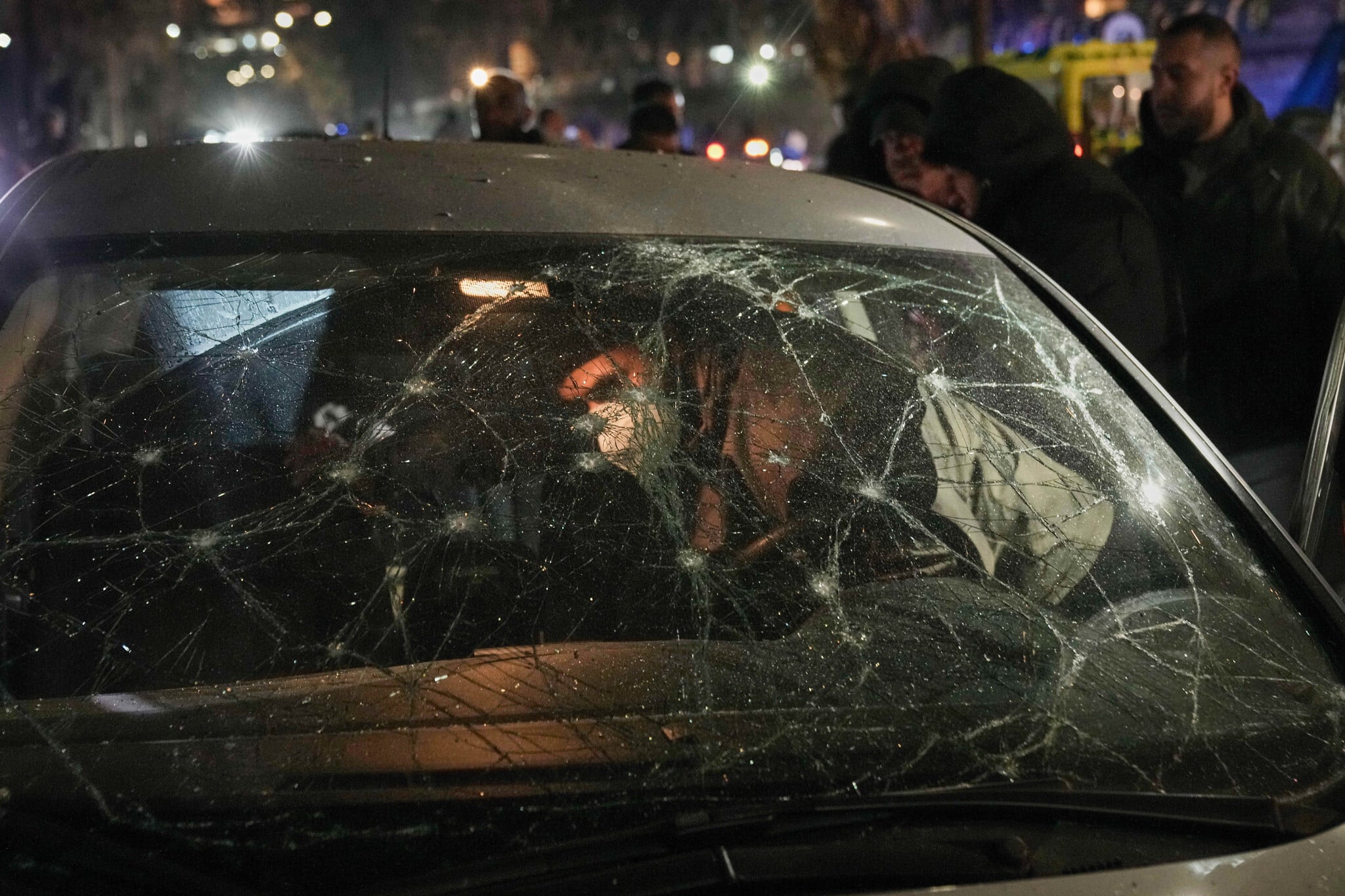
A man inspects a damaged car hit in an Israeli airstrike targeting Hezbollah operatives at the Ramlet al-Baida public beach, in Beirut, Lebanon, March 12, 2026. (AP Photo/Bilal Hussein)
Lebanon says an Israeli strike on central Beirut’s seafront killed at least seven people.
The strike came after the Hezbollah terror group fired barrages of rockets and drones at Israel for a number of hours.
Local media aired footage showing smoke rising along the seaside road area after the strike in central Beirut, which state-run National News Agency (NNA) said targeted a car.
“The Israeli enemy strike on Ramlet al-Bayda in Beirut led to an initial toll of seven dead and 21 wounded,” the health ministry says in a statement.
The NNA reports that Israeli strikes also hit targets in several towns in southern Lebanon, including Taybeh and al-Sultaniyya as well as Qana, near the city of Tyre.
Israel has said it is targeting Hezbollah operatives and infrastructure.
Reinforced room the only part of Haniel home undamaged in Hezbollah rocket strike last night
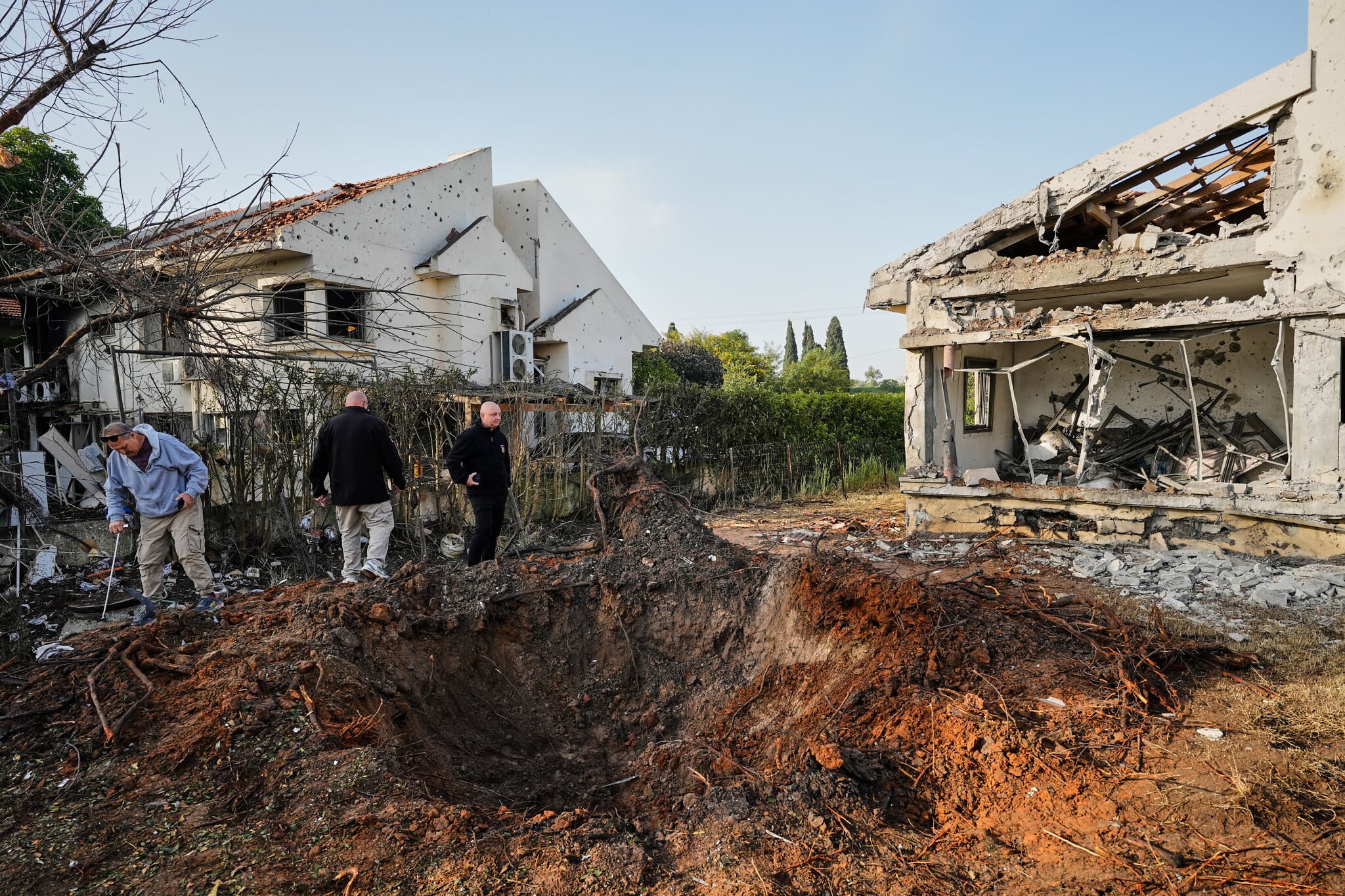
People inspect homes damaged by a rocket fired by Hezbollah from Lebanon, in Haniel in central Israel, March 12, 2026. (AP Photo/Baz Ratner)
More details are emerging about the rocket strike in Moshav Haniel in central Israel last night.
Footage shows massive damage after the rocket fired by the Hezbollah terror group hit the yard of the home, causing a crater.
The blast virtually destroyed the building, with the exception of the reinforced room, Channel 12 reports.
According to the outlet, the woman and her carer who lived there managed to make it to the safe room during the 90 second warning from the siren, and were likely saved as a result.
3 crew members ‘believed trapped’ aboard Thai ship attacked by IRGC in Strait of Hormuz yesterday
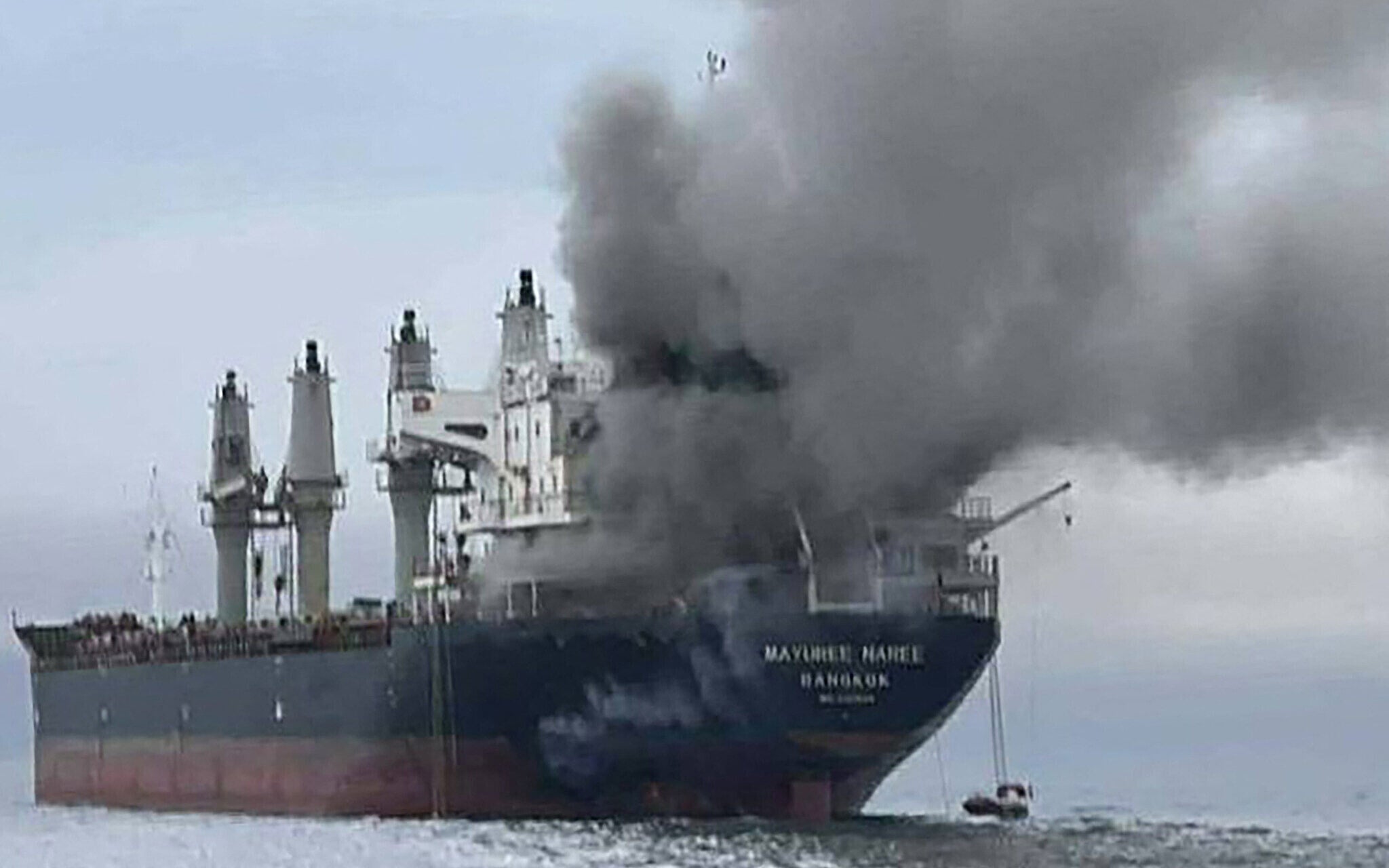
This handout photo taken on March 11, 2026, and released by the Royal Thai Navy, shows smoke rising from the Thai bulk carrier 'Mayuree Naree' near the Strait of Hormuz after an attack. (Handout / Royal Thai Navy/AFP)
Three crew members believed to be trapped aboard a Thai bulk carrier hit by projectiles while traveling through the crucial Strait of Hormuz are yet to be rescued, the vessel’s owner says.
Iran’s Revolutionary Guards said yesterday they had struck the Thai-registered Mayuree Naree, as well as a Liberia-flagged vessel, in the strait because the ships had ignored “warnings.”
The Thai ship was struck while transiting through the Gulf waterway, after departing Khalifa port in the United Arab Emirates.
The two projectiles damaged the Mayuree Naree’s engine room and caused a fire, Thai transport company Precious Shipping says in a statement.
“Three crew members are reported missing and believed to be trapped in the engine room,” it says, adding that authorities are working to rescue them.
“Unfortunately, that remains the case,” the firm’s managing director Khalid Hashim says.
“We still have not been able to get anyone to board our ship, even though the fire has been extinguished,” Hashim says in an email.
“We are trying different avenues to get onboard.”
The Omani navy rescued 20 of the vessel’s sailors on Wednesday, the Thai navy said. Thailand’s foreign ministry said all 23 crew members were Thai.
All Thai vessels have left the Strait of Hormuz and Bangkok had “protested against the violence done to the commercial ships,” the ministry’s deputy spokesman Panidol Patchimsawat tells reporters.
“Please be assured that we are on a mission to find the missing three,” he adds.
Saudi Arabia intercepts drone targeting Shaybah oilfield for 3rd time in a day
Saudi Arabia’s defense ministry says it intercepted a drone heading toward the Shaybah oilfield, marking the third such incident reported within a day.
Iranian drones have been targeting the area regularly this week.
Times of Israel staff contributed to this report.
Reports: Settlers attempt to set fire to mosque in West Bank village, no injuries
Palestinian media outlets report that settlers attempted overnight to set fire to a mosque in the village of Duma, in the Nablus area of the West Bank.
Damage was caused to the entrance, but there are no injuries reported.
Footage circulating online shows Hebrew graffiti sprayed at the entrance reading: “From Nahman’s synagogue.”
عصابات المستعمرين يحرقون مسجدا في قرية #دوما جنوب شرق #نابلس وكتابة شعارات متطرفة على جدرانه pic.twitter.com/iEzL35cwrk
— زاهر ابو حسين (@ZAHERABUHUSIEN) March 12, 2026
Italy says its military base in Iraqi Kurdistan attacked, no injuries
Italian Foreign Minister Antonio Tajani says there has been an “attack” on an Italian base in the Iraqi Kurdish city of Erbil, but there are no injuries.
“I strongly condemn the attack on the Italian base in Erbil,” Tajani says on X, without giving details. “I just spoke with the Italian ambassador to Iraq. Fortunately, all our soldiers are well and safe in the bunker,” he says.
Italy has soldiers in Erbil training Kurdistan security forces as part of an international coalition force.
Oil prices again spike over $100 amid Iran’s attacks on shipping, energy infrastructure

A person holds a petrol pump near Monza, northern Italy on March 11, 2026 (Stefano RELLANDINI / AFP)
Oil soars above $100 and stocks sink as Iran’s fresh attempts to hit supplies in the Middle East and threats to bring down the global economy overshadow a record release of strategic crude by the International Energy Agency.
The IEA said yesterday that its members had agreed to unlock 400 million barrels of oil from their reserves — their largest release ever.
But the move was unable to overcome fears about the choking of energy supplies from the Middle East, with the Strait of Hormuz — through which a fifth of global crude passes — effectively shut down.
IDF detects new Iran missile attack; sirens to sound in central Israel
A new ballistic missile attack from Iran has been detected by the IDF.
Sirens are expected to sound in central Israel in the coming minutes.
Three overnight Iranian missile attacks on Israel caused no injuries, as the projectiles were intercepted or hit open areas.
No injuries reported in Iran’s 4th ballistic missile attack on Israel since midnight
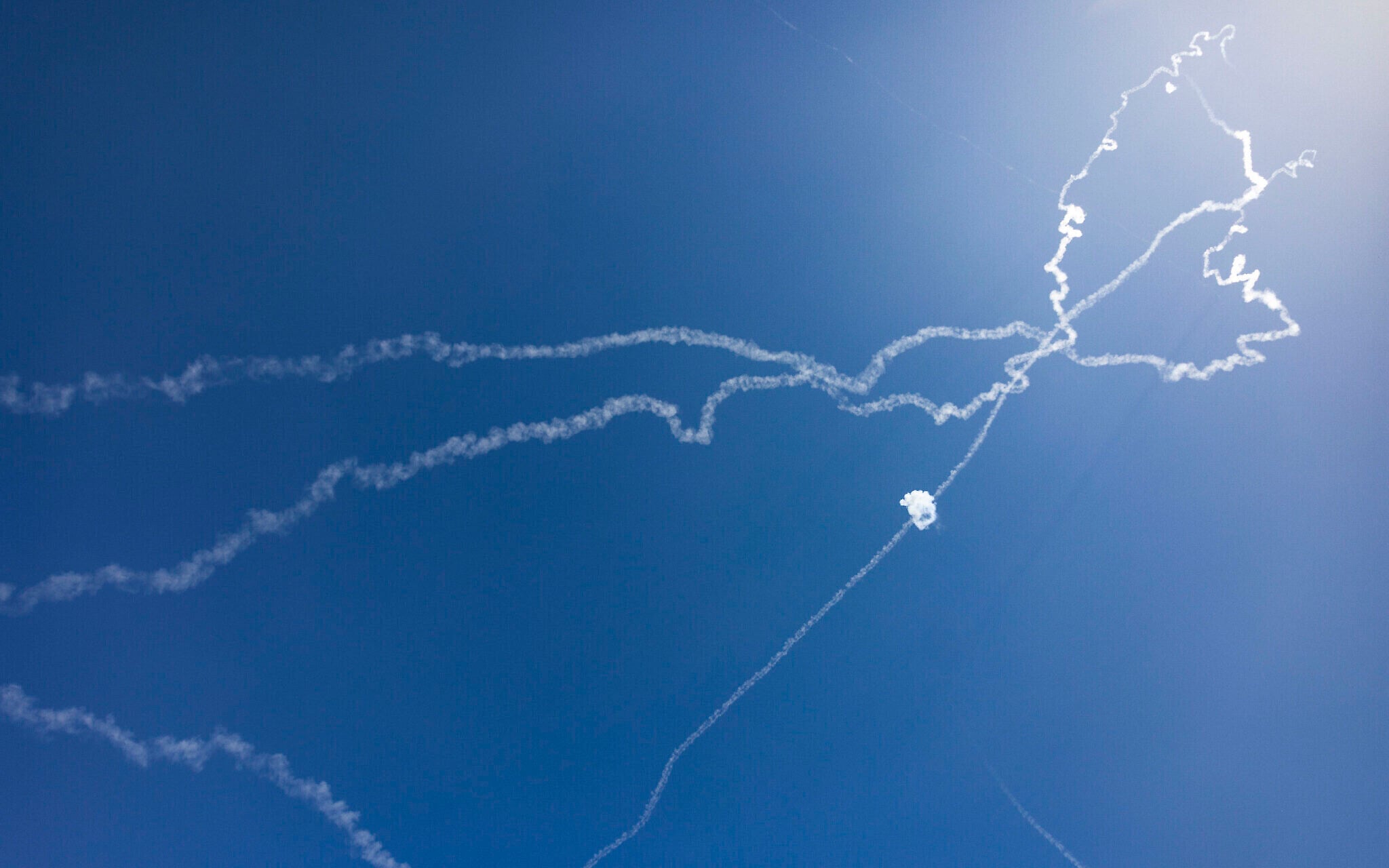
The trails after aerial defenses are activated against missile fire from Iran, as seen over Jerusalem, March 12, 2026 (Yonatan Sindel/Flash90)
No injuries are reported in Iran’s latest ballistic missile attack on Israel, the fourth since midnight.
The missile was intercepted, according to initial military assessments.
Sirens had sounded across the Jerusalem area and parts of the south and West Bank.
179 admitted to hospitals over past day due to Iran war, Health Ministry says
The Health Ministry reports that in the past 24 hours, 179 injured people have been taken to hospitals as a result of the conflict with Iran. This figure includes both civilians and soldiers.
Among those treated in hospitals, four are in moderate condition and 157 are in good condition. Eighteen people have been treated for anxiety.
While the ministry does not give a breakdown of the causes of injuries, it is assumed that most are sustained by people trying to reach shelter rather than as a direct result of missile fire from Iran or rocket fire from Lebanon.
The ministry also says that since the beginning of the war with Iran on February 28, 2,745 people have been admitted to hospitals, 85 of whom are currently hospitalized.
Among those hospitalized, 11 people are in serious condition, 10 people are in moderate condition, and 64 are in good condition.
Explosions heard in downtown Dubai amid ongoing Iranian attacks
Explosions were heard in downtown Dubai, one very loud, a correspondent reports, as Iran continues its campaign against the Gulf in response to US-Israeli attacks.
The correspondent says they saw small clouds of smoke rise above a residential neighborhood.
Man arrested on suspicion of setting fire to playground equipment in Jerusalem’s Sacher Park
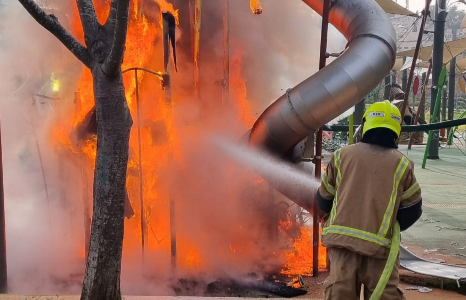
A fire in Sacher Park in Jerusalem, after a man allegedly set fire to the playground equipment on March 12, 2026. (Fire and Rescue Service)
Police have arrested a young man suspected of setting fire to playground equipment this morning in one of Jerusalem’s most popular public parks.
The alleged arsonist, a 23-year-old from the West Bank settlement of Bat Ayin, caused heavy damage to the playground at Sacher Park.
He was nabbed by law enforcement after attempting to flee, police say.
The fire was extinguished by firefighters.
Officers found a lighter in suspect’s possession and noted that his hands appeared to be covered in soot. He was taken for interrogation at the Lev Habira police station.
US military destroyed several Iranian planes in strikes, footage shows
The American military destroyed Iranian cargo planes and other aircraft in strikes at Kerman Airport in Iran’s south, footage shows.
A video released by the US Central Command shows strikes on a Lockheed C-130 Hercules, Lockheed P-3 Orion, and an Ilyushin Il-76.
The US-made planes were supplied to Iran before the 1979 Islamic Revolution.
“The Iranian regime is losing air capability day by day. US forces aren’t just defending against Iranian threats, we are methodically dismantling them,” CENTCOM says on X.
The Iranian regime is losing air capability day by day. U.S. forces aren’t just defending against Iranian threats, we are methodically dismantling them. pic.twitter.com/CrJj2nFtHB
— U.S. Central Command (@CENTCOM) March 12, 2026
Haredi parties understood draft law wouldn’t pass, prioritized budgetary demands – Likud source

An ultra-Orthodox Jew takes part in a parade in the Mea Shearim neighborhood of Jerusalem for a Haredi draft dodger who was released from military prison, December 18, 2025. (Chaim Goldberg/Flash90)
The ultra-Orthodox Shas and United Torah Judaism parties did not publicly protest the government’s decision to halt advancement of its bill exempting yeshiva students from military service because they understand that it was unlikely to pass and are concerned about obtaining their budgetary demands, a Likud source tells The Times of Israel.
“The Haredi factions have an interest in passing the budget, and they’ve realized there’s no chance of getting the conscription law the way they wanted,” the source states, adding, “I don’t believe there’s any feasibility of passing the law after the budget. There simply won’t be a majority.”
On Tuesday evening, Prime Minister Benjamin Netanyahu and Finance Minister Bezalel Smotrich announced that the government was putting aside the controversial legislation as part of a larger effort to pass the 2026 state budget as fast as possible to help cover the cost of war with Iran.
Hours before the statement by Smotrich and Netanyahu, the government authorized over NIS 5 billion ($1.6 billion) in discretionary funds for Haredi institutions, West Bank settlements and other coalition priorities, drawing harsh condemnations from the opposition.
Netanyahu had previously stated that the passage of the bill would have to wait until after that of the budget, a stance the Haredi parties looked increasingly willing to accommodate in the days leading up to the premier’s announcement.
1 dead, unknown number missing as 2 oil tankers attacked near Iraq amid Iran war
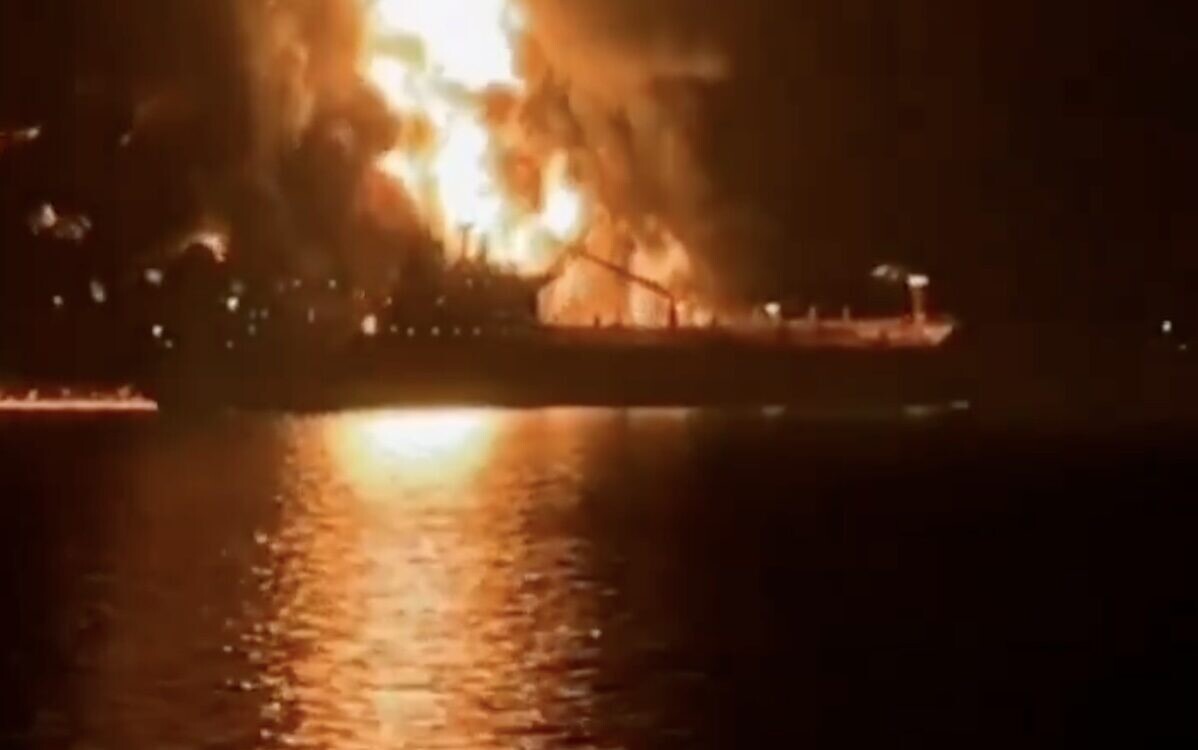
An oil tanker is engulfed in flames after an apparent attack by Iran in Iraqi waters, March 12 (Screen grab used in accordance with Clause 27a of the Copyright Law)
An overnight attack on two oil tankers near Iraq kills at least one crew member, an Indian national, as Iran pressed a campaign aimed at disrupting global energy markets in retaliation for US and Israeli strikes.
Dramatic footage on social media apparently shows the two vessels engulfed in flames.
Additional footage of the two oil tankers struck by Iran in the northern Persian Gulf tonight, both reportedly loaded with Iraqi oil.
The tankers have been completely engulfed in flame, and are leaking burning oil. pic.twitter.com/wX2sNYZXuB
— OSINTtechnical (@Osinttechnical) March 11, 2026
Farhan Al-Fartousi, from Iraq’s General Company for Ports, tells state television that one crew member had been killed and 38 rescued while the “search continues for the missing.”
He does not specify the crew members’ nationalities or provide details on who was behind the attack, which occurred roughly 50 kilometers (30 miles) from the coast.
However, India’s embassy in Iraq says an Indian national died in the attack, with 15 other Indian crew members evacuated.
The Iraqi government tells national news agency INA that “two tankers were subject to sabotage.”
The Strait of Hormuz, the waterway carrying a fifth of the world’s oil, remains closed to almost all oil tankers, and Iran has vowed that not one liter of oil would be exported from the Gulf while its war with the United States and Israel continues.
Iran attacks fuel tanks in Bahrain; local residents told to stay home, close windows
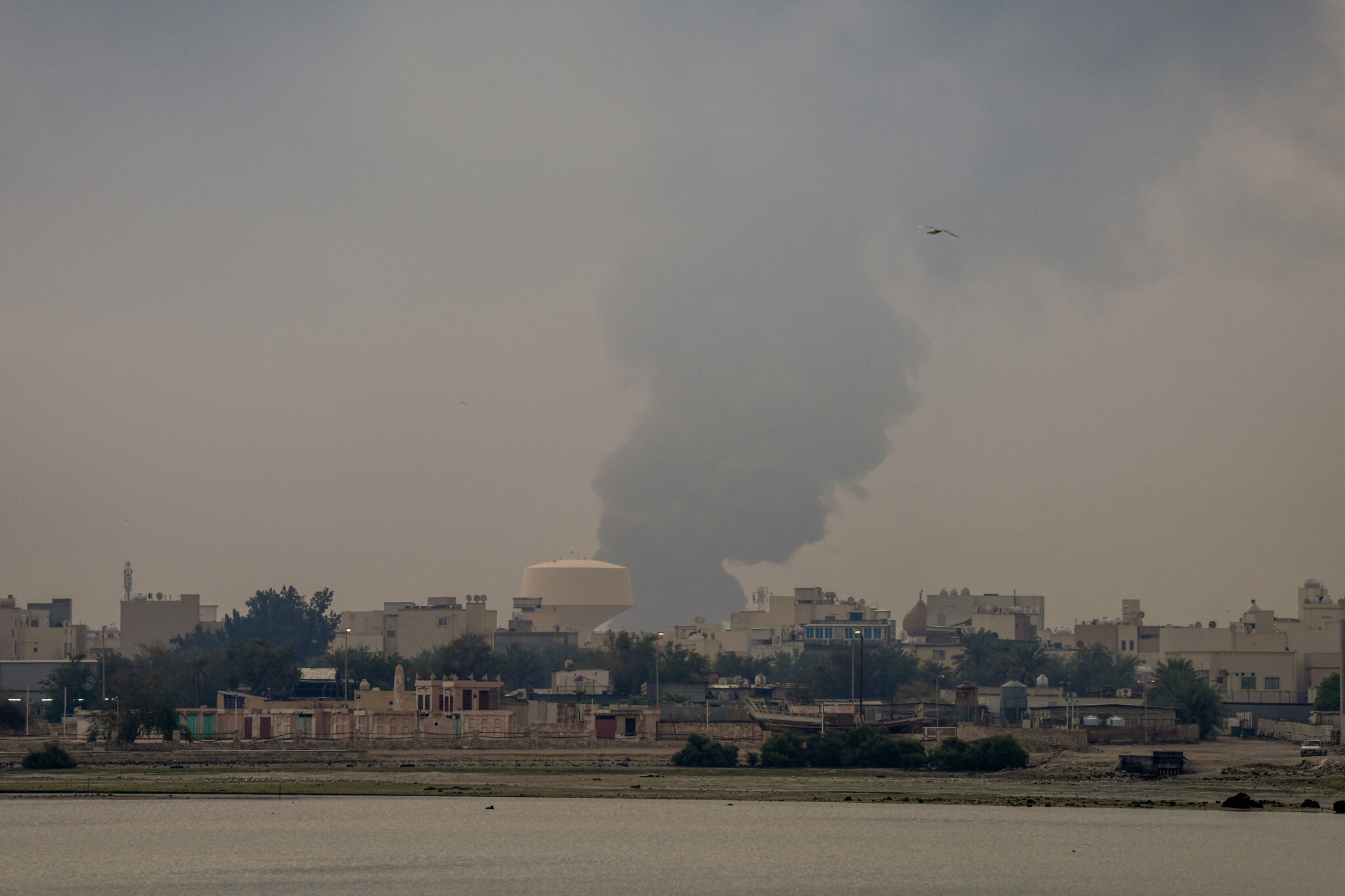
A plume of smoke rises after a reported Iranian strike on fuel tanks in Muharraq, Bahrain, on March 12, 2026. (Fadhel MADHAN / AFP) /
Bahrain tells residents to stay home after an Iranian attack on fuel tanks as Tehran carries out a campaign in the Gulf to disrupt global energy markets.
“The blatant Iranian aggression targets fuel tanks at a facility in Muharraq Governorate,” Bahrain’s Ministry of Interior posts on X.
The ministry tells residents in three parts of Muharraq to “remain in their homes, close windows and ventilation openings as precaution against potential effects of smokes from the fire currently being fought.”
Iranian drones damage Kuwait’s international airport; no casualties
Drone strikes caused damage at Kuwait’s international airport, authorities say, after the facility came under fire again during Iran’s attacks against the Gulf.
“The civil aviation announces that Kuwait International Airport was targeted by several drones, resulting only in material damage,” authorities say in a statement, adding that there are no casualties.
IDF launches fresh wave of ‘extensive’ airstrikes in Iran
The Israeli Air Force has launched a new wave of “extensive” airstrikes in Iran, the IDF announces.
The military says the strikes are targeting Iranian regime infrastructure sites in several areas of Iran.
1st six days of Iran conflict cost US over $11 billion – New York Times
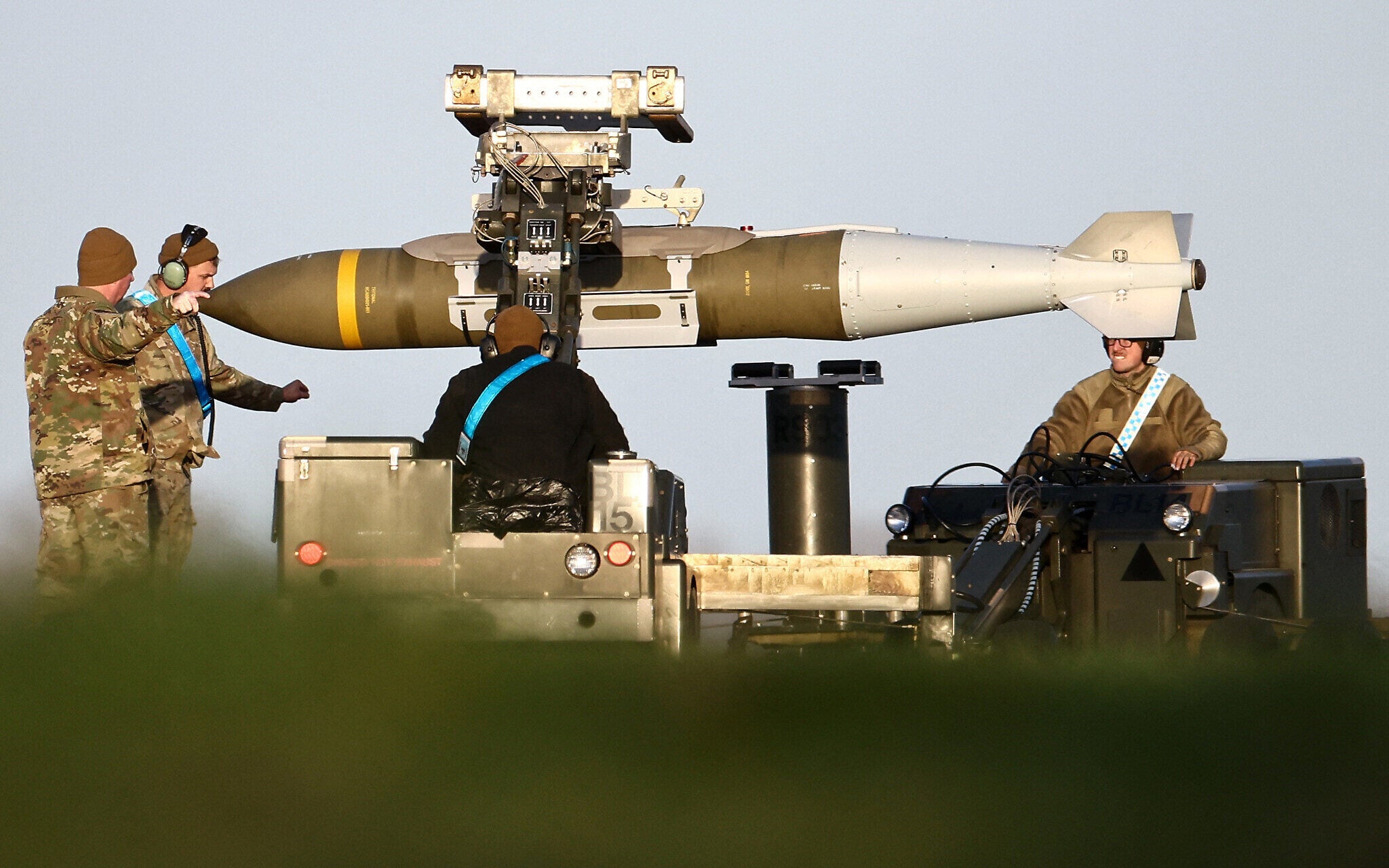
USAF military ground personnel load Joint Direct Attack Munitions (JDAM) into a US Air Force (USAF) B-1 Lancer bomber on the tarmac at RAF Fairford in south-west England on March 11, 2026 (Henry NICHOLLS / AFP)
The opening week of the war against Iran cost the United States more than $11.3 billion, lawmakers were told in a Pentagon briefing, according to a New York Times report underscoring the pace at which the conflict is consuming weapons and resources.
The Times, citing unnamed sources familiar with Tuesday’s closed-door briefing, says members of Congress were told that the figure excludes many costs connected with the buildup to the strikes — suggesting the final tally for the first week could rise substantially.
Defense officials had previously told Congress that roughly $5.6 billion worth of munitions were expended in just the first two days of fighting, according to US media — a burn rate far higher than earlier public estimates.
The Center for Strategic and International Studies (CSIS) independent think tank in Washington estimated that the first 100 hours of Operation Epic Fury cost $3.7 billion — or more than $891 million per day.
Most of these costs, $3.5 billion, had not already been budgeted, the CSIS said.
The Iran War Cost Tracker website, which estimates the cost of the conflict in real time, showed a figure of more than $17 billion on its counter at around 08:00 GMT on Thursday.
According to the site, the United States is spending $1 billion per day on the war.
However, it points out the true cost of the war is likely higher, as the figures do not take into account long-term expenses such as veteran healthcare.
IDF admits error in not updating public ahead of last night’s major Hezbollah barrage
People inspect homes damaged by a rocket fired by Hezbollah from Lebanon, in Haniel in central Israel, March 12, 2026. (AP Photo/Baz Ratner)
The IDF acknowledges that it was a mistake not to update the public ahead of Hezbollah’s large rocket and drone attack on northern Israel last night, especially once Israel’s assessments of the planned barrage were leaked on social media and published by international media.
The military had indications that Hezbollah planned a larger-than-usual attack, though it was not seen by the IDF as exceptionally major, considering that the terror group had already been firing hundreds of rockets at Israel amid the war with Iran.
News of the indications leaked on social media in the late afternoon, and several regional councils in northern Israel updated their residents that heavy fire from Lebanon was expected. CNN also reported, citing Israeli officials, that Israel was expecting a potential “significant expansion” of attacks from Hezbollah and Iran.
Military officials admit that the IDF should have been more transparent with the Israeli public regarding the assessments ahead of the barrage, especially once they were circulating online, mainly to maintain public trust.
The military did begin to update local authorities in the north shortly before the Hezbollah attack began. But IDF officials acknowledge that this was far too late, saying that the public should have been notified much earlier.
The IDF says it will investigate and learn from the incident, and in the future, will work to update the public ahead of potential major attacks.
Hezbollah’s attack consisted of around 200 rockets and some 20 drones, according to the IDF, which says that this was only a third of what the terror group had initially planned.
The vast majority of the 200 rockets were intercepted or struck open areas. There were two impacts in residential areas, causing damage and lightly injuring two people. Nearly all of the drones were intercepted, aside from one that crashed near a border community without exploding, according to the military.
The IDF says it carried out several actions ahead of the barrage to thwart the attack, including striking at least one of the rocket launchers and several Hezbollah command centers in Lebanon.
Once the rocket barrage began, the IDF launched strikes against the launchers it was further able to identify, saying it destroyed around half of them.
Since March 2, when Hezbollah began attacking Israel in response to the killing of Iran’s late supreme leader Ali Khamenei, the terror group has launched around 100 rockets a day, according to the IDF.
The IDF says two-thirds of those rockets have been aimed at Israeli forces operating in southern Lebanon and along the border, while a third have been aimed at Israel.
In addition, Hezbollah has launched more than 100 drones at Israel during that time, the vast majority of which were shot down by the Israeli Air Force, according to the military.
Footage shows Hezbollah's large rocket barrage on northern Israel this evening. Around 100 rockets were fired, according to IDF assessments. pic.twitter.com/8wuG6J8kgg
— Emanuel (Mannie) Fabian (@manniefabian) March 11, 2026
Education minister: Plan to partially reopen schools won’t include Tel Aviv area, northern Israel

Education Minister Yoav Kisch attends a joint meeting of the Education, Culture and Sports Committee, the Welfare Committee, and the Committee on the Rights of the Child at the Knesset in Jerusalem, January 26, 2026. (Yonatan Sindel/Flash90)
Education Minister Yoav Kisch confirms that the ministry’s plan for a partial reopening of schools starting as early as next week will not include northern Israel or the Tel Aviv area (Gush Dan).
He makes the comments during a situation assessment in the northern city of Nahariya after a night of heavy fire on the region by both Iran and the Lebanon-based Hezbollah terror group.
On Monday, Kisch presented a plan to reopen daycares, special education, and grades 1, 2, 11, and 12 in areas designated as “yellow,” or at lower risk of attacks, by the Home Front Command, provided the schools have shelters. So far, no area has been designated as such. The next assessment is set for Saturday night.
According to a statement by the minister’s spokesperson, the ministry expects most of the country to remain at high risk, with schools continuing to operate only remotely.
The statement adds that once an area is designated as yellow, it will take 24 hours to organize a return to the classroom and, therefore, schools are not expected to reopen before Monday.
It also says that the minister asked the Home Front Command to move up its assessment to allow schools to get organized to reopen as soon as Sunday, where possible.
Local authorities that have expressed interest in reopening schools under Kisch’s outline next week include Jerusalem, Maale Adumim in the West Bank, and the Gaza border communities in the south.
Northern, Gaza border councils fight budget cuts; Bennett: ‘Coalition takes care of itself, abandons its people’
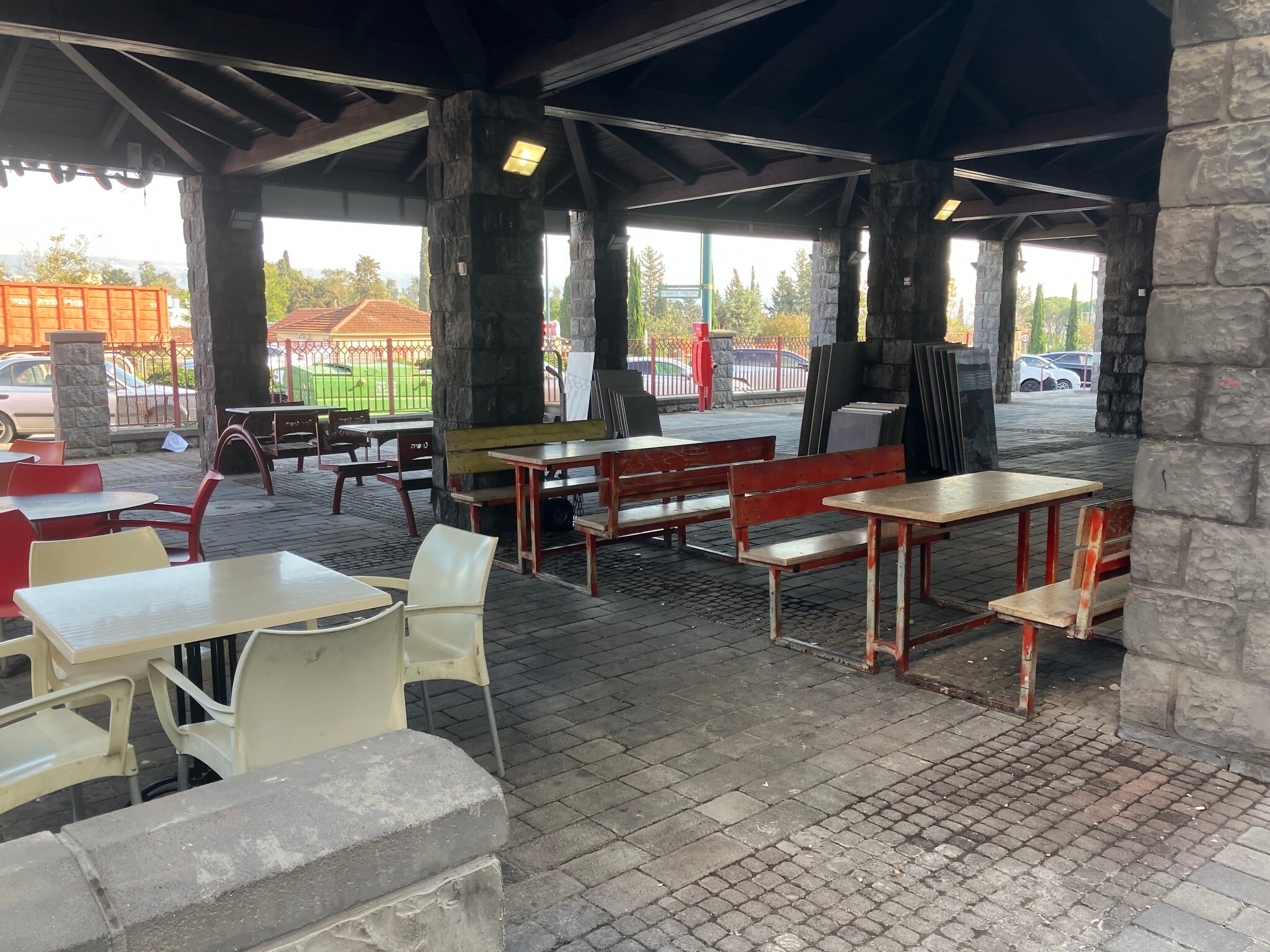
Empty tables along Kiryat Shmona's main street, once a bustling area, on December 16, 2025. (Diana Bletter/Times of Israel)
The regional councils of the communities along Israel’s northern and Gaza borders write to Prime Minister Benjamin Netanyahu to protest the cutting of budgets “intended to restore and strengthen the frontline areas of the State of Israel.”
The representatives of the Confrontation Line Forum, Sdot Negev Regional Council and other local governmental bodies urge the prime minister and Finance Minister Bezalel Smotrich to spare these programs from the broad three percent cut to all ministries, with the exception of the Defense Ministry, that was announced this week in order to bolster the defense budget.
“We ask you, the prime minister and the finance minister, to exclude [this] funding from the cuts, and to ensure that the funding intended for the rehabilitation and development of the confrontation line areas and the Gaza perimeter will be maintained in full,” they write.
The local officials argue that these funds are not for “ordinary development” but rather “are intended to enable a long-term rehabilitation process, the return of full civilian life to an area that was hit in an unprecedented way, and the building of a stable infrastructure for growth, security, and community resilience for years to come.”
The civilians living in these areas are still suffering under an ongoing security threat, with many living in fortified rooms for long stretches, and cutting these budgets “could delay vital projects that are already in the planning and execution stages and create budgetary uncertainty” precisely when it is necessary to strengthen these hard-hit regions, the local authorities argue.
Sharing the letter in a post on X, former prime minister Naftali Bennett says that “while the residents of the north were sheltering under heavy barrages of fire, government ministers cut their rehabilitation and protection budgets,” noting that this was on the same day that the government approved “5 billion shekels of coalition funds for the [Haredi] draft dodgers.”
“And now, the heads of the councils on the confrontation line are forced to beg the government to return the money they so desperately need. A government with inverted priorities, that takes care of itself and abandons its own people,” Bennett writes.
Pushing back on his own government’s move, Otzma Yehudit MK Yitzhak Kroizer, chairman of the Knesset Internal Affairs and Environment Committee, writes a letter to Smotrich signed by nine coalition and opposition lawmakers to demand that the budgets for the northern communities be exempted.
“The northern settlements are grappling with a complex and ongoing security reality. The budgets designated for rehabilitation, for strengthening civilian resilience, and for regional development are not luxuries; they are a top national necessity,” he writes on X.
Katz: If Lebanon doesn’t prevent Hezbollah attacks, Israel will ‘take the territory and do it ourselves’
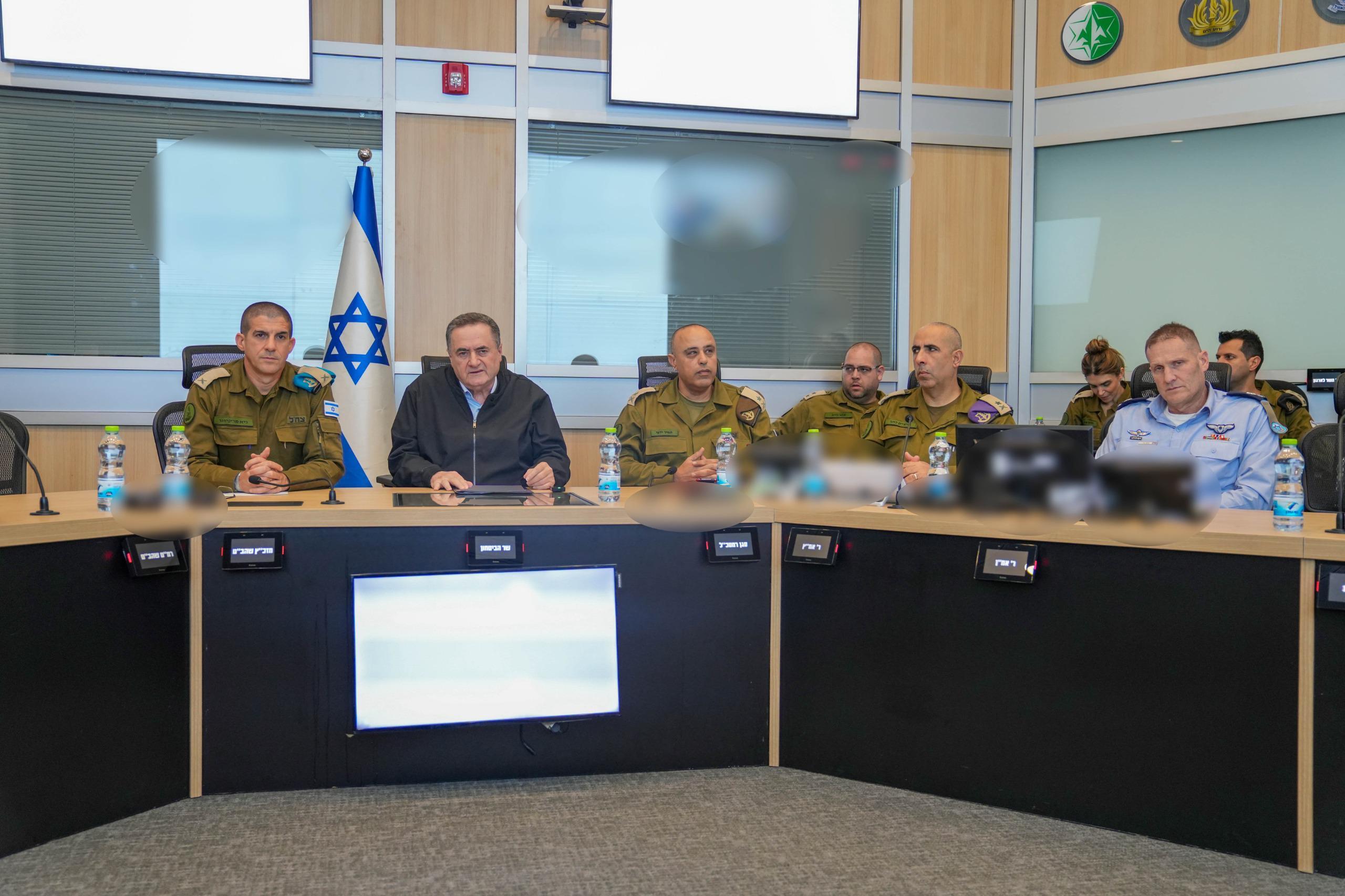
Defense Minister Israel Katz (center) meets with senior IDF officers at the military's underground command center, March 12, 2026. (Ariel Hermoni/Defense Ministry)
Defense Minister Israel Katz says he has warned Lebanon that if it does not prevent Hezbollah from attacking, Israel will “take the territory and do it ourselves.”
“Hezbollah launched heavy barrages toward the State of Israel yesterday. The IDF responded forcefully in the Dahiyeh [the southern suburbs of Beirut, a Hezbollah stronghold] and against Hezbollah targets across Lebanon,” Katz says during an assessment with senior IDF officers.
“I warned the president of Lebanon that if the Lebanese government does not know how to control the territory and prevent Hezbollah from threatening the northern communities and firing at Israel, we will take the territory and do it ourselves,” he says.
Katz also says that he and Prime Minister Benjamin Netanyahu “instructed the IDF to prepare for an expansion of IDF activity in Lebanon and to restore calm and security to the northern communities.”
Sirens in north warn of suspected drone attack from Lebanon
Sirens sound in the Upper Galilee, warning of a suspected drone attack from Lebanon.
Last night, Hezbollah launched some 20 drones at northern Israel, the vast majority of which were intercepted according to the IDF.
Knesset to increase parliamentary activity, more reinforced rooms to be prepared
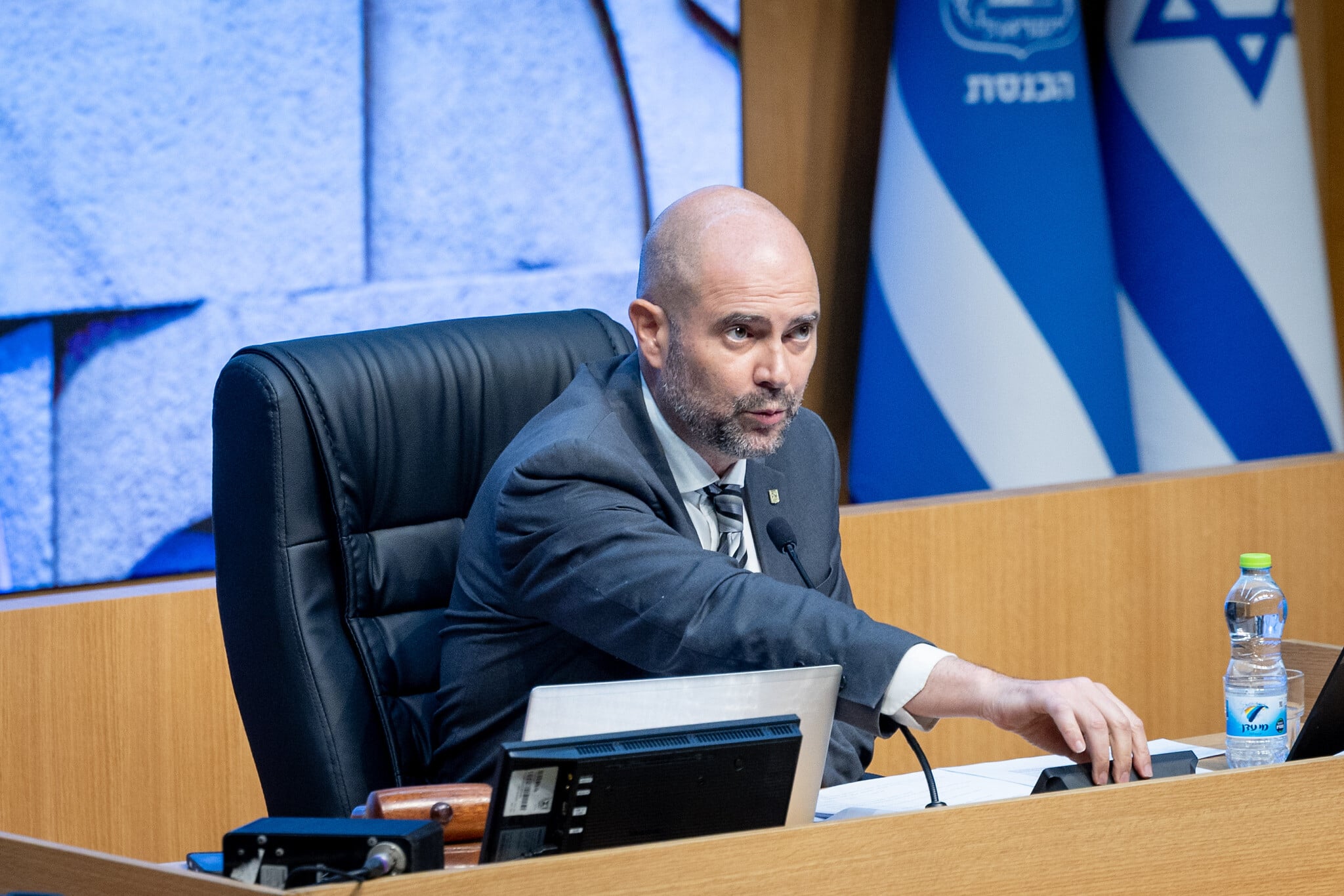
Knesset Speaker Amir Ohana at a plenum session held in a reinforced area of the Knesset in Jerusalem, March 11, 2026 (Oren Ben Hakoon/FLASH90)
Knesset Speaker Amir Ohana announces plans to resume more parliamentary activity following nearly two weeks of war with Iran.
In a statement, Ohana’s office says that following an fresh situational assessment with senior Knesset staffers, it has been decided to prepare additional chambers as protected spaces in order to “allow for broader Knesset activity during the next week, in accordance with requests received from both the opposition and the coalition.”
Knesset staff are set to “prepare a plan for holding the discussions in a staggered manner so that at any time it will be possible to evacuate participants to protected spaces at short notice,” the statement adds.
According to Channel 12, the discussions will be allowed to be held without any restrictions on content, including controversial laws, despite the fact that Israel remains at war.
Last Thursday, the Knesset resumed limited legislative activity after suspending nearly all committee meetings and plenum sessions following the outbreak of war with Iran. It was decided at the time that committee meetings would only be held in chambers that serve as protected spaces or adjacent to them, while visits and tours would remain curtailed.
Plenum sessions have been taking part in a fortified auditorium rather than in their usual chamber.
‘An angel’: Herzog meets widower of Filipina caregiver killed in Iranian missile attack

President Isaac Herzog (R) meets with Bernie Galsim Lavarias, the widower of Mary Anne Velasquez de Vera (pictured center), who was killed in an Iranian missile attack on Tel Aviv, at the President's Residence in Jerusalem, March 12, 2026 (Yonatan Sindel/Flash90)
President Isaac Herzog meets with the widower of Filipina carer Mary Anne Velasquez de Vera, who was killed last week in an Iranian missile strike on Tel Aviv, expressing his condolences for his loss.
“Mary Anne was an angel,” Herzog tells Bernie Galsim Lavarias, during a meeting at the President’s Residence, according to a readout from his office. “So many Israelis were hurt by and took to heart the loss of Mary Anne,” Herzog adds.
Velasquez de Vera, 32, was the first fatality in Israel during the ongoing US-Israeli war with Tehran.
Philippine Ambassador to Israel Aileen Mendiola, who is also in attendance, adds that “Mary Anne is not the only Filipino killed in this war,” noting that four Filipino nationals were killed in the Hamas-led massacre on October 7, 2023, which sparked Israel’s war with the terror group in Gaza and expanded to include confrontations with Tehran, which backs Hamas and other regional proxies.
Mendiola adds that another Filipina national working as a caregiver was killed in an Iranian missile attack during Israel’s 12-day war with Iran in June.
“It pains us, but when you ask the Filipino community, many choose to remain because they see themselves as a partner and a family member,” Mendiola adds.
IDF says it recently struck site where Iran advanced ‘critical capabilities’ in nuclear weapons
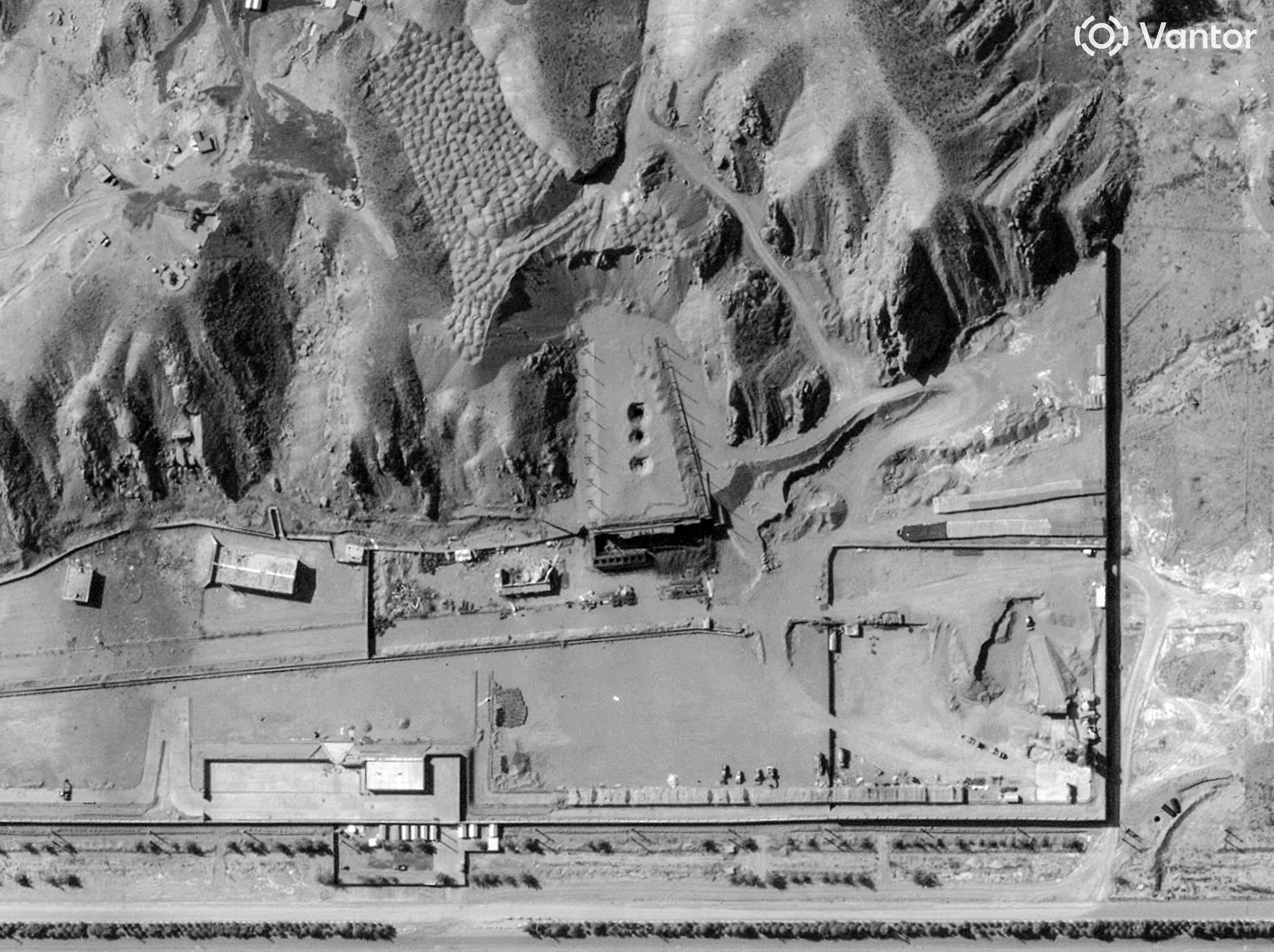
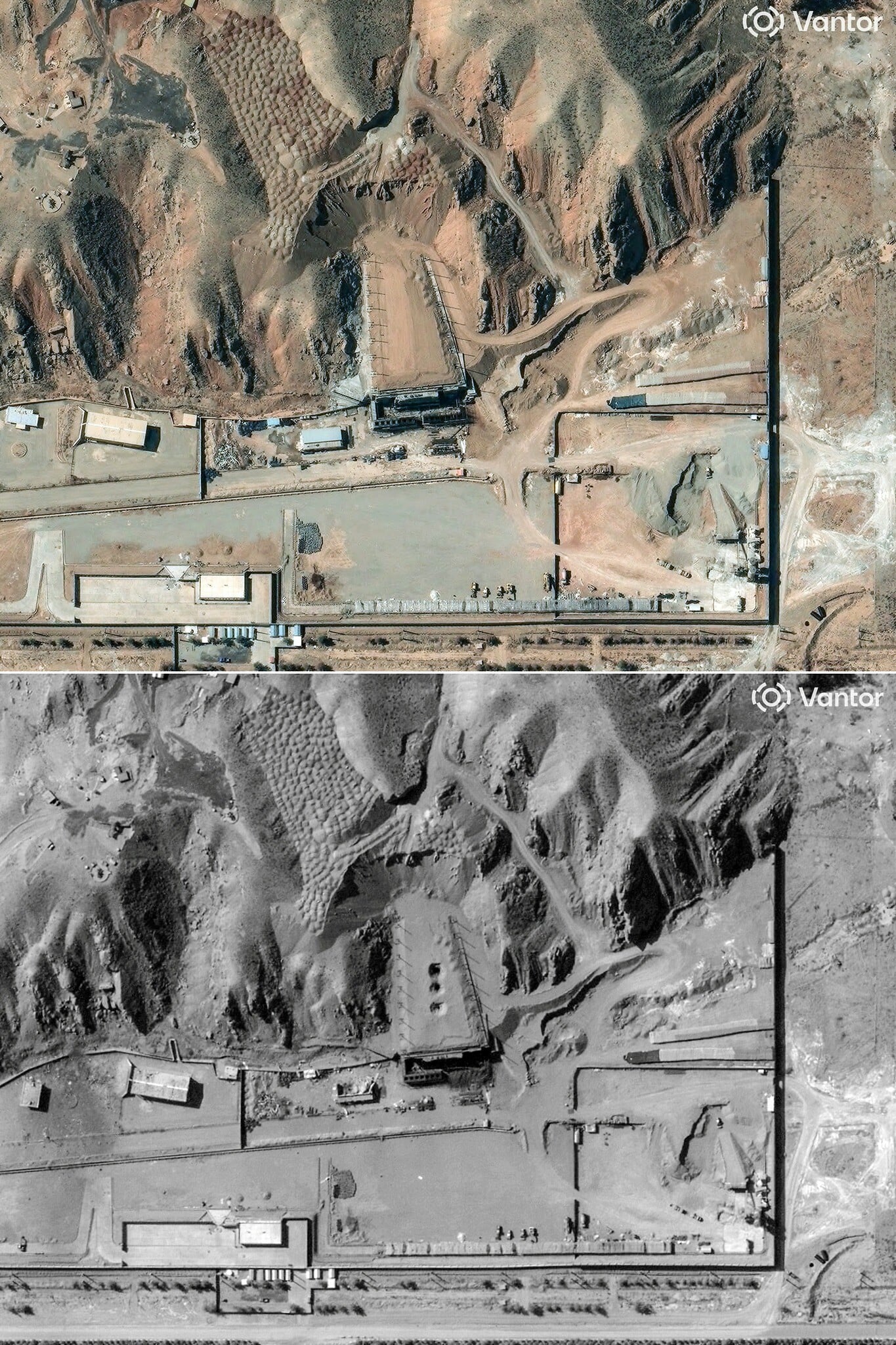
This satellite image taken and released on March 11, 2026 courtesy of Vantor shows a view of Taleghan 2 facility with three craters after airstrikes at the Parchin military complex, some 30 kms (20 miles) southeast of Tehran, Iran (Satellite image ©2026 Vantor / AFP)
The IDF says it recently struck an Iranian nuclear facility where the regime worked on “critical capabilities in the development of nuclear weapons.”
The site near Tehran, identified by the military as the Taleghan compound, was hit during waves of strikes the air force carried out in the area over the past few days.
The IDF says that in recent years, Iran used the site for “the development of advanced explosives and for conducting sensitive experiments as part of AMAD Project,” Iran’s alleged secret nuclear weapons development program.
The Taleghan compound had been struck by Israel in October 2024, during a retaliation for an Iranian missile attack on Israel earlier that month.
The military says that it recently detected that Iran had “taken steps to rehabilitate the compound” following those strikes.
“The Iranian regime has continued efforts to advance and develop capabilities required for the development of a nuclear weapon,” the IDF says, adding that the recent strike is part of a “series of operations” aimed at “further damaging the Iranian terror regime’s nuclear aspirations.”
Poland says ‘many indications’ foiled cyberattack on nuclear center originated in Iran
Poland has foiled a cyberattack on its nuclear research center and is examining signs that Iran may be behind it, the government says, cautioning the indicators might be a deliberate misdirection to hide the attackers’ true location.
Poland says it has been the target of numerous cyberattacks since Russia’s full-scale invasion of Ukraine in 2022. Moscow has repeatedly denied involvement.
Digital Affairs Minister Krzysztof Gawkowski tells private broadcaster TVN24+ that the attack on Poland’s National Centre for Nuclear Research had taken place “in the past few days.”
“The attack may not have been on a huge scale, but there was an attempt to break through the security that was stopped. Appropriate services are already working,” Gawkowski says, adding that the center was safe.
“The first identifications of the entry vectors, i.e., those places from which [the center] was attacked, are related to Iran,” he says. “When there is final information and the services will check it, we will verify it, but there are many indications that it took place on the territory of Iran.”
The Iranian embassy in Warsaw does not immediately reply to an emailed request for comment.
The center conducts research into nuclear energy, subatomic physics and related fields. Poland has no nuclear weapons and is building its first nuclear power plant.
Australia tells non-essential diplomats to leave Israel, UAE amid ‘deteriorating security situation’

Australia's Foreign Minister Penny Wong in Adelaide on June 16, 2024. (Asanka Ratnayake / POOL / AFP)
Australia has told “non-essential” diplomats to leave Israel and the United Arab Emirates, Foreign Minister Penny Wong says.
They are told to leave due to the “deteriorating security situation.”
Essential officials would remain in both Israel and the UAE to support Australian citizens who need it, Wong says on X.
Up to 3 million people displaced inside Iran amid war, UN says
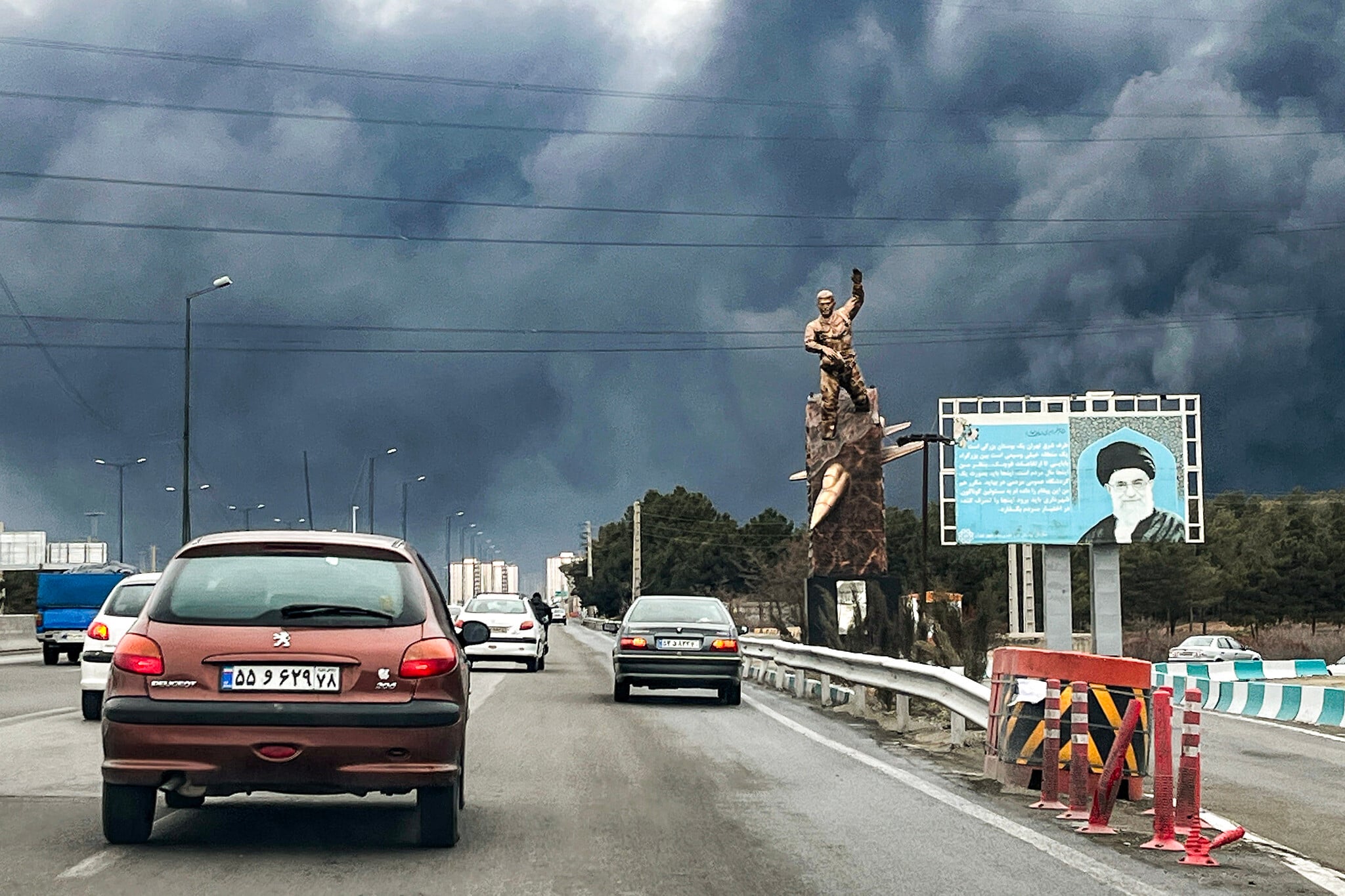
Vehicles move along a highway past a war memorial statue and a billboard depicting Iran's late supreme leader Ayatollah Ali Khamenei, with plumes of black smoke billowing, in Tehran on March 8, 2026. (AFP)
Up to 3.2 million people have been displaced inside Iran since the Middle East war erupted nearly two weeks ago, the United Nations refugee agency says.
“Between 600,000 and one million Iranian households are now temporarily displaced inside Iran as a result of the ongoing conflict, according to preliminary assessments, representing up to 3.2 million people,” says Ayaki Ito, who heads UNHCR’s emergency support team and is refugee response coordinator for the Middle East emergency.
“This figure is likely to continue rising as hostilities persist, marking a worrying escalation in humanitarian needs,” he says in a statement.
There is no mention of the number of people who have left their homes in Gulf countries and Israel as a result of Iran’s attacks.
IRGC officer who commanded Hezbollah missile unit killed in Israeli airstrike in Lebanon, IDF says

A fireball rises from the site of an Israeli airstrike that targeted an area in Beirut's southern suburbs overnight March 10 to 11, 2026. (Fadel Itani/AFP)
A member of Iran’s Islamic Revolutionary Guard Corps who was operating as a commander in Hezbollah’s missile unit was killed in an Israeli airstrike in Lebanon this week, the IDF announces.
Abu Dharr Mohammadi, who the military says was a “central figure in the military coordination” between Hezbollah and the Iranian regime, was targeted in Beirut on Tuesday.
The IDF says Mohammadi coordinated between Hezbollah and senior Iranian officials, was “a key figure” in Hezbollah’s military force build-up in the field of missiles, and “served as an authority on the subject of Hezbollah’s strategic weapons.”
צה"ל חיסל מפקד מטעם משמרות המהפכה שפעל ביחידת הטילים של ארגון הטרור חיזבאללה בלבנון
צה"ל תקף מוקדם יותר השבוע, וחיסל את המחבל אבו ד'ר מחמדי, מפקד מטעם משמרות המהפכה שפעל ביחידת הטילים של ארגון הטרור חיזבאללה בביירות.
מחמדי היווה גורם מרכזי בתיאום הצבאי בין ארגון הטרור חיזבאללה… pic.twitter.com/tKwjQZ8XHH
— צבא ההגנה לישראל (@idfonline) March 12, 2026
Sirens in northern towns warn of suspected drone attack
Fresh sirens sound in the Western Galilee, warning of a suspected drone attack from Lebanon.
Last night, Hezbollah launched some 20 drones at northern Israel, the vast majority of which were intercepted, according to the IDF.
Iran accuses EU of ‘complicity’ in US-Israeli strikes
Iran’s foreign ministry spokesman accuses the European Union of “complicity” in the US-Israeli attacks on the Islamic Republic.
“The European Union’s indifference and acquiescence in the face of US and Israeli aggression, brutalities and atrocities amounts to nothing less than complicity,” Esmaeil Baghaei says in a post on X.
Top commander in elite Hezbollah unit killed in strike last week — IDF
The IDF says the commander of the south Lebanon sector in Hezbollah’s elite Radwan Force was killed in an airstrike last week.
Abu Ali Riyan was targeted in an airstrike in the southern Lebanese town of Harouf on Saturday, according to the military.
The military says Riyan managed the Radwan Force in southern Lebanon and was a “central figure responsible for coordinating operations, recruiting operatives, and managing the unit’s weapons supply chain.”
The IDF says it has killed over 350 terror operatives in Lebanon since hostilities escalated this month, mostly Hezbollah members, including over 100 fighters in the Radwan Force.
More than 60 command centers of the Radwan Force have also been struck, the army says.
The Radwan Force was previously tasked with invading Israel in a future war, and the IDF says the elite unit had advanced the terror group’s “Conquer the Galilee” plan for years, until the 2023-2024 war that saw most of Hezbollah’s leadership eliminated.
Man arrested for trying to kidnap his two young daughters into West Bank
Police say they arrested a man who tried to kidnap his two young daughters into the West Bank earlier today.
The kidnapping attempt began this morning in Ashdod, following a domestic violence incident between the 31-year-old suspect and his wife.
He then fled the scene, making off with his daughters — aged one and three — to the Palestinian village of Bayt Awwa, west of Hebron, police say.
The suspect was arrested by police detectives, who were assisted by IDF troops accompanying them into the town.
The toddlers were returned to their mother and the suspect was transferred for questioning at the Ashdod police station.
Iran’s new supreme leader Mojtaba Khamenei to issue 1st message since his appointment
This handout picture taken in Tehran on October 30, 2024, shows Mojtaba Khamenei, son of Iran's slain supreme leader Ayatollah Ali Khamenei. (Office of Supreme Leader / AFP)
Iran’s new supreme leader Mojtaba Khamenei will issue his first message since his appointment “in a few moments,” his official Telegram channel says, without specifying if it will be a recorded message or written statement.
“The first message of Ayatollah Seyyed Mojtaba Hosseini Khamenei, the supreme leader of the Islamic revolution, will be released in a few moments,” the channel says.
The message will address “the martyred leader of the revolution (Ali Khamenei), the role and duties of the people, the armed forces, executive bodies, the resistance front, as well as the countries of the region and dealing with enemies.”
The message comes after Iran said the new supreme leader was injured in a strike at the start of the war, but was “safe and sound.”
US military ‘not ready’ to escort tankers through Hormuz Strait, says energy secretary
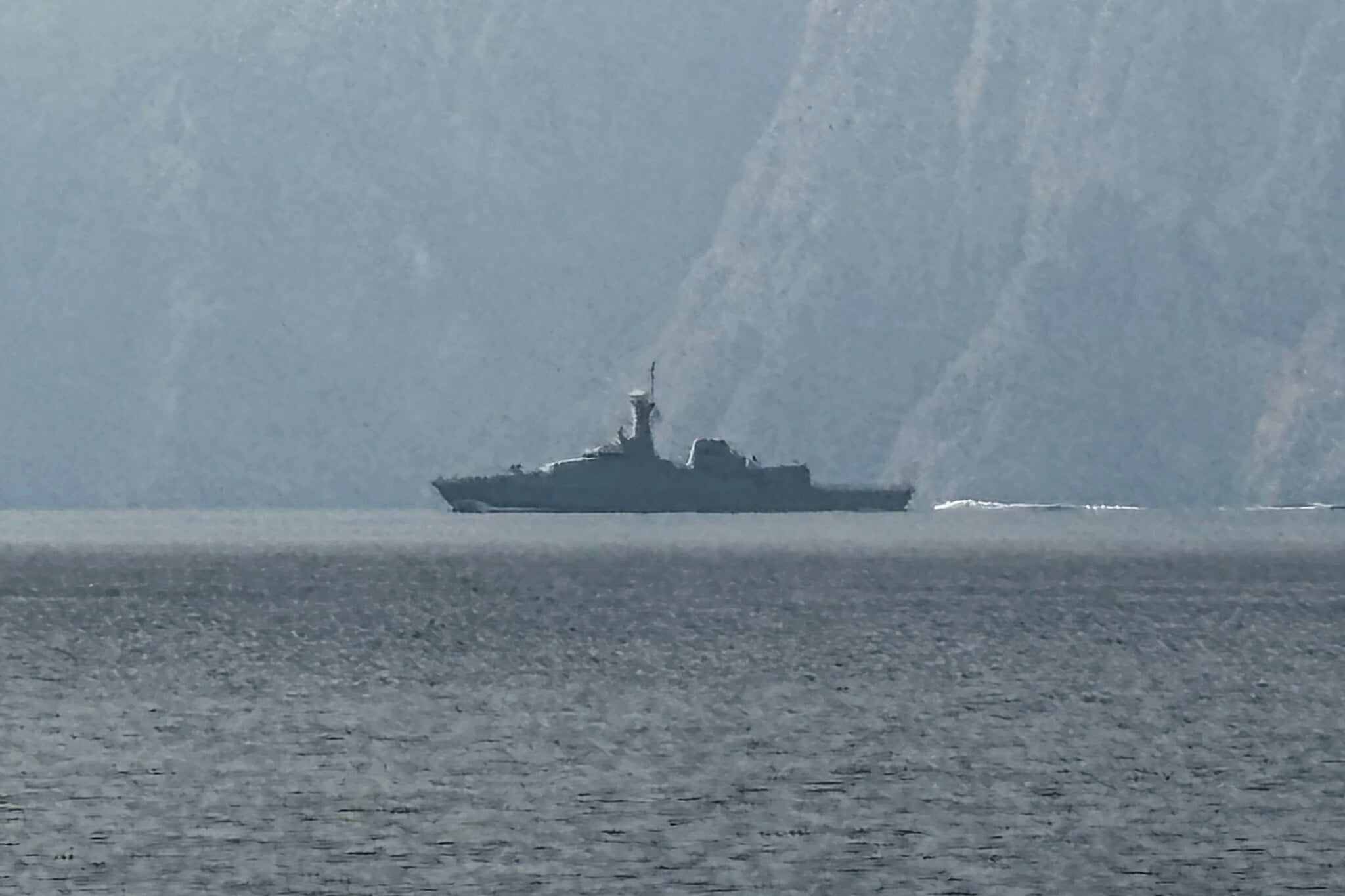
A navy vessel is seen sailing in the Strait of Hormuz, a vital waterway through which much of the world's oil and gas passes on March 1, 2026. (Sahar Al Attar/AFP)
The US military is currently “not ready” to escort tankers through the critical Strait of Hormuz because all its assets are focused on striking Iran, US Energy Secretary Chris Wright says.
“It’ll happen relatively soon, but it can’t happen now. We’re simply not ready,” Wright tells CNBC. “All of our military assets right now are focused on destroying Iran’s offensive capabilities and the manufacturing industry that supplies their offensive capabilities.”
He adds that it is “quite likely” such escorts will be taking place by the end of the month.
IDF says it struck 250 drones, killed ‘many’ soldiers in Iran’s UAV force
The Israeli military says it has destroyed over 250 Iranian drones and dozens of launchers, and killed numerous soldiers and commanders in Iran’s unmanned aerial vehicle (UAV) array in strikes.
In recent days, the IDF says it has expanded its strikes on Iran’s UAV capabilities.
During one wave of strikes, the military says, the Israeli Air Force identified Iranian soldiers from the UAV array preparing to launch drones at Israel. Within a short while, the launcher and the soldiers were struck by the IAF, thwarting the planned attack, the military says.
“So far, the Air Force has struck more than 250 unmanned aerial vehicles, launchers, and dozens of launch sites. In addition, many commanders and soldiers in the unmanned aerial vehicle array responsible for numerous launches toward the State of Israel have been eliminated,” the IDF says in a statement.
It publishes footage showing some of the strikes.
חיל האוויר ממשיך להעמיק את הפגיעה במערכי האש של משטר הטרור האיראני: הותקפו יותר מ-250 כלי טיס בלתי מאוישים, משגרים ועשרות אתרי שיגור
לאחר הפגיעה הקשה במערך הטילים של משטר הטרור האיראני, צה״ל הרחיב בימים האחרונים את התקיפות לעבר מערך כלי הטיס הבלתי מאוישים של משטר הטרור האיראני.… pic.twitter.com/UXH0sPYz7G
— צבא ההגנה לישראל (@idfonline) March 12, 2026
According to the IDF, since the start of the war, more than 110 drones launched from Iran have been intercepted by the IAF with fighter jets and helicopters. The Navy has also intercepted several drones.
IDF detects new Iran ballistic missile launch, as sirens sound in Galilee amid rocket fire from Lebanon
A new ballistic missile attack from Iran has been detected by the IDF.
Sirens are expected to sound in central Israel in the coming minutes.
Meanwhile, sirens sound in the Galilee amid a rocket and suspected drone attack from Lebanon.
IDF warns more of south Lebanon to evacuate amid fighting with Hezbollah

An IDF evacuation warning issued for southern Lebanon on March 12, 2026. (Israel Defense Forces)
The IDF expands its evacuation warning of southern Lebanon, telling all civilians south of the Zahrani River they should evacuate their homes immediately, amid the fighting against Hezbollah.
“The activity of the Hezbollah terror organization is forcing the IDF to act against it with force, especially in your areas. The IDF does not intend to harm you,” says army spokesman Col. Avichay Adraee.
“For your safety, we call on all residents located south of the Zahrani River, you must evacuate your homes immediately,” he says. “You must move immediately to the north of the Zahrani River.”
Last week, the IDF called on Lebanese civilians in southern Lebanon to evacuate to the north of the Litani River.
The new evacuation warning includes dozens more Lebanese towns.
“Anyone who is near Hezbollah members, its facilities, or its [weapons] is putting their life at risk. Any building used by Hezbollah for military purposes may become a target,” Adraee says.
He warns that “any movement southward may put your life at risk.
#عاجل ‼️ انذار عاجل إلى سكان جنوب لبنان
????إنّ نشاط حزب الله الإرهابي يُجبر جيش الدفاع على العمل ضده بقوة لا سيما في مناطقكم. جيش الدفاع لا ينوي المساس بكم.
????حرصًا على سلامتكم، نتوجّه إلى جميع السكان الموجودين جنوب نهر الزهراني – عليكم إخلاء منازلكم فورًا????
????كل من يتواجد… pic.twitter.com/W7vedTLPVs
— افيخاي ادرعي (@AvichayAdraee) March 12, 2026
No injuries reported as Iran fires ballistic missile salvo, Hezbollah launches rockets at Israel
No injuries are reported in Iran’s latest ballistic missile attack on Israel, the fifth since midnight.
A small number of missiles were launched, which were intercepted, according to initial military assessments.
Sirens had sounded across central Israel amid the attack.
Concurrently, rockets were launched by Hezbollah from Lebanon at northern Israel, setting off sirens in several towns in the Galilee. No injuries are reported from that fire either.
Sirens sound in Safed and surrounding towns as Hezbollah fires rockets at north
Sirens sound in Safed and surrounding towns in the Galilee amid a Hezbollah rocket attack from Lebanon.
There are no immediate reports of injuries or damage.
Hezbollah increased its rate of fire on northern Israel with a barrage of some 200 projectiles last night. Today, the terror group has fired several times at the north.
The IDF has said that Hezbollah is launching most of its attacks from deeper within southern Lebanon, and not from close to the border.
Man seriously wounded in Tel Aviv-area stabbing; police checking if incident terror-related

Paramedics arrive at the scene of a stabbing in Ramat Gan on March 12, 2026. (Magen David Adom)
A man has been stabbed and seriously wounded in Ramat Gan, first responders say.
Police are checking whether the incident is terror-related.
Paramedics have rushed the victim, a 47-year-old man in serious condition, to Tel Aviv’s Ichilov Hospital, says the Magen David Adom emergency service.
The perpetrator has fled the scene.
In 1st statement, read out in his name, Iran’s new supreme leader ostensibly backs closing Strait of Hormuz as leverage, continued attacks on Gulf
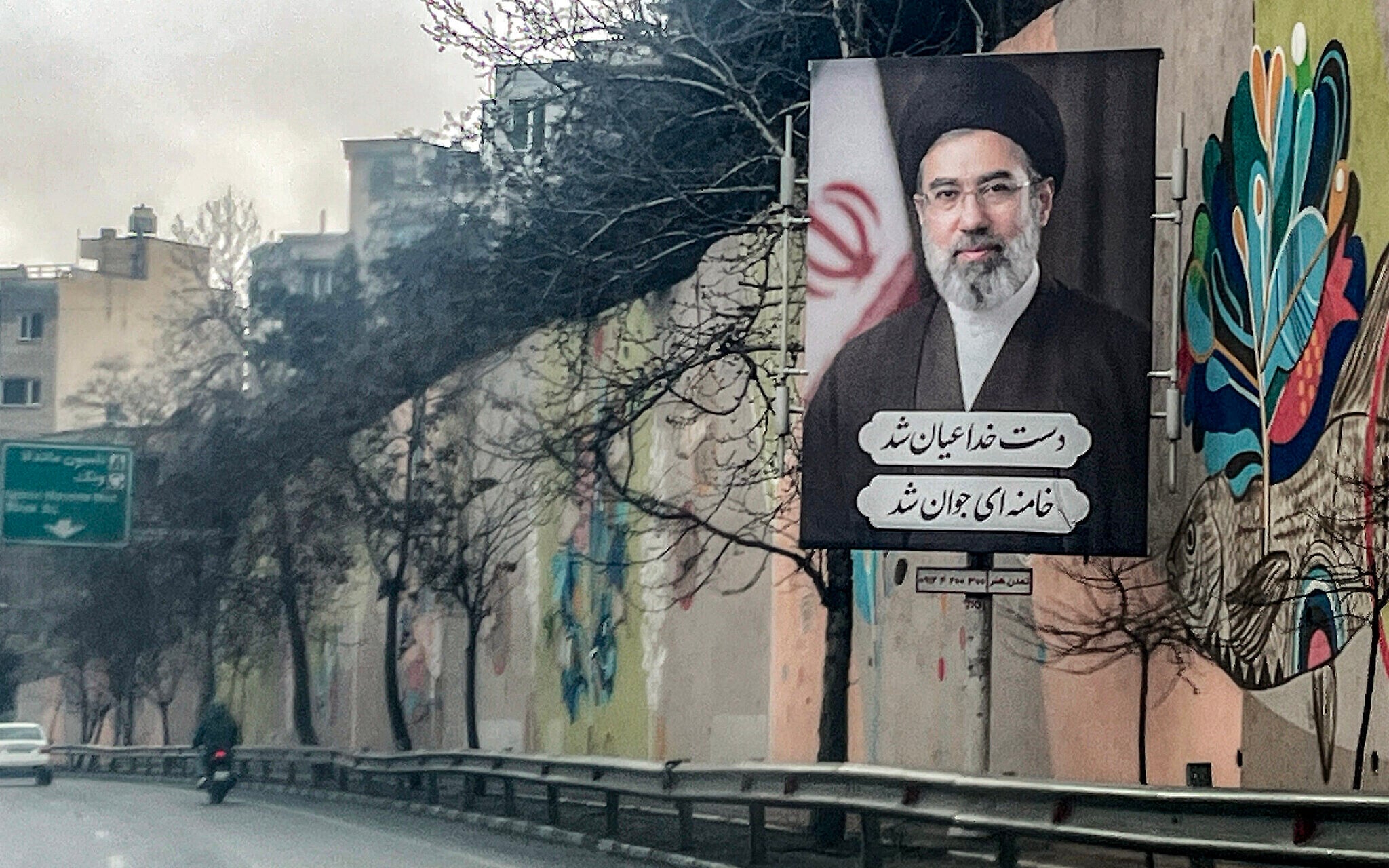
A banner depicting Iran's new Supreme Leader Ayatollah Mojtaba Khamenei is displayed on the side of a highway in Tehran on March 10, 2026. (AFP)
In a statement read out on state TV, Iran’s Supreme Leader Ayatollah Mojtaba Khamenei ostensibly says the leverage of closing the Strait of Hormuz should be used and that Iran’s attacks on Gulf Arab neighbors will continue — arguing that all US bases in the region should be closed as they will be attacked.
His first purported statement since his appointment is read on state television by a news anchor. Khamenei, who was reportedly wounded in the war’s opening salvo, does not appear on camera and is not heard.
In the statement attributed to him, he vows to avenge those killed in the war, including in a strike on a school. He ostensibly says Iran will “obtain compensation” from its enemy, referring to the United States. If it refuses, Iran will “take from its assets” or destroy them to the same extent, he is said to claim.
Police arrest suspect in Ramat Gan stabbing; victim is head of city’s religious council; terror motive checked
Police say they have arrested an individual suspected of stabbing a man in Ramat Gan, after he tried to flee the scene.
The suspected assailant is a 20-year-old from the Arab village of Jatt, police say.
Police are checking whether the stabbing is terror-related.
The victim, 47-year-old Gedalyahu Ben Shimon, is the head of Ramat Gan’s religious council.
He is in serious condition after sustaining several stab wounds, medics say. He is being treated in Tel Aviv Sourasky Medical Center- Ichilov.
In bombshell, top IDF lawyer nixes charges against troops accused of abusing Palestinian detainee in 2024
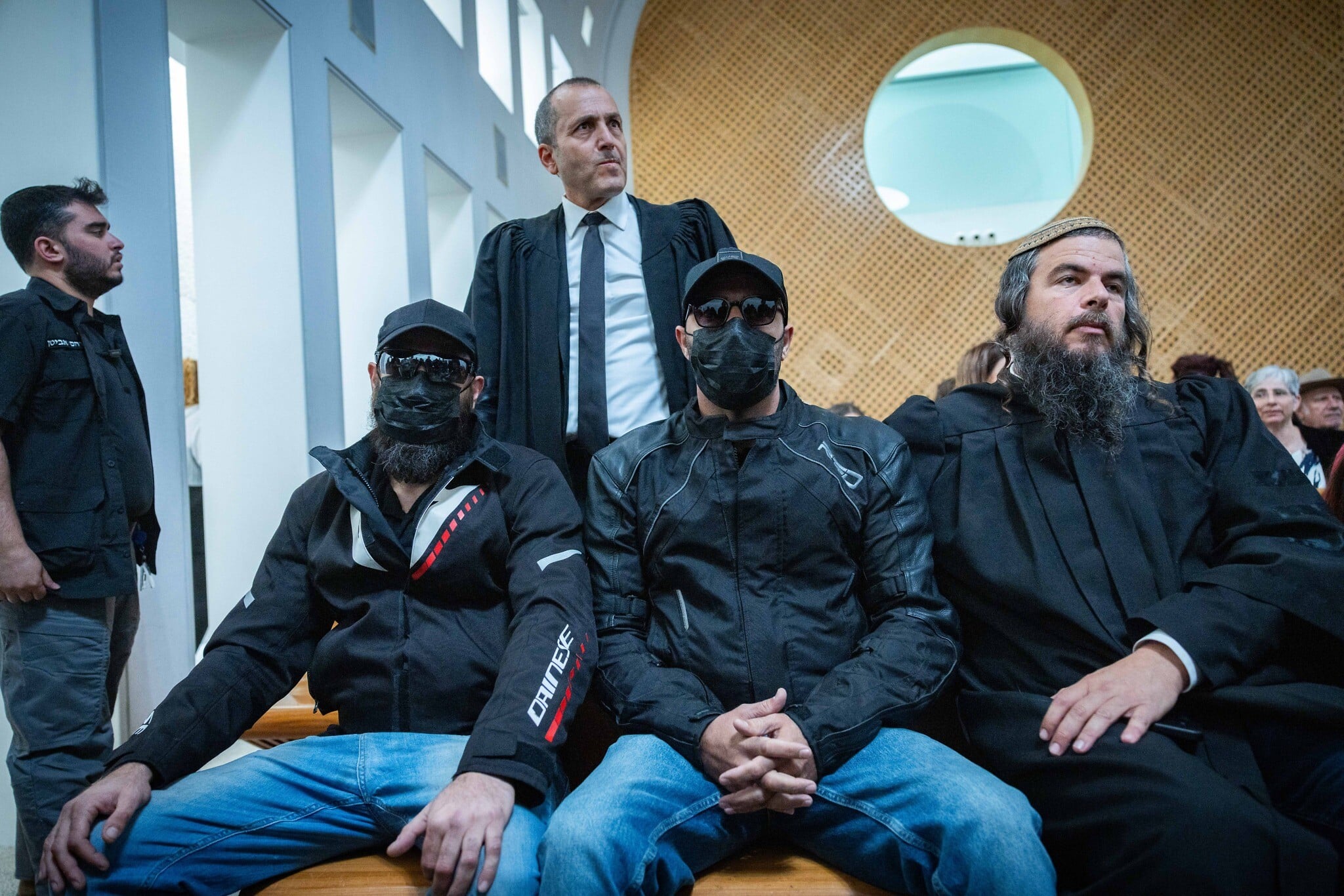
IDF soldiers accused of abusing a Palestinian detainee at the Sde Teiman detention facility appear at a High Court hearing on the investigation into the leak of the video showing the alleged abuse, at the High Court in Jerusalem, November 27, 2025. (Yonatan Sindel/Flash90)
In a bombshell decision, Military Advocate General Maj. Gen. Itai Ofir has ordered the cancellation of an indictment against five IDF reserve soldiers who were accused of severely abusing a Palestinian detainee at the Sde Teiman detention facility in 2024.
According to the indictment filed last year, the five soldiers severely beat and assaulted the prisoner after he was brought to the detention facility, leaving him with severe injuries, including broken ribs and an internal tear in his rectum.
The IDF says the decision to cancel the charges follows “significant developments” in the case since the indictment was filed and a review of all considerations, evidence and relevant circumstances.
Among the reasons listed by the IDF for canceling the charges are “complexity regarding the existing evidence”; the release of the detainee back to Gaza in the October 2025 ceasefire; “the conduct of senior officials in the Military Advocate General’s (MAG) Corps and in the IDF’s law enforcement system in this case, and its exceptional and unprecedented circumstances” — an apparent reference to former MAG Maj. Gen. Yifat Tomer-Yerushalmi, who leaked a surveillance video to Channel 12 news while the indictments were being prepared; and “procedural difficulties” regarding the transfer of investigative materials from a police investigation, “in a manner that harms the defendants’ right to a fair trial.”
“The accumulation of all these exceptional circumstances, and their impact on the fundamental and basic right to a fair trial, requires, in the view of the military advocate general, the cancellation of the indictment,” the IDF says.
The military says Ofir updated IDF Chief of Staff Lt. Gen. Eyal Zamir on the decision, and that Zamir “strengthens, appreciates and backs the military advocate general and expressed to him his appreciation for the process carried out since he entered the position.”
The IDF says that “in light of the serious professional failure that was revealed,” Zamir also “instructed that lessons be learned and that all necessary steps be taken to prevent similar cases in the future.”
Tomer-Yerushalmi resigned from the military over the leak, and several other top officials in the MAG Corps were suspended from service. The IDF says that Zamir has instructed that the “personnel proceedings” be completed as soon as possible.
Homesh settlement repopulated, over 20 years after Disengagement
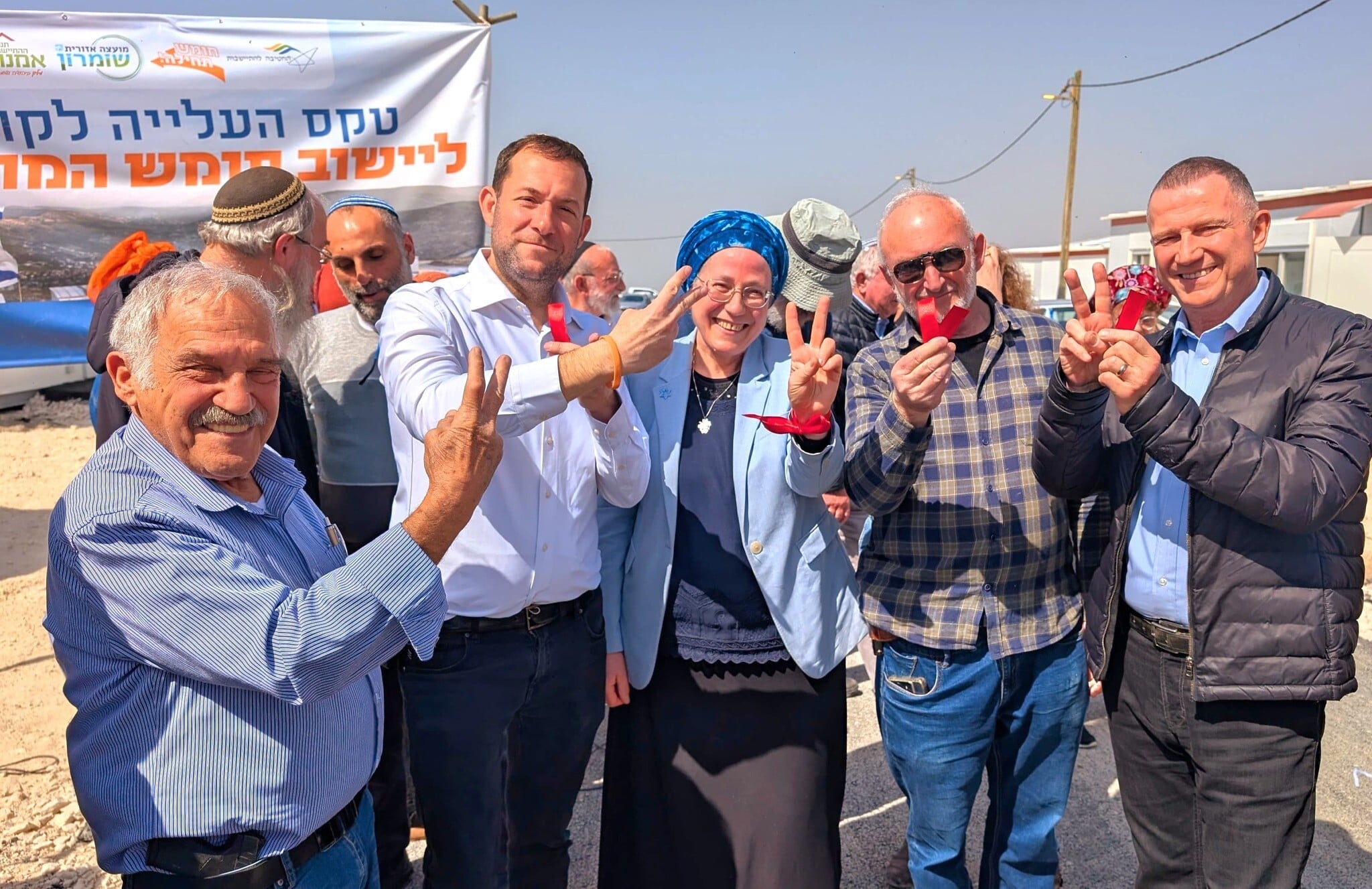
An inauguration ceremony for the repopulated West Bank settlement of Homesh, more than 20 years after it was evacuated in the 2005 disengagement, March 12, 2026, in a photo distributed by the Samaria Regional Council. (Roy Hadi)
Ten families take up residence in the settlement of Homesh in the West Bank, in the final step of a lengthy process to legalize and repopulate the settlement that was evacuated in 2005 as part of the Gaza Disengagement.
The new residents formally resettle Homesh in a celebratory ceremony attended by Settlements and National Missions Minister Orit Strock, Likud MK Yuli Edelstein, chairman of the Samaria Regional Council Yossi Dagan, head of the Amana settlements organization Ze’ev Hever, and other pro-settlement dignitaries.
Homesh was evacuated with three other northern West Bank settlements — Sa Nur, Ganim and Kadim — in 2005 as part of the Ariel Sharon government’s plan to afford Palestinians territorial contiguity in the region.
The settlement movement long chafed at the dismantlement and evacuation of these settlements, and in 2023, the government, spearheaded by Edelstein, repealed the legislation that had enabled their evacuation.
In May 2025, the cabinet approved the legalization of Homesh, which has been rebuilt on a slightly different site, as well as Sa Nur, although the latter is yet to be repopulated.
“We chose Homesh as the arrowhead to lead the rectification for all the sins of the Disengagement, the sins of Oslo and the betrayal of the Land of Israel,” says Strock at the ceremony.
The current government has established or legalized 69 new settlements, and some 120 illegal settlement outposts have been built on its watch. The EU and other countries have strongly criticized the government’s deepening control of the West Bank and expansion of the settlements.
Reports: Gazan shot dead by Hamas in recent days; two others seriously wounded
The family of Assad Abu Mahdi, a resident of the Nuseirat refugee camp in central Gaza, says he was shot dead by Hamas forces at a police checkpoint. According to the family, he was killed while sitting in his car with his son and “was not involved in any political activity in any way.”
The London-based newspaper Asharq Al-Awsat reports that after the family on Tuesday demanded accountability from Hamas under tribal law, which calls for blood revenge, Hamas attempted to send a delegation to the family to reach a resolution and prevent retaliation, but the family refused.
Meanwhile, Gaza-based media outlets have reported that Hamas shot and severely injured Muhammad Abu Omara yesterday in the Deir al-Balah area. The motive is unclear, though one report said Abu Omara was involved in facilitating the entry of aid into the Strip.
In addition, reports on social media say that earlier this week, Ashraf Nasser Salah, a Gazan who had expressed support for peace with Israel, was beaten by Hamas operatives and seriously wounded.
IDF warns central Beirut residents to evacuate area of Hezbollah target, in rare warning outside Dahiyeh
The IDF issues an evacuation warning for a building in central Beirut, ahead of an airstrike on Hezbollah targets.
“Urgent warning to the residents of Beirut, specifically the Bashoura neighborhood. You are located near a facility belonging to the Hezbollah terror organization, which the IDF will act against,” says army spokesman Col. Avichay Adraee, attaching a map showing the building.
Civilians are instructed to distance themselves at least 300 meters from the site.
The building is located in central Beirut, near St. Joseph University. It is rare for the IDF to strike outside of Beirut’s southern suburbs, a known Hezbollah stronghold.
Earlier, the IDF again reiterated an evacuation warning for the southern suburbs of Beirut, known as the Dahiyeh.
#عاجل ‼️انذار عاجل إلى سكان بيروت وتحديدًا حي الباشورة
⭕️الى كل من يتواجد في المبنى المحدد بالأحمر في الخريطة المرفقة والمباني المجاورة له: أنتم تتواجدون بالقرب من منشأة تابعة لحزب الله الإرهابي والتي سيعمل ضدها جيش الدفاع.
⭕️حرصًا على سلامتكم وسلامة أفراد عائلاتكم عليكم اخلاء… pic.twitter.com/s8Br4mcUOa
— افيخاي ادرعي (@AvichayAdraee) March 12, 2026
Two US sailors injured after noncombat fire aboard aircraft carrier in Red Sea
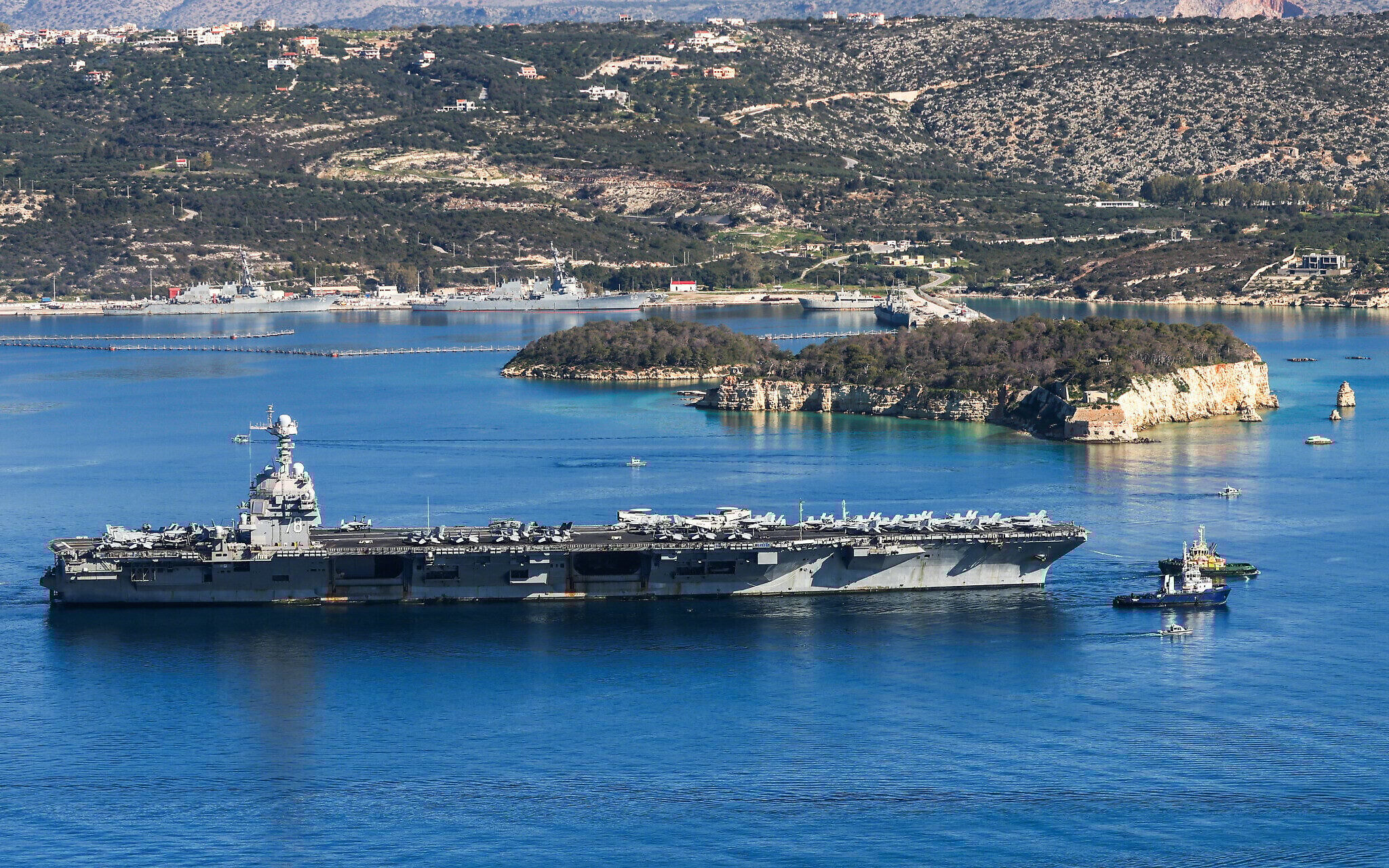
The US Navy aircraft carrier USS Gerald R. Ford, dispatched to the region amid tensions with Iran, departs Souda Bay on the Greek island of Crete on February 26, 2026. (Costas METAXAKIS / AFP)
Two US sailors were injured after the USS Gerald Ford suffered a noncombat-related fire on board, the US military says.
In a statement, the military says the sailors are receiving medical treatment for non-life-threatening injuries and are in stable condition.
“There is no damage to the ship’s propulsion plant, and the aircraft carrier remains fully operational,” the military says.
The carrier is taking part in operations against Iran and is currently located in the Red Sea.
IDF says 2 Palestinians who attempted shooting, car-ramming attack in West Bank shot dead
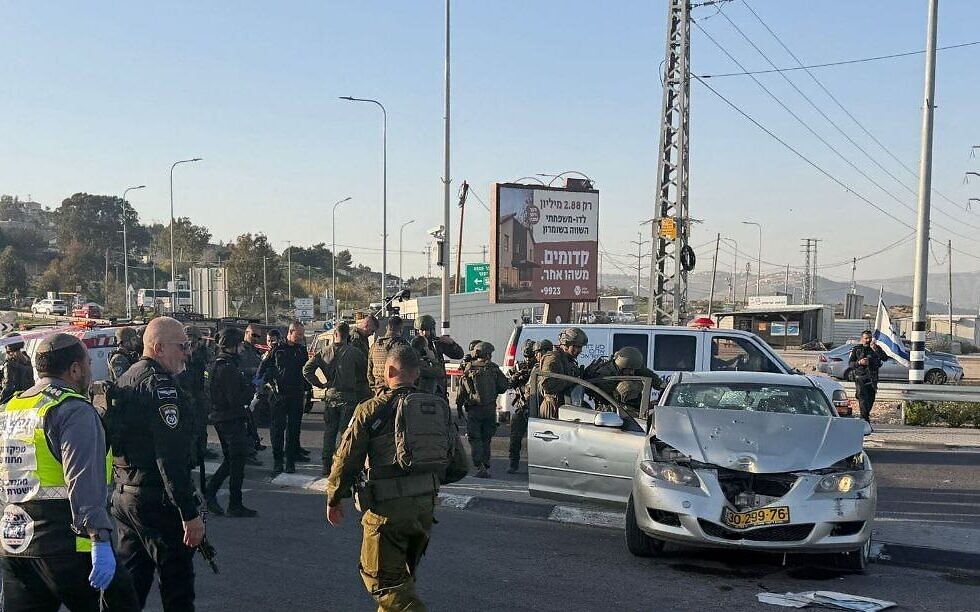
The scene of an attempted car-ramming and shooting attack against IDF troops near Tapuah Junction at the West Bank, March 12, 2026. (Rescuers Without Borders)
The IDF says troops have shot dead two Palestinians who attempted to carry out a car-ramming and shooting attack against Israeli forces near Tapuah Junction in the West Bank a short while ago.
“The troops responded with fire and neutralized the terrorists,” the army says, adding that no soldiers were hurt.
According to an initial military investigation, the two gunmen opened fire at an army post, then fled in their vehicle toward the junction where they tried to ram into soldiers.
Both assailants were shot dead, first responders say.
IDF strikes Hezbollah rocket launcher used in recent barrage toward Galilee
The IDF says it struck and destroyed a Hezbollah rocket launcher in southern Lebanon used in a barrage a short while ago on the Western Galilee.
No injuries were reported in the rocket attack.
בסגירת מעגל מהירה: צה״ל תקף בדרום לבנון את המשגר ממנו בוצעו השיגורים לעבר הגליל המערבי לפני זמן קצר pic.twitter.com/GjQIHllQON
— צבא ההגנה לישראל (@idfonline) March 12, 2026
Germany steps up security for Israeli, Jewish, American institutions
Germany has ramped up security in and around Israeli, Jewish and US institutions since the two countries started their war on Iran last month, German Chancellor Friedrich Merz says.
“At present, there is no evidence to suggest that we should assume an increased threat domestically,” Merz says in a speech in Wiesbaden.
“However, we are stepping up security measures, reviewing protective measures and increasing our presence – particularly for Israeli, Jewish and American institutions,” he adds.
Trump: Iran’s soccer team can attend World Cup, but ‘I really don’t believe it is appropriate’
US President Donald Trump says Iran’s national soccer team will be allowed to attend the World Cup in the US later this year.
“I really don’t believe it is appropriate that they be there, for their own life and safety,” Trump adds on Truth Social, where he makes the announcement.
Trump has a good relationship with the president of FIFA, who has been urging him to allow the Iranian team to participate.
Six members of Iran’s national women’s team sought and were granted asylum while playing in Australia last week.
Sirens in Kiryat Shmona area warn of suspected drone attack from Lebanon
Sirens sound in Kiryat Shmona and surrounding towns, warning of a suspected drone attack from Lebanon.
Last night, Hezbollah launched some 20 drones at northern Israel, the vast majority of which were intercepted according to the IDF.
Minister says repatriation of all Israelis stranded in UAE to be completed by Saturday
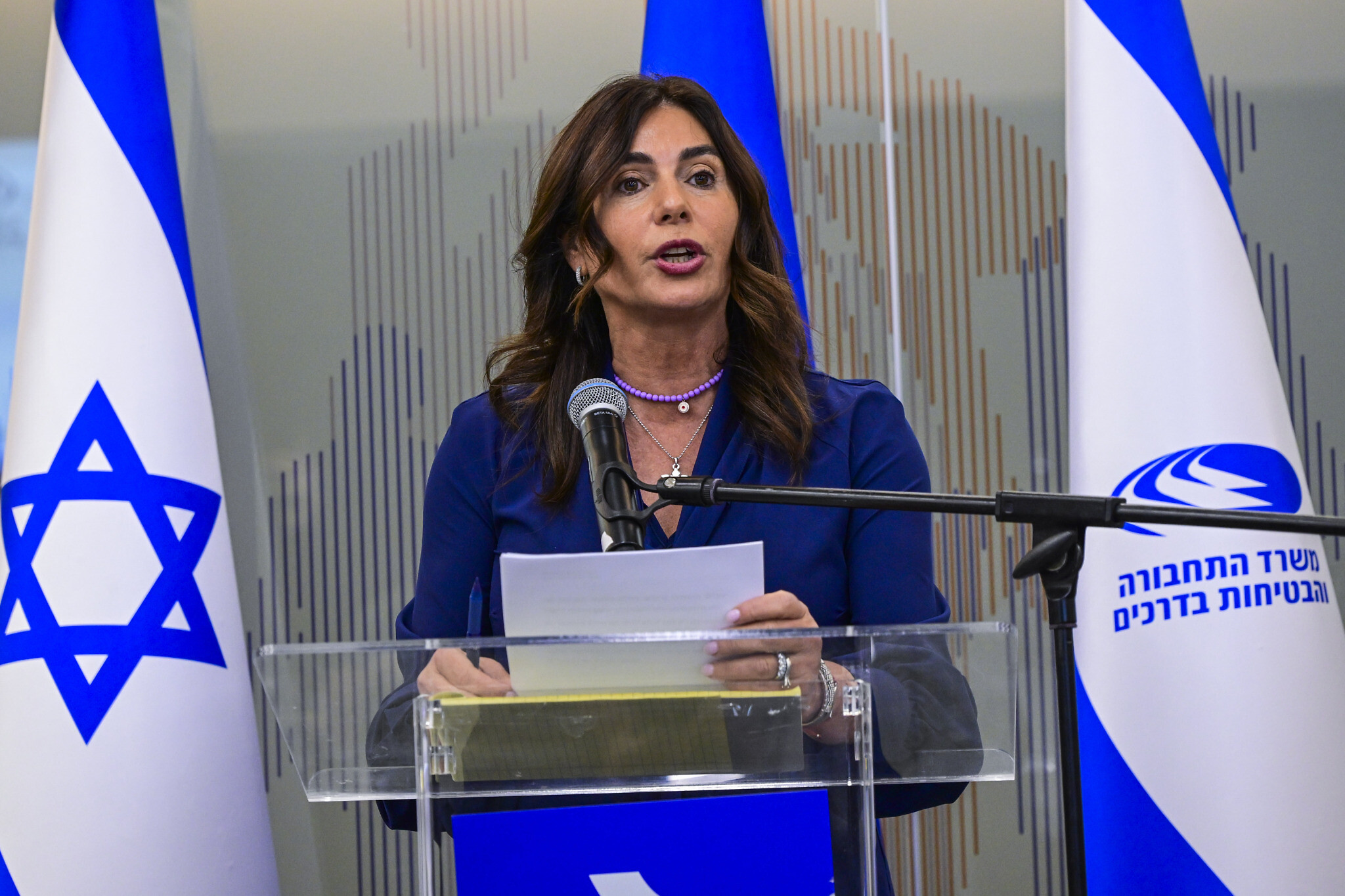
Transportation Minister Miri Regev speaks at a press conference in Lod, March 12, 2026. (Avshalom Sassoni/Flash90)
Transportation Minister Miri Regev says the operation to repatriate all Israelis stranded in the United Arab Emirates amid the Iran war is expected to be completed on Saturday night.
“If the security situation does not change, the operation to rescue thousands of Israelis from the Emirates will be over by the end of Shabbat,” Regev says at a press conference.
Regev calls on Israelis not to travel to or via the Emirates, emphasizing that there is a travel warning from the National Security Council.
A total of 1,790 Israelis arrived at Ben Gurion Airport today from the Emirates, and another 320 passengers are expected to arrive tonight. According to the Israel Airports Authority, there are still 1,150 Israelis in the UAE.
The repatriation flights are part of an operation led by the Transportation Ministry to fly home thousands of Israelis stranded mainly in Dubai and Abu Dhabi since the joint US-Israel attack on Iran on February 28. The repatriation operation, which was launched earlier this week, comes as Iran has been firing missiles and drones at Israel, the UAE and other countries in the region.
Regev adds that in the coming days, Israel will increase commercial flights from Bangkok, Phuket and Japan to help bring back an estimated 8,000 Israelis from Southeast Asia.
Since the partial reopening of the country’s skies on March 4, about 100,000 Israelis have returned home via repatriation flights landing at Tel Aviv’s Ben Gurion Airport and via land border crossings with Egypt and Jordan, Regev says.
IDF launches wave of strikes on Hezbollah targets in various parts of Beirut
The Israeli Air Force has begun a wave of strikes against Hezbollah infrastructure across Beirut, the IDF announces.
Earlier, the IDF issued an evacuation warning for a building in central Beirut, as well as reiterating a wider evacuation for the Lebanese capital’s southern suburbs, a Hezbollah stronghold.
IDF says commander, top members of Iranian militia in Lebanon were killed last night
The commander of the Imam Hossein Division, an Iranian militia that operates alongside Hezbollah, was killed along with his deputy and other commanders in an airstrike in Lebanon last night, the military says.
The Imam Hossein Division commander is named by the IDF as Ali Musallam Tabaja. The military says he was appointed to the role after the previous commander was killed by Israel in October 2024.
“This is an Iranian division of the Revolutionary Guards whose role is to attack Israel from Lebanese territory. For years, we have been trying to locate and eliminate them. Last night, while they were managing the fire toward Israel, they were eliminated within seconds,” IDF Chief of Staff Lt. Gen. Eyal Zamir says in a video statement.
According to the IDF, also killed in the strike last night were Jihad al-Safira, the deputy division commander; Sager al-Handasa, the division’s UAV officer; and a number of other top commanders.
IDF chief apologizes for failure to notify public of planned Hezbollah attack last night
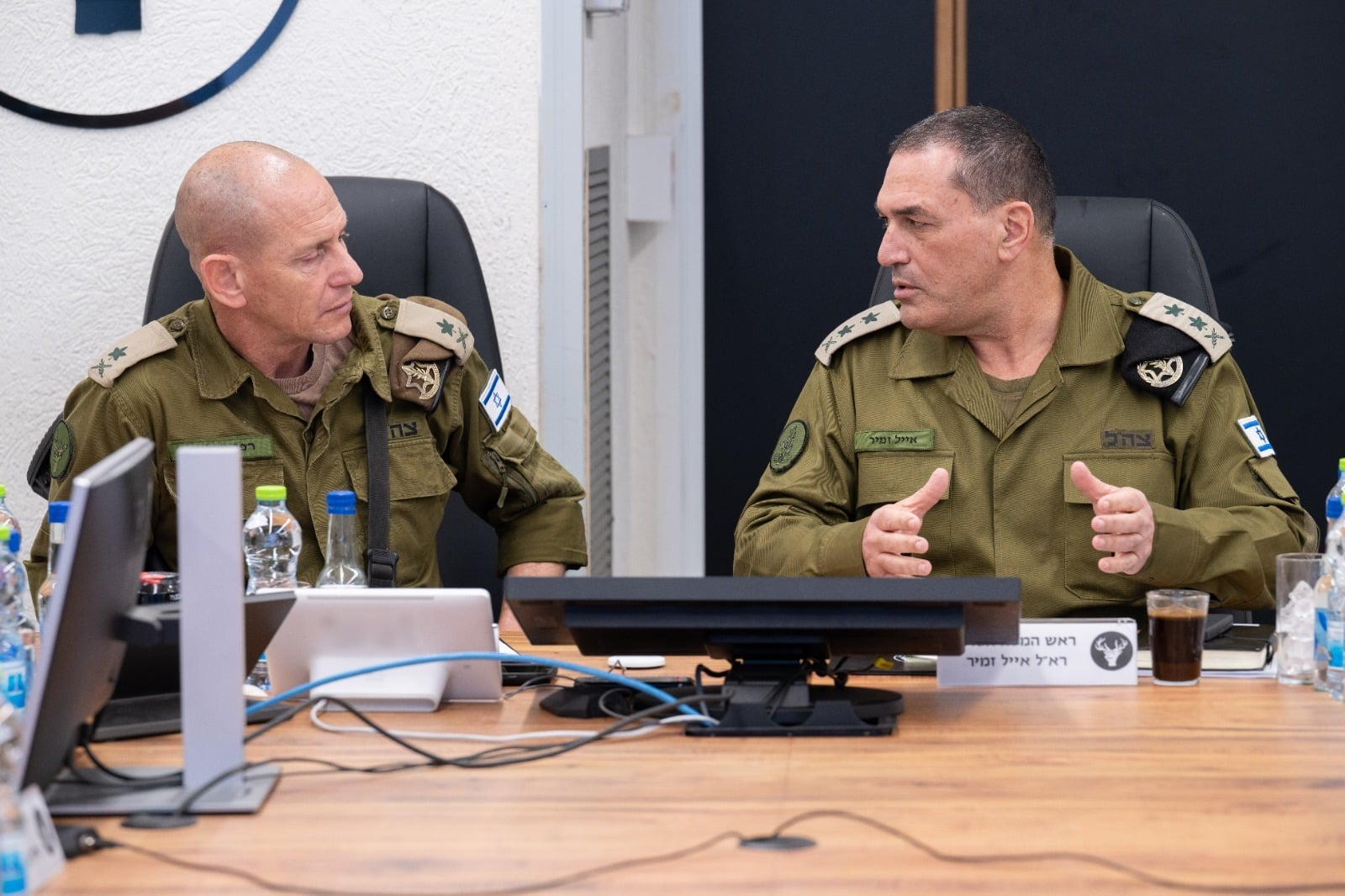
IDF Chief of Staff Lt. Gen. Eyal Zamir (left) meets with Northern Command chief Maj. Gen. Rafi Milo at the Northern Command HQ in Safed, March 12, 2026. (Israel Defense Forces)
IDF Chief of Staff Lt. Gen. Eyal Zamir apologizes to the Israeli public for not notifying in advance about Hezbollah’s large rocket and drone attack on northern Israel last night, even as assessments of the planned barrage were leaked.
“Yesterday, an intelligence warning emerged. Following it, we prepared for incoming fire, carried out strikes, disrupted Hezbollah’s intentions, reinforced the air defenses, and thwarted most of the threat. Most of the launchers were neutralized within minutes,” Zamir says in a video statement following a visit to the Northern Command today.
“Yesterday evening, a sense of lack of clarity arose among the public regarding the defensive guidelines. If there was a mistake, and my starting point is that there was, I, as chief of staff, am responsible for everything,” he says.
“Public trust is the most important asset of the IDF, and if it has been harmed, I regret it; we will investigate and learn,” Zamir adds.
IDF issues evacuation warning for another area of central Beirut
The IDF issues an evacuation warning for another building in central Beirut ahead of an airstrike on a Hezbollah site.
“Urgent warning to the residents of Beirut, specifically the Zokak el-Blat neighborhood. You are located near a facility belonging to the Hezbollah terror organization, which the IDF will act against,” says army spokesman Col. Avichay Adraee, attaching a map showing the building.
Civilians are instructed to distance themselves at least 300 meters from the site.
It is the second building in central Beirut that the IDF has ordered to evacuate in the past hour, as it carries out a wave of strikes on Hezbollah targets.
#عاجل ‼️انذار عاجل إلى سكان بيروت وتحديدًا حي زقاق البلاط
⭕️الى كل من يتواجد في المبنى المحدد بالأحمر في الخريطة المرفقة والمباني المجاورة له: أنتم تتواجدون بالقرب من منشأة تابعة لحزب الله الإرهابي والتي سيعمل ضدها جيش الدفاع.
⭕️حرصًا على سلامتكم وسلامة أفراد عائلاتكم عليكم… pic.twitter.com/lhZBsMKqVs
— افيخاي ادرعي (@AvichayAdraee) March 12, 2026
Netanyahu, others hail dropping of ‘blood libel’ charges in Sde Teiman abuse case; rights group accuses IDF of whitewashing
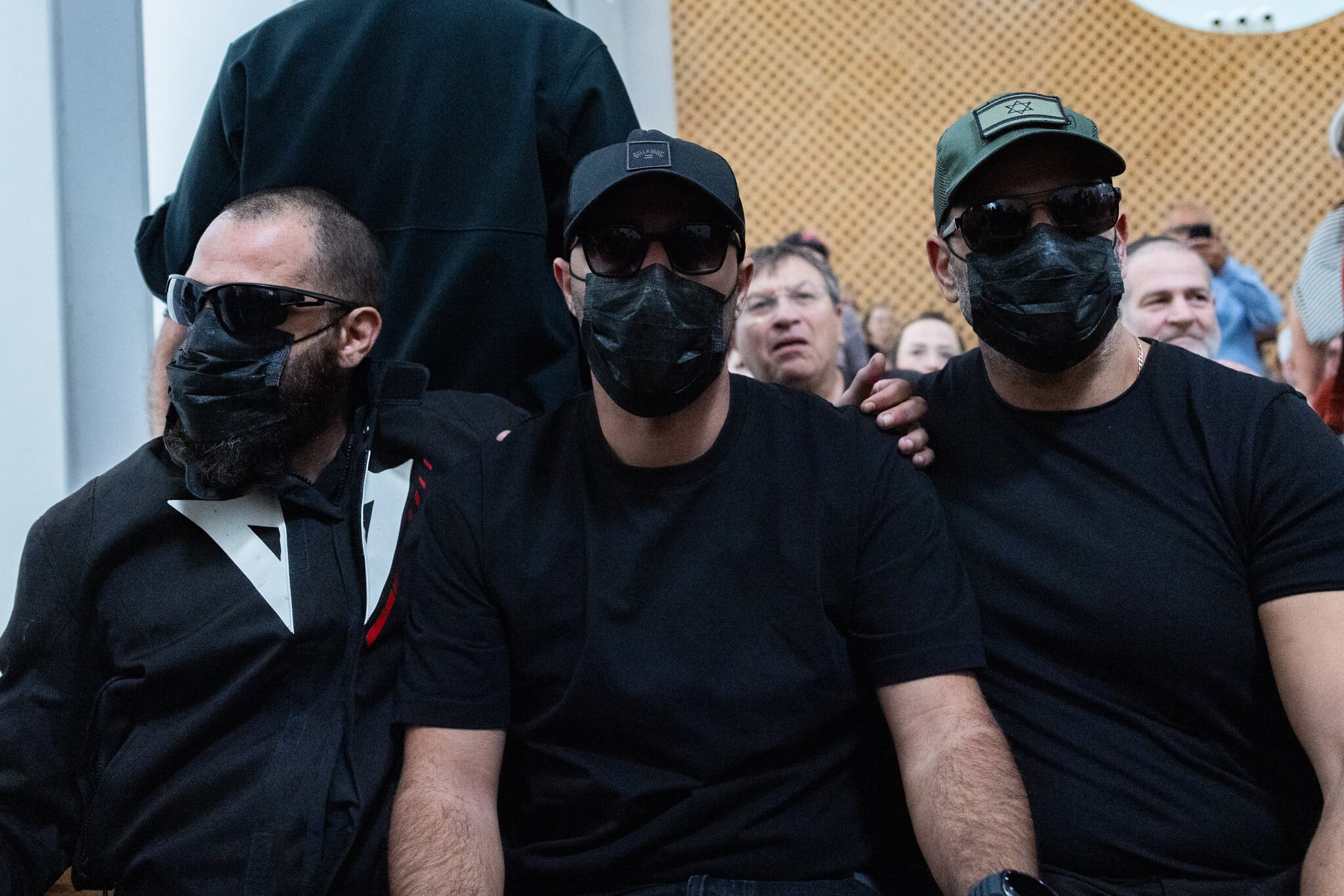
IDF reserve soldiers accused of abusing a Palestinian security detainee at the Sde Teman detention center attend a High Court hearing on who will have authority over the Sde Teiman leak investigation, November 11, 2025. (Yonatan SIndel/Flash90)
Prime Minister Benjamin Netanyahu’s office and others in his government welcome the cancellation of a 2024 indictment against IDF reserve soldiers accused of abusing a Palestinian detainee at the Sde Teiman detention facility.
“The blood libel known as the ‘Sde Teiman affair’ against the fighters of Force 100, which smeared Israel’s reputation around the world in an unprecedented way, has come to an end,” the Prime Minister’s Office says in a statement, shortly after Military Advocate General Maj. Gen. Itai Ofir ordered the cancellation.
“It is unacceptable that it took so long to close the case, which was conducted in a criminal manner against IDF soldiers who are confronting the worst of our enemies. Israel must pursue its enemies, not its heroic fighters,” the statement concludes.
Defense Minister Israel Katz, who selected Ofir for the role, also hails the decision, saying that “justice has been done.”
“This trial was born in sin by the previous military advocate general, using a blood libel against IDF soldiers and criminal investigative methods, and I am glad that justice has been done and the trial has been canceled,” he says.
National Security Minister Itamar Ben Gvir similarly lauds the move, saying it constitutes “an indictment of the justice system, the previous military advocate general, and Attorney General Gali Baharav-Miara” — accusing them of falsifying a case against the indicted soldiers.
“Those who need to be held accountable for this grave affair are those officials in the legal system who took part in this criminal conduct and damaged the good name of IDF soldiers,” adds the far-right minister, who has implemented harsh conditions for Palestinian security prisoners.
Diaspora Affairs Minister Amichai Chikli likewise calls the indictments “a blood libel” and says they did “unprecedented damage” to Israel’s image abroad.
In contrast, the Public Committee Against Torture in Israel accuses Ofir of whitewashing the Sde Teiman abuse scandal.
“The condition in which the detainee arrived at the hospital after being attacked in the detention facility leaves no room for doubt as to the acts committed against him and their severity, and the footage released from the security cameras at the scene clearly indicates that these [acts] were inflicted on him by the guards, who abused him with blood-curdling cruelty for a long time,” the organization says.
The original indictment against the five defendants cited medical records from the hospitalization of the detainee that testified to the severe wounds he had sustained in Sde Teiman, including broken ribs and a tear to his rectum. Numerous reports have found evidence of severe abuse at Sde Teiman by IDF soldiers and other security services personnel.
California governor sees no imminent Iran threat despite FBI warning about possible drone attack
California Governor Gavin Newsom seeks to downplay the recent FBI warning about a potential Iranian drone attack.
“We’ve been aware of that information,” the Democrat says. “It’s all about a posture of preparedness for worst-case scenarios.”
The FBI warned police departments before the war that Iran could try to strike the US state.
“Iran allegedly aspired to conduct a surprise attack using unmanned aerial vehicles from an unidentified vessel off the coast of the United States Homeland, specifically against unspecified targets in California, in the event that the US conducted strikes against Iran,” the alert said, according to ABC News.
The FBI alert said it had no additional information.
Putin’s ‘hidden hands’ may be influencing Iran’s drone tactics, says UK defense secretary
Britain’s Defense Secretary John Healey says Russian leader Vladimir Putin is possibly helping Iran with drone tactics in its attacks on Western bases and positions in the Middle East.
“At the moment, we’re taking part in analyzing the drone that struck the hangar at Akrotiri [Cyprus] for any evidence of Russian or any other foreign components and parts,” Healey says in a press conference, according to UK media.
“We will update you and appropriately publish any findings from that when we’ve got them, but I think no one will be surprised to believe that Putin’s hidden hand is behind some of the Iranian tactics, potentially some of their capabilities as well, not least because one world leader that is benefiting from the sky high oil prices at the moment is Putin,” he says. “It helps him with a fresh supply of funds for his brutal war in Ukraine.”
Iran has allowed ships from some countries to cross Strait of Hormuz, deputy FM says
Iran has allowed ships from some countries to cross the Strait of Hormuz, deputy foreign minister Majid Takht-Ravanchi says, denying the Islamic Republic is laying mines there as the waterway remains effectively closed during the war with the US and Israel.
“Some countries have already talked to us about passing the strait and we have cooperated with them,” says Takht-Ravanchi during an interview with AFP in Tehran.
“As far as Iran is concerned, we feel that those countries that joined the aggression should not benefit from safe passage through the Strait of Hormuz,” he says.
Takht-Ravanchi adds that Iran is not laying mines in the strait, after US President Donald Trump said US forces had struck 28 Iranian minelaying vessels in the waterway.
“Not at all. This is not true,” he says when asked about reports of Iran laying mines in the strategic waterway.
He also says Iran wants to ensure that a war will not be imposed on it again in the future.
“We want to see that war is not going to be imposed again on Iran,” says Takht-Ravanchi. “When the war started last June, after 12 days there was so-called cessation of hostilities… but after eight or nine months, they regrouped and they did it again.”
UK says US troops injured last night in drone attack on base in Iraq
UK Brig. Guy Foden says a number of drones last night hit a base in Erbil in northern Iraq that houses both British and American troops, and that several US personnel have been injured.
Another officer, Lt. Gen. Nick Perry, says there are no British casualties in last night’s attack, and that the US casualties are “nothing too serious.”
Trump endorses Brandon Herrera, Texas GOP candidate who owned copy of ‘Mein Kampf’

Brandon Herrera, a firearms YouTuber and US congressional candidate, poses with a bust of Hitler in a March 2025 video. (Screenshot via YouTube; used in accordance with Clause 27a of the Copyright Law)
US President Donald Trump endorses Brandon Herrera, the de facto GOP nominee for a Texas congressional district whose past comments about Nazis have drawn scrutiny.
“Brandon is strongly supported by many Highly Respected MAGA Warriors in Texas, and Republicans in the U.S. House,” the president writes on his social network Truth Social about the gun-enthusiast YouTuber. Trump adds that Herrera would “[p]rotect our always under siege Second Amendment” and concludes: “HE WILL NEVER LET YOU DOWN!”
Herrera won his primary race after his opponent, incumbent Rep. Tony Gonzales, admitted to having conducted an affair with a former staffer who later died by suicide. Gonzales withdrew from his reelection bid, which was scheduled for a runoff, as a House investigation opened into his conduct.
Herrera is best known for his Second Amendment advocacy that has included criticizing a gun-control bill drafted in the wake of the 2022 Uvalde school shooting in the district he hopes to lead. His output has also included reviews of Nazi-era weaponry, a recreation of Hitler’s suicide, and the occasional Holocaust joke.
In 2024, on his own podcast, Herrera also discussed owning a copy of “Mein Kampf,” Hitler’s manifesto. The resurfaced clip recently raised eyebrows, though Herrera and the other podcast hosts lauded Dorothy Thompson, an American journalist expelled from Nazi Germany who panned the book in 1939, and joked about his remarks being edited to sound like he was a Nazi. Herrera recently said he didn’t agree with its “teachings.”
During their 2024 matchup, Gonzales had called his opponent a “known neo-Nazi,” which Herrera disputes. Trump’s endorsement of Herrera stands in contrast to the Republican Jewish Coalition, whose spokesperson told Jewish Insider will continue to oppose him.
A spokesperson for Herrera’s campaign rejects accusations of antisemitism in a statement to the Texas Tribune.
“Brandon has never done or said anything antisemitic, and he has earned the support of leaders in the Jewish community,” campaign manager Kimmie Gonzalez tells the news outlet. “In Brandon’s work as a historical firearms educator, he has simulated the execution and poisoning of Adolf Hitler. The misleading clip about Brandon’s rare book collection omits his comments ridiculing and condemning Hitler’s book.”
The campaign does not immediately return a Jewish Telegraphic Agency request to specify which Jewish communal leaders are supporting Herrera. Texas’s 23rd Congressional District stretches across the state’s southwestern region and includes parts of San Antonio and the outskirts of El Paso.
Iran says many ships can pass through Strait of Hormuz if they coordinate with Iranian navy
Many ships can still pass through the Strait of Hormuz if they coordinate with the Iranian navy, Iran’s Foreign Ministry spokesperson Esmaeil Baghaei says in comments carried by Mehr news agency.
“After the current events, generally we cannot return to conditions before February 28” — when the current Iran war started — “as we have understood how important the safety of the Strait of Hormuz is, and so did the others,” the spokesperson adds.
As it hits Beirut, IDF also launches fresh strikes on southern Lebanon
The Israeli Air Force has begun a new wave of strikes against Hezbollah infrastructure in southern Lebanon, the IDF announces.
The strikes come as the IAF also hits Hezbollah sites in Beirut.
The military says it will provide further details on the strikes later.
IDF confirms targeting members of Iran’s Basij in Tehran strikes over past day
The IDF confirms carrying out drone strikes against members of Iran’s Basij paramilitary force in Tehran over the past day, publishing footage of the attacks.
According to the military, the Basij established checkpoints in several areas of Iran’s capital in recent days.
Following the identification, the Israeli Air Force struck the Basij checkpoints and members of the paramilitary force, the IDF says.
Iranian media reported that several members of Iran’s internal security forces and Basij stationed at the checkpoints were killed.
“These armed forces are part of the Iranian regime’s security apparatus and have for years been responsible for carrying out terror activities,” the military says, adding that “these forces lead the main repression operations against internal protests, particularly in the recent period, using severe violence, widespread arrests, and the use of force against civilian demonstrators.”
Drone strikes are carried out by the Israeli Air Force against checkpoints and soldiers of Iran’s Basij paramilitary force in Tehran, in footage published by the military on March 12, 2026. (Israel Defense Forces)
UN chief renews call for end to war, return to negotiations
UN Secretary-General Antonio Guterres says the US-Israeli military strikes, followed by Iran’s retaliatory attacks, have caused “immense suffering” and pushed the region to a breaking point.
“And as always, the most vulnerable are being hurt first and worst,” Guterres says. “De-escalation and dialogue are the only way out.”
He makes the comments in the Turkish capital, where he has received the country’s peace prize on behalf of the global UN staff.
US says it has struck around 6,000 targets since start of Iran war
The United States has struck around 6,000 targets since the start of the war against Iran late last month, the US military says.
Among the targets hit are more than 90 Iranian vessels — around 60 ships and 30 minelayers — the US Central Command, which is responsible for American forces in the region, the military says.
‘Active security incident’ reported at Michigan synagogue
The Jewish Federation of Detroit reports an “active security incident” at Temple Israel, a Reform congregation in the area.
“Law enforcement are responding. Our Jewish agencies are currently in precautionary lockdown,” the federation says in a statement.
Michigan police confirm ‘active shooting’ at Detroit-area synagogue
The Michigan State Police confirm an “active shooting incident” at Temple Israel, in West Bloomfield, near Detroit.
“We are asking for community members to stay away from the area to allow for police response,” police say in a statement. “Troopers are also increasing patrols at other places of worship in the district.”
There is no immediate information on casualties.
BREAKING: A vehicle deliberately crashed into the Temple Israel synagogue in West Bloomfield, Michigan. Smoke can be seen coming from the building. Shots were fired following the impact, and the vehicle subsequently caught fire. Officials have described the incident as… pic.twitter.com/a0ip5JhisS
— World Source News (@Worldsource24) March 12, 2026
FBI director says Michigan synagogue attack was a vehicle ramming and shooting
FBI Director Kash Patel says the agency’s personnel are at the scene of an “apparent vehicle ramming and active shooter situation” at Temple Israel, near Detroit.
Michigan governor laments ‘heartbreaking’ attack on Jewish community
Michigan Governor Gretchen Whitmer condemns a “heartbreaking” attack on the Jewish community, amid early reports of a shooting at a Detroit-area synagogue.
“This is heartbreaking. Michigan’s Jewish community should be able to live and practice their faith in peace. Antisemitism and violence have no place in Michigan. I am hoping for everyone’s safety,” Whitmer says.
Whitmer adds that her office is working with the US state’s police to get more information.
The Secure Community Network, a national Jewish security group, says it is coordinating with law enforcement and community partners.
The international unit of ZAKA, an Israeli volunteer organization that responds to emergencies, says “there are casualties at the scene,” although there are no official confirmations yet.
The Anti-Defamation League’s Michigan branch urges community members to avoid the area.
Netanyahu to give press conference shortly, his first of current Iran war
Prime Minister Benjamin Netanyahu will give a press conference tonight at 8:15 p.m., according to an official in his office. It will be conducted over Zoom.
It will be the first time he has spoken to the Israeli press since the war against Iran began 13 days ago.
IDF says it has sent ground troops further into Lebanon, destroying Radwan Force sites
The IDF publishes bodycam footage of troops operating in southern Lebanon as part of its “enhanced forward defense posture,” after Hezbollah began attacking Israel this month.
The military says that this week, troops of the 91st “Galilee” Regional Division carried out an overnight raid, during which infrastructure sites of Hezbollah’s elite Radwan Force were destroyed.
The IDF says it struck the Hezbollah sites with artillery and airstrikes.
The military has deployed troops deeper in southern Lebanon in the past week, saying it aims to “establish a forward defense that will create an additional security layer for the residents of the north.”
Bodycam footage released by the IDF on March 12, 2026, shows IDF troops operating in southern Lebanon. (Israel Defense Forces)
UAE says it intercepted 10 missiles, 26 drones launched by Iran today
The United Arab Emirates intercepted 10 ballistic missiles and 26 drones launched by Iran today, according to the Emirati defense ministry.
Since the start of the war on February 28, says the UAE, its air defenses have intercepted 278 ballistic missiles, 15 cruise missiles and 1,540 drones. Six people have been killed, all foreigners.
No confirmed casualties yet at Michigan synagogue incident, police say

People gather near Temple Israel synagogue in West Bloomfield Township, Michigan, amid a ramming and shooting attack, March 12, 2026. (AP Photo/Corey Williams)
The sheriff of the Oakland County police, Michael Bouchard, says there are no confirmed casualties yet in the attack on a Detroit-area synagogue.
Bouchard says synagogue security saw the suspected attacker approaching and “they engaged the threat.”
He adds that a “vehicle was involved” and “shots were fired.”
“Nobody at the moment has been confirmed to be hurt except potentially the shooter,” he says.
The information is all preliminary and it remains too early to determine the suspect’s motivation, he says.
Schoolchildren who were at the synagogue have been relocated to a local Jewish Community Center for reunification with their parents, he says.
Michigan synagogue attacker reportedly killed
The suspect who attacked a Michigan synagogue has been killed, multiple US reports say.
Law enforcement sources tell the Associated Press and CNN that the shooter has been killed.
There is no additional information.
The sheriff of Oakland County police, Michael Bouchard, has declined to confirm whether the attacker was killed at a news conference.
“We don’t have that person in custody. It’s a work in progress. That’s why we’re sheltering in place, to figure it out. It’s a big facility with a lot of land around it,” he says.
“We’re looking to see if there’s more than one person. We’re still trying to figure that out. We’re trying to get access to the video,” Bouchard says.
Detroit Jewish federation says lockdowns lifted after synagogue attack
US law enforcement respond to a call at Temple Israel synagogue on March 12, 2026, in West Bloomfield Township, Michigan. (AP Photo/Corey Williams)
The Jewish Federation of Detroit says that Jewish community lockdowns have been lifted following an attack on a local synagogue.
“We have received word that while there is still a large security presence at Temple Israel, all other Jewish organizations are no longer required to be in lockdown or lockout protocol,” the federation says in a statement.
“There will continue to be a strong police and security presence throughout the community. We ask community members to refrain from speculation or sharing unconfirmed information — especially on social media,” the statement says.
Police investigating suspicious behavior at Norway synagogue, one arrested
One suspect has been arrested at a synagogue in Trondheim, Norway, after police investigated suspicious behavior.
Police arrived on the scene with extensive forces, and large areas will be cordoned off, Norway’s Channel 2 reports. Police are searching for a vehicle that left the scene.
The story is developing, and no further information is available yet.
Police had reportedly increased security around the synagogue following the attack on the American embassy in Oslo on March 8, the report says.
Poll: Smotrich’s party passes electoral threshold for first time in months, strengthening pro-Netanyahu bloc
Finance Minister Bezalel Smotrich’s Religious Zionism party passes the electoral threshold for the first time since January with four seats, according to a new poll by The Times of Israel’s Hebrew-language sister site, Zman Yisrael.
At the same time, Prime Minister Benjamin Netanyahu’s ruling Likud falls to 29 seats, from 31 last week, after the start of Israel’s war with Iran.
Despite this, the coalition bloc appears to have strengthened slightly, rising from 53 seats last week to 54, in part due to Religious Zionism passing the threshold, but also because Benny Gantz’s Blue and White fails to do so.
In the opposition bloc, former IDF chief Gadi Eisenkot’s Yashar party continues to gain ground, rising to 15 seats, up from 12 two weeks ago and from 9 three weeks ago.
That bloc also sees an increase from 53 to 56 seats, not including the four Arab parties that signed an agreement in January to work toward running together on a joint list and remain projected to win 10 seats if they end up running separately.
The poll was conducted on March 11-12, 2026, among 500 respondents, controlled by age, religion, gender and place of residence. The margin of error is 4.4%.
IDF launches new wave of ‘extensive’ strikes on Tehran
The Israeli Air Force has launched a new wave of “extensive” airstrikes in Tehran, the IDF announces.
The military says the strikes are targeting Iranian regime infrastructure sites.
WATCH: Netanyahu holding his first press conference of current Iran war
Prime Minister Benjamin Netanyahu is holding his first press conference since the start of the current war with Iran.
Michigan synagogue guard injured; children and staff all safe with everyone accounted for, police say
US law enforcement respond to a call at Temple Israel synagogue on March 12, 2026, in West Bloomfield Township, Michigan. (AP Photo/Corey Williams)
A security guard at the Michigan synagogue attack was wounded, but children and staff there are unscathed, says the sheriff of the Oakland County police, Michael Bouchard.
The attacker “came to the facility, breached the facility by driving into it, was engaged by security.”
He drove a truck through the building’s doors, “drove down the hall,” and “security did engage the suspect with gunfire,” he says. The vehicle is inside the building, he says.
It is unclear how the attacker was killed.
“We believe there is one individual deceased in the vehicle. It’s been complicated because there was some fire, to say the least, with that vehicle. We believe that individual is deceased,” he says. First responders had to enter the hallway with gas masks due to smoke.
“No kids or no staff was injured whatsoever, so we have no victims other than one of the lead security people, who was hit by the car and was taken to the hospital for treatment. That individual should be okay,” he says.
Other security guards pulled the injured member from the scene.
Everyone in the building appears to be accounted for. Law enforcement is sweeping the area for potential explosives.
“We want to ensure the community, there doesn’t appear to be anything active,” he says.
Bouchard says the information is all preliminary and subject to change.
In first press conference since war began, Netanyahu says Israel ‘crushing’ Iran and Hezbollah, mocks IRGC ‘puppet’ Mojtaba Khamenei, who ‘cannot show his face in public’
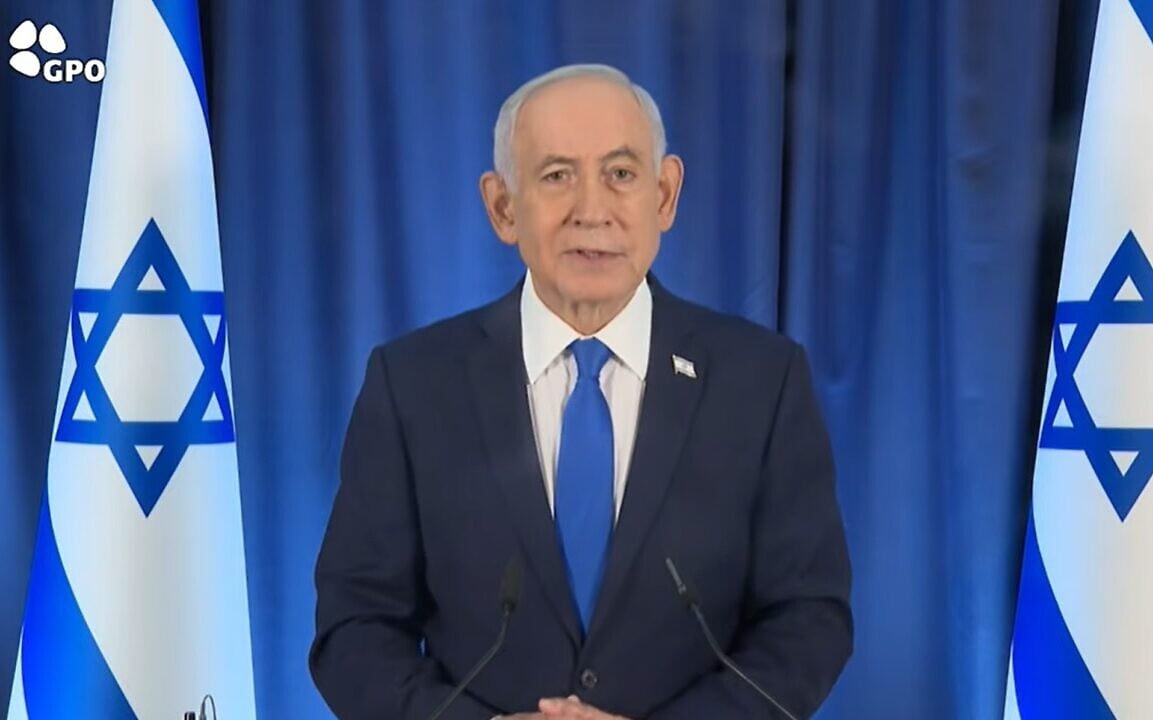
Prime Minister Benjamin Netanyahu holds a press conference on March 12, 2026. (Screenshot/GPO)
Prime Minister Benjamin Netanyahu says Israel is “crushing” the Iranian regime as well as its proxy Hezbollah, in his first press conference since the war with Iran began 13 days ago.
“We are crushing the terror regime in Iran. We are striking and defeating its proxies – Hezbollah in Lebanon,” he tells Israeli reporters in a Zoom conference.
“Hezbollah is feeling our force, and it will feel it even more so. It will pay a very heavy price for its aggression,” Netanyahu warns.
“Through an unprecedented joining of forces between Israel and the United States, we have achieved tremendous accomplishments — achievements that are changing the balance of power in the Middle East and even beyond it,” Netanyahu says.
The premier reiterates his claim that Iran’s military ambitions necessitated a swift campaign.
Israel warned Iran’s supreme leader Ali Khamenei not to try to rebuild Iran’s “industries of death” after last June’s war, he says, but Khamenei “accelerated” the Iranian nuclear program, and buried it more deeply.
“If we had not acted immediately, within a few months Iran’s industries of death would have become immune to any strike. Therefore, we went out together to battle — the United States and Israel — to continue what we began and to prevent Iran from developing nuclear weapons. To prevent Iran from developing ballistic missiles that threaten Israel, the United States, and the entire world. That is our objective.”
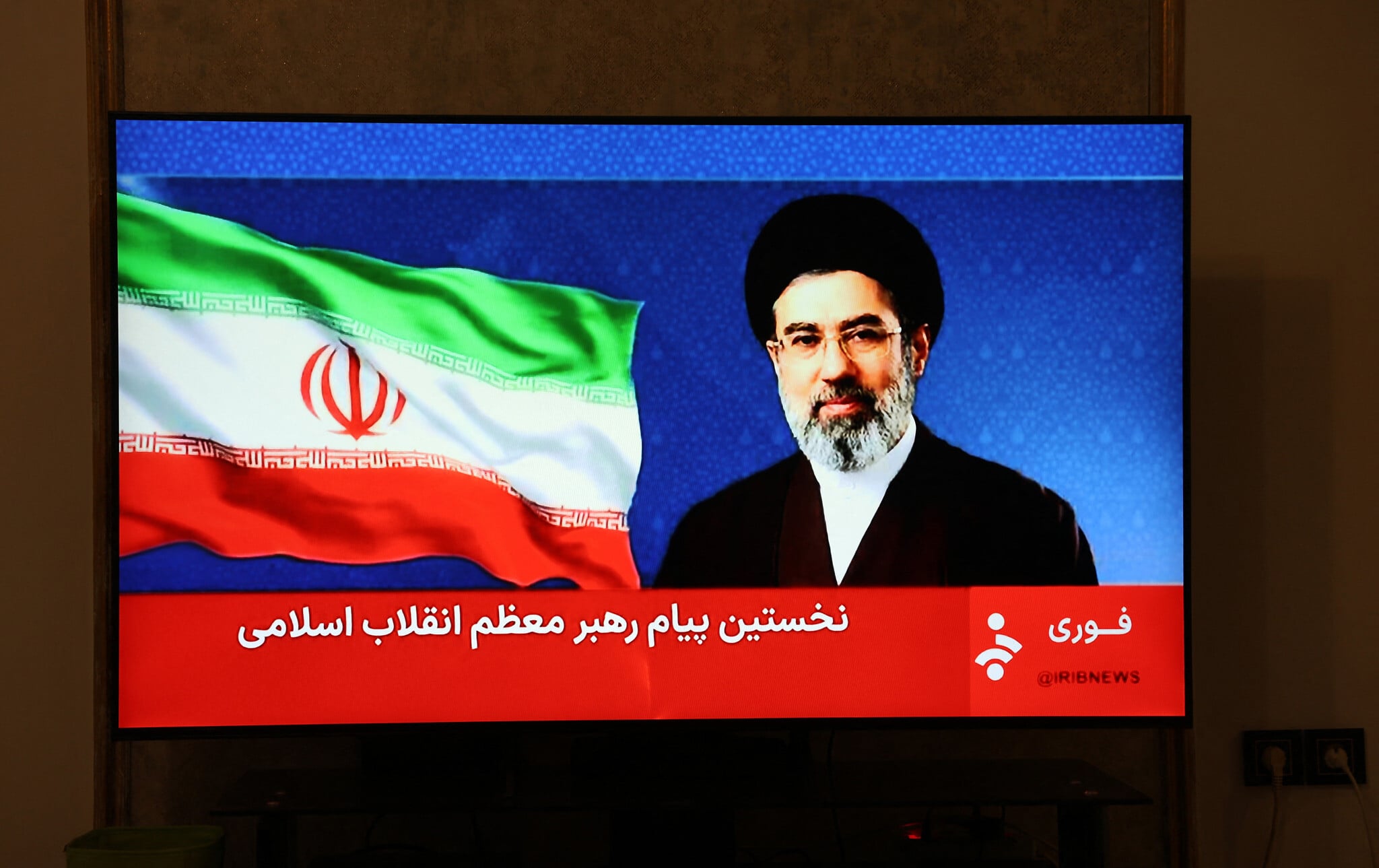
“We eliminated Khamenei,” Netanyahu says. And he scoffs that Khamenei’s son and successor Mojtaba Khamenei, who he calls a “puppet” of Iran’s Islamic Revolutionary Guard Corps, “cannot show his face in public.”
No injuries as Hezbollah targets north with more rockets
Sirens sound in Kiryat Shmona and surrounding towns amid a fresh Hezbollah rocket attack from Lebanon.
No injuries are reported, medics say.
Hezbollah ramped up its rocket fire on Israel last night. Today, it has carried out several rocket barrages and drone attacks, with no reports of injuries.
New Iranian missile attack detected, sirens expected in central Israel
After a lull of over six hours, a new ballistic missile attack from Iran has been detected by the IDF.
Sirens are expected to sound in central Israel in the coming minutes.
Netanyahu to Iranian people: Your path to freedom is near, ‘we are helping, but in the end it depends on you; it’s in your hands’
Prime Minister Benjamin Netanyahu tells the Iranian people in his Hebrew-language press conference this evening that the “moment” they will have the chance to gain freedom is “approaching.”
In addition to aiming to dismantle the Iranian regime’s missile and nuclear capabilities in the ongoing US-Israeli bombing campaign, “we are working to advance another objective: to create the conditions that will allow the Iranian people to remove the cruel tyrannical regime that has oppressed them for nearly fifty years,” Netanyahu says.
“We are delivering crushing blows to the Revolutionary Guards and the Basij, their street forces, their checkpoints – and more is yet to come,” he continues.
“I say to the Iranian people: The moment when you will be able to embark on a new path of freedom is approaching. That moment is drawing closer. We stand with you. We are helping you. But in the end — it depends on you. It is in your hands,” the premier says.
Netanyahu delivered similar remarks five days ago, telling the Iranian people in a video message that “The moment of truth is drawing near.” He also said as much on Tuesday. However, in this evening’s press conference, he indicates that there is no guarantee that the Iranian people will be willing and able to oust the regime.
One arrested, one still at large after Norway synagogue incident
Norwegian police have arrested one suspect after a car chase that began near a synagogue in Trondheim, authorities say. They continue to search for another individual who fled on foot.
Police tell Norwegian broadcaster NRK that the incident began around 5:30 p.m. local time, when officers attempted to stop a vehicle near the city’s synagogue. During the attempted stop, a passenger exited the car and ran from the scene, carrying what police said may have been a bag.
Meanwhile, the driver sped away, the report says, prompting a highway police chase that ended near Svorkmo, about an hour away, when officers used a spike strip to force the vehicle to stop. The driver was taken into custody. Details about the driver have not been released.
Meanwhile, police continue to search for the second suspect, maintaining a significant presence around the synagogue, including monitoring the area with drones. Reports indicate that officers have been seen wearing bulletproof vests and carrying rifles and protective shields.
The area around the synagogue has been cordoned off. Local media reports that an event was scheduled at the synagogue later tonight.
Authorities say there is no immediate threat to residents in central Trondheim.
Police had increased security around the synagogue following the attack on the American embassy in Oslo on March 8, reports say.
No injuries reported as single missile from Iran at central Israel is downed; fragments hit open areas
No injuries are reported in Iran’s latest ballistic missile attack on Israel, the sixth since midnight.
A single missile that was launched was likely intercepted, with fragments hitting open areas, according to initial military assessments. Sirens had sounded across central Israel amid the attack.
Iran threatens to ‘set region’s oil and gas on fire’ if energy infrastructure attacked
Iran threatens to wreak havoc on the region’s oil and gas industry if its own energy infrastructure is attacked during its war with the US and Israel.
“We will set the region’s oil and gas on fire with the slightest attack on Iran’s energy infrastructure and ports,” says a spokesman for the Iranian military’s central operational command, known as Khatam al-Anbiya.
Netanyahu hails Trump ties, says Israel ‘weaving’ previously unimaginable new regional alliances amid war
Prime Minister Benjamin Netanyahu lauds his relationship with US President Donald Trump amid the ongoing US-Israeli bombing campaign in Iran, saying Israel is also working to forge new regional partnerships during the war.
“We have created an alliance unlike any before with the United States – an alliance with our great friend, my personal friend, President Trump. We speak almost every day. We speak freely, exchange ideas and advice, and make decisions together,” Netanyahu says during his press conference.
He says he and Trump spoke a short time ago, and the president told him, “‘Our relationship is one hundred times stronger than any relationship that has existed between an American president and an Israeli prime minister. We are not thinking only about our countries, or only about this generation. We are thinking about future generations – about the future of humanity.'”
Netanyahu adds that Israel is also pursuing new diplomatic openings in the region.
“In these days, my team and I are weaving additional alliances with countries in the region – alliances that only a few weeks ago would have seemed unimaginable,” he adds, without elaborating.
Trump’s first administration brokered the Abraham Accords normalization agreements between Israel and several Arab states, which Netanyahu and Trump have repeatedly said they hope to expand as part of a broader regional realignment.
Netanyahu says he doesn’t know if Iranians will oust regime: ‘You can lead someone to water, you can’t make them drink’
Prime Minister Benjamin Netanyahu holds a press conference on March 12, 2026. (Screenshot/GPO)
There is no guarantee that the Iranian people will rise up after Israel “creates the conditions” for them to topple the regime in Tehran, says Prime Minister Benjamin Netanyahu.
“You can lead someone to water, you cannot make him drink,” says Netanyahu. “We will create optimal conditions to do this, including airstrikes as we did yesterday, as we are doing these days, to try to give them the space needed to take to the streets.”
“I do not deny it: I cannot say for certain that the Iranian people will bring down the regime,” he repeats.
“Ultimately, a regime is ousted from within,” he says. “But we can certainly help,” he stresses, noting that, “We told you, ‘Help is on the way.’ Well, the help has come and more will follow.”
“We all are hoping for the result of this regime falling,” he notes.
Even if the regime in Iran does not fall, says Netanyahu, “it will be much weaker.”
“It’s simply a different Iran — it no longer threatens as it did before,” he continues. “It is not the same power. It’s not the giant bully that nothing can be done against and that no one can unite against.”
Together with the US, Israel is preventing a regime that sought to destroy it from doing so. “Our enemies are not disappearing in an instant,” he says, “but look at our amazing successes.”
He says that countries are uniting with Israel against Iran, both in overt ways and in “other ways that will become clear later.”
Israel was thought to be finished after October 7, 2023, but today Israel is stronger than ever, “at least a regional power,” he says, and it eliminated “a kind of Hitler” who sought its destruction for almost half a century.
Asked about whether he would go after Iran’s new Supreme Leader, Mojtaba Khamenei, Netanyahu replies: “I wouldn’t take out a life insurance policy on any of the leaders of the terror organizations.”
He says Israel has targeted Iran’s nuclear infrastructure and killed another “very important” nuclear scientist, that Israel has “many surprises” up its sleeve for the current campaign, and that it is going better than expected.
Netanyahu leaves door open for Lebanon to act against Hezbollah before Israel exacts ‘very heavy price’
Prime Minister Benjamin Netanyahu leaves open the possibility that a ground operation in Lebanon could be forestalled, warning the Lebanese government that if it “continues to allow Hezbollah to act in violation of your commitment to disarm it,” then Israel will do so.
“You committed, so take your fate into your own hands,” he says. “The time has come for you to do it.”
“If they don’t, it’s clear to you that we will,” he continues. “How? On the ground, not on the ground, other things — I will not detail here. But I promise you, as I said, we will exact a very heavy price from Hezbollah.”
He says that if Lebanon’s government “wants to save itself,” they should “participate in this action.”
“If they don’t, we will have no choice but to do so in our own ways,” he says.
He notes that before Israel drastically weakened Hezbollah in 2024, it had 150,000 rockets and missiles, and the potential capacity to “bring down the skyscrapers of Tel Aviv and cause devastation in central Israel and beyond, with 15,000-20,000 fatalities. That did not happen because we hit them with a massive blow,” he says, responding to a question that asserted he had exaggerated Israel’s past successes against Hezbollah given its ongoing rocket and missile attacks. They have certain remaining capacities,” he acknowledges, but — like Iran — they are much weakened. “We’ll deal with it,” he says.
Netanyahu promises not to “abandon the residents of the north,” adding that he is holding discussions “not for the sake of discussion, but discussions for the sake of action.”
IDF says 4 alleged terror operatives killed after crossing Gaza ceasefire line
Four alleged Palestinian terrorists who crossed the Gaza ceasefire line in the Strip’s north earlier today were killed in an airstrike, the military says.
According to the IDF, the four terror operatives crossed the Yellow Line and approached reservists of the 205th “Iron Fist” Reserve Armored Brigade, “in a manner that posed an immediate threat.”
Following their identification, the military says it “eliminated the terrorists to remove the threat.”
It publishes footage of the strike.
כוחות צה"ל חיסלו מחבלים שהפרו את ההסכם וחצו את הקו הצהוב בצפון רצועת עזה
כוחות צוות הקרב של חטיבת 'אגרוף הברזל' (205) הפועלים בצפון רצועת עזה זיהו מוקדם יותר היום ארבעה מחבלים שחצו את הקו הצהוב והתקרבו לעבר הכוחות באופן שהיווה איום מיידי.
מיד לאחר הזיהוי, הכוחות חיסלו את… pic.twitter.com/NusLzCCdDN
— צבא ההגנה לישראל (@idfonline) March 12, 2026
Netanyahu says Trump entitled to excoriate Herzog over pardon, says Israeli president should ‘do the right thing’ and end trial
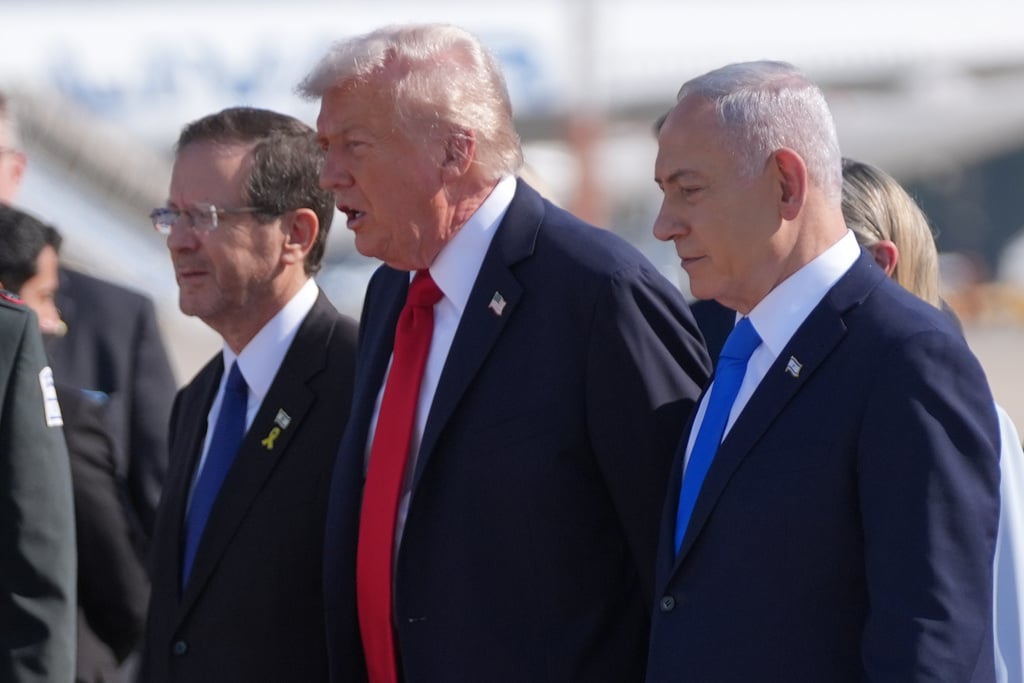
US President Donald Trump (center) walks with President Isaac Herzog (left), and Prime Minister Benjamin Netanyahu at Ben Gurion Airport, October 13, 2025, near Tel Aviv. (AP/Evan Vucci)
After US President Donald Trump called President Isaac Herzog “weak and pathetic” and criticized him repeatedly for not yet pardoning the Israeli prime minister, Benjamin Netanyahu says in a press conference that “US presidents are entitled to say what’s in their hearts.”
He says that the trial is a political witch hunt, and Trump agrees with his position.
Netanyahu repeats his assertion that he never asked Trump to raise the pardon issue.
The trial, he says, “should never have come about, and certainly should have been closed once we encountered extortion and threats against witnesses, crimes, fabrication of protocols, rummaging, threats to destroy families, peddling of the personal data of Israeli citizens in the thousands — 13,000 — and not a small part of that targeted my personal circle.”
“It should have been closed, and President Trump has the right to say his piece,” he continues. “I am not responsible for the words he chooses, and you can certainly ask yourselves whether he speaks from the heart. The answer is yes.”
Netanyahu asserts the trial is “collapsing and everyone sees it.”
He claims that foreign ambassadors and ministers tell him, “We can’t believe what we’re seeing.”
Netanyahu says that the case “does not show equality before the law — it shows inequality before the law, because they wouldn’t do this to ordinary citizens if they weren’t trying to topple a right-wing government under my leadership.”
Herzog “is free to make his decision,” he says, “and should not be subject to pressure. He should simply do the right thing.”
Netanyahu says that he is referring to both international pressure and domestic pressure. “He should do the right thing, and the right thing today is to stop, end this absurd circus, give Israel the time — and me the time — to do what’s necessary both to defeat our enemies and to generate huge opportunities for peace, prosperity and alliances in our region.”
Asked about a potential Supreme Court ruling that would require him to fire National Security Minister Itamar Ben Gvir, he says it would be “beyond madness” for Israel to have to face a constitutional crisis when it is in the middle of a campaign “for its existence and future.”
He also says he has only shelved, rather than abandoned, controversial legislation regarding ultra-Orthodox service in the IDF, because he needs to get the state budget passed as a priority by the end of this month.
Now that he anticipates being able to do so, he says he expects his coalition to serve out its full term, or nearly its full term, with elections “in September or October.”
Targeted Michigan synagogue: ‘We are safe, and we love you all’

Law enforcement respond to a call at Temple Israel synagogue, March 12, 2026, in West Bloomfield Township, Michigan. (AP Photo/Corey Williams)
Temple Israel, near Detroit, confirms that all children and staff are unharmed after an armed attacker rammed his truck through the synagogue’s doors.
“Everyone is safe. All 140 students in our Susan and Harold Loss Early Childhood Center, our amazing staff, our courageous teachers, and our heroic security personnel are all accounted for and safe,” the congregation says in a statement.
“Temple Israel was the victim of a terrorist gunman who was confronted and neutralized by our security personnel, who are truly heroes. Our teachers followed their training and kept the children safe and calm,” the statement says.
“We are deeply and humbly grateful to our teachers, staff, security, law enforcement, and Shenendoah Country Club that welcomed us, fed us, and sheltered our staff, teachers, children, and parents. What incredible neighbors we have. What incredible police force we have,” the congregation says. “We wanted you to know we are safe, and we love you all.”
Iran not going to close Strait of Hormuz, Iran’s UN envoy claims
Iran’s UN Ambassador Amir Saeid Iravani claims Tehran is not going to close the Strait of Hormuz, but adds it is Iran’s inherent right to preserve the peace and security of the waterway.
He makes his comments in remarks to reporters at the United Nations.
Trump: ‘We’re going to be right down to the bottom’ of Michigan synagogue attack
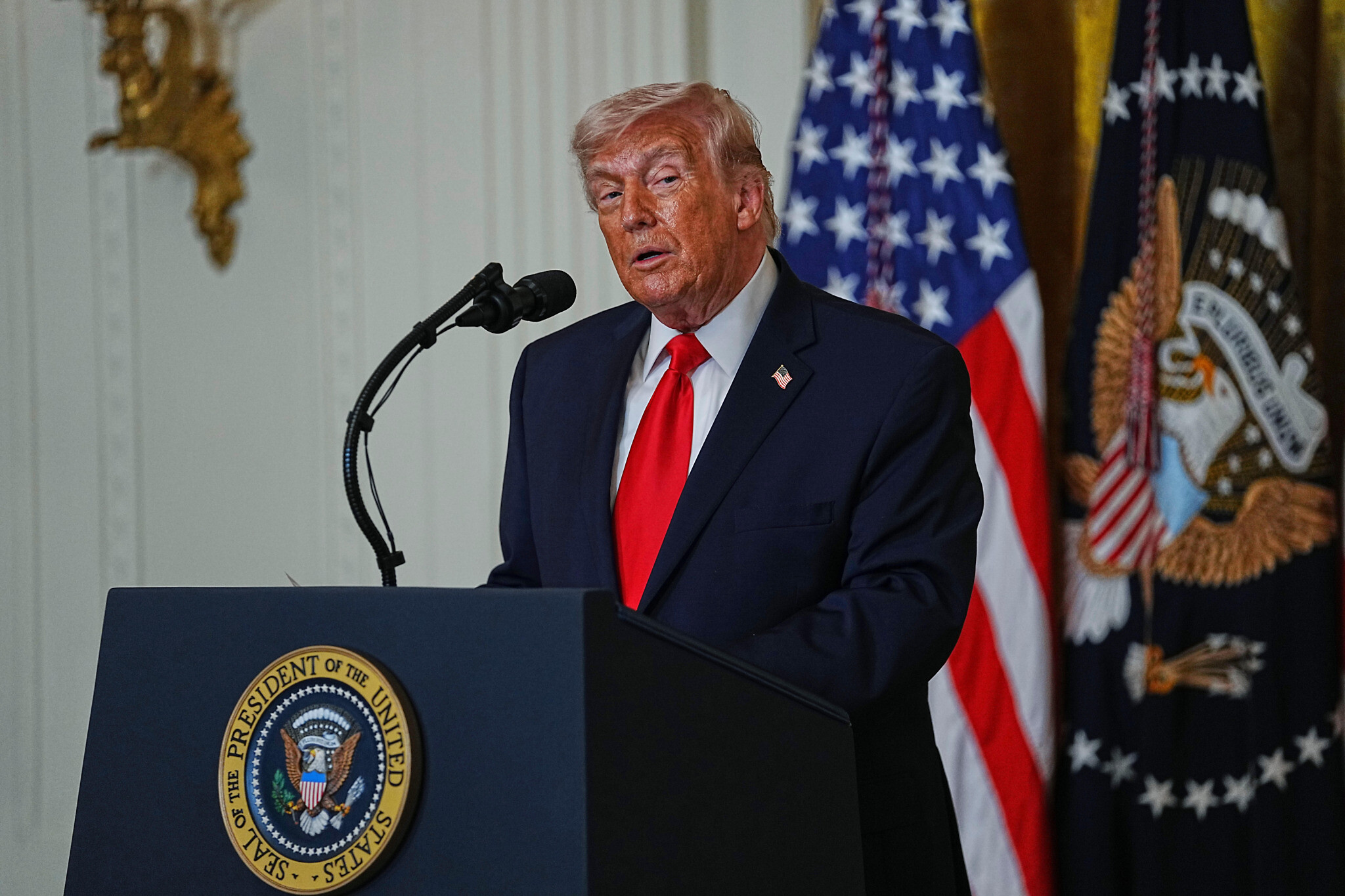
US President Donald Trump speaks during a women's history month event in the East Room at the White House, March 12, 2026, in Washington. (AP Photo/Allison Robbert)
US President Donald Trump laments today’s ramming-shooting attack targeting Temple Israel outside of Detroit.
“I want to send our love to the Michigan Jewish community and all of the people in the Detroit area following the attack on the Jewish synagogue early today,” Trump says in the opening of his remarks at a White House event.
“I’ve been fully briefed, and it’s a terrible thing, but it goes on,” Trump says.
“We’re going to be right down to the bottom of it,” he continues. “It’s absolutely incredible that things like this happen.”
He subsequently gives a brief update on the war with Iran, reiterating that it is going “very well” and “moving along very rapidly.”
Netanyahu: Relationship with Trump administration doesn’t work through ‘diktats’ but through dialogue
Prime Minister Benjamin Netanyahu says he “always welcomes seeing” White House envoy Steve Witkoff, who is expected in Israel next week.
Netanyahu insists that there are no “diktats” from the US.
“The relationship between President Trump and me, and the ties we built between Israel and the United States, and the cooperation between the two militaries — the best militaries in the world, and the best air forces in the world — this cooperation is immense,” he continues.
“It does not work through diktats,” Netanyahu stresses, saying that it works through “dialogue, shared concepts. consultation and joint work. Start thinking that way. It’s true at all levels, but first of all between the president and me, and also between our staff.”
Teen girl fatally run over in Rehovot, reportedly while rushing to shelter amid Iran missile attack
A 17-year-old girl was fatally run over by a car in Rehovot this evening, paramedics say, reportedly while dashing across a street to seek shelter ahead of an Iranian missile attack.
The teenager received an early warning of an incoming strike on her phone and rushed with her friend to a protected area, Hebrew media reports. While crossing the road, she was hit by a car.
In the end, sirens did not go off in the city.
Medics dispatched to the scene found the girl unconscious and in critical condition. They pronounced her dead on the scene, Magen David Adom says.
Threat to Norway synagogue downgraded after second suspect identified
Police in Norway no longer believe there is a threat to the synagogue in Trondheim after a suspicious incident earlier this evening, according to Norwegian broadcaster NRK.
While a second suspect is still at large after the first was arrested following a car chase, police now believe they know his identity, and are not worried that he will attack, NRK says, quoting police incident commander Karl Småland.
Police have begun removing the cordons around the synagogue and reducing security.
Earlier in the evening, officers attempted to stop a vehicle that was missing license plates near the city’s hundred-year-old Orthodox synagogue. During the attempted stop, a passenger ran from the car carrying what police said may have been a bag.
Meanwhile, the driver sped away, prompting a highway police chase that ended near Svorkmo, about an hour away, when officers used a spike strip to force the vehicle to stop. The driver was arrested for car theft and for violating the Road Traffic Act, local media says.
Supreme Court deputy chief rejects right-wing demand that he back US sanctions on his boss
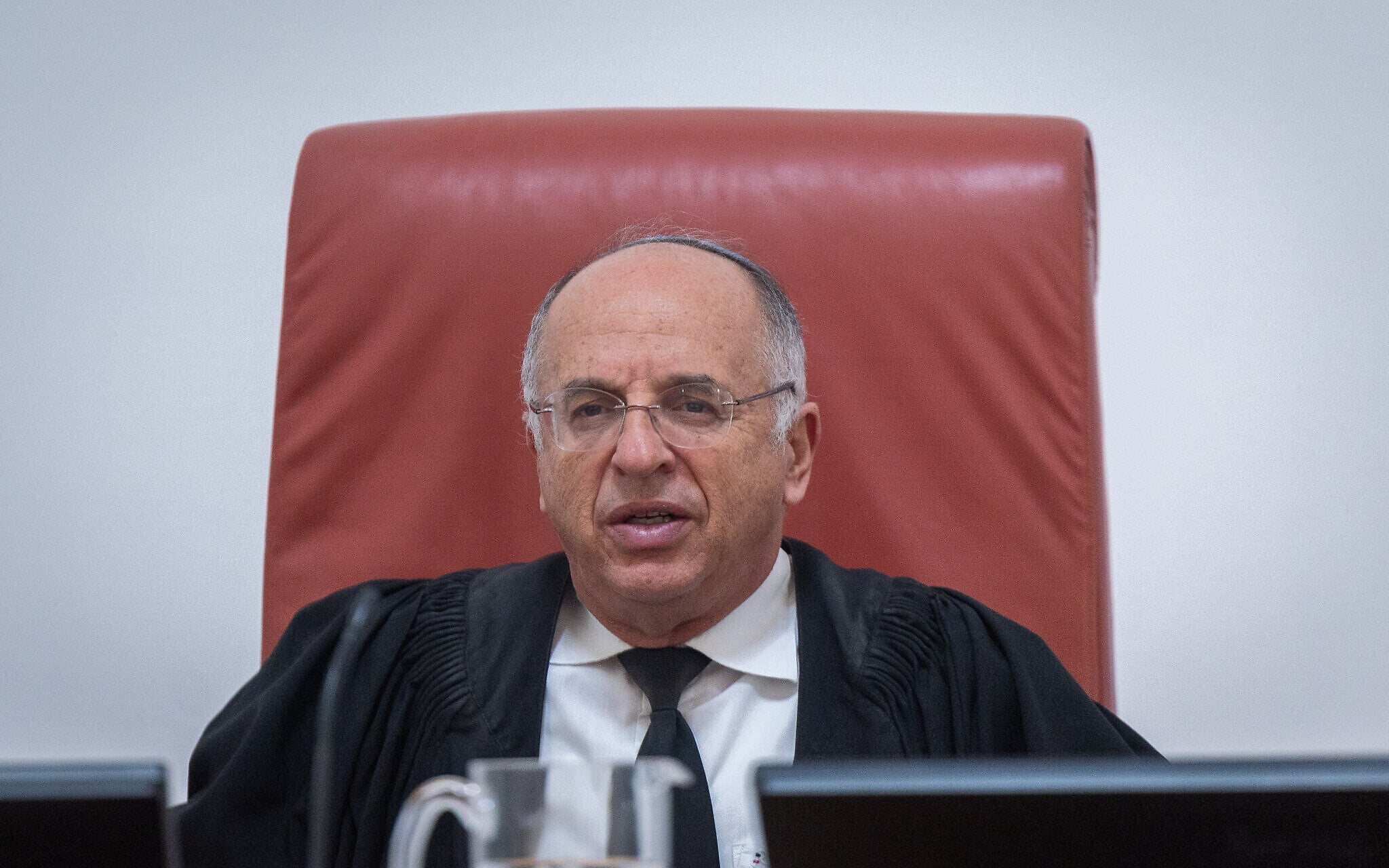
Supreme Court Deputy President Noam Sohlberg at a court hearing, February 2, 2026. (Yonatan Sindel/Flash90)
In a rare public statement, Supreme Court Deputy President Noam Sohlberg rejects a right-wing campaign calling on him to support US sanctions on the Supreme Court chief justice and on the attorney general.
Prof. Moshe Cohen-Eliya, who appears regularly on the pro-government Channel 14, has been spearheading a public campaign urging Sohlberg — a judicially conservative justice, as opposed to the more activist court president Isaac Amit — to “stand up” to Amit and support US measures against him and Attorney General Gali Baharav-Miara, whom the government considers adversarial to it.
The demand appears to be related to US President Donald Trump’s demand that President Isaac Herzog pardon Netanyahu amid the corruption trial against him.
In response, Sohlberg recalls a historic case in which Israelite brothers who had been competing for the throne asked Roman general Pompey to settle the dispute more than 2,000 years ago, with the latter picking the one seen as more comfortable to the Romans and later leading a conquest of Jerusalem.
“The lesson is, we have the solutions, even if they are difficult. Not others,” Sohlberg says.
“Disagreements are definitely permitted, but President Isaac Amit is not a foe. He’s a friend,” he adds, making a pun as Amit’s surname means “friend” in Hebrew.
3 Palestinians injured as Border Police interferes to halt armed clashes in East Jerusalem
Undercover Border Police officers have shot and injured three Palestinians, two of whom were armed, during clashes in the East Jerusalem neighborhood of Silwan, police say.
Officers say their forces shot at the trio in the wake of a “violent dispute between local individuals,” two of whom were using firearms.
Three have been wounded by police gunfire and taken to the hospital. The severity of their injuries is not immediately clear.
Officers from the Shalem police station are currently at the scene and have launched an investigation into the violent incident, police add.
IDF says it hit Hezbollah command centers during wave of strikes in Beirut and southern Lebanon
The IDF says it completed several waves of airstrikes on Hezbollah infrastructure in Beirut and southern Lebanon a short while ago.
The sites hit by the Israeli Air Force included several command centers from which Hezbollah operatives “advanced terror attacks against Israel and its citizens,” the military says.
Ahead of the strikes, the IDF issued evacuation warnings for Lebanese civilians.
The military publishes footage showing some of the strikes.
צה"ל תקף מפקדות של ארגון הטרור חיזבאללה בביירות ובדרום לבנון
צה"ל השלים לפני זמן קצר, מספר גלי תקיפות נוספים לעבר תשתיות של ארגון הטרור חיזבאללה בביירות ובדרום לבנון.
הותקפו מפקדות של ארגון הטרור חיזבאללה, מהן פעלו מחבלי הארגון לקידום מתווי טרור נגד מדינת ישראל ואזרחיה.
ארגון… pic.twitter.com/8bvdyEha7e
— צבא ההגנה לישראל (@idfonline) March 12, 2026
US military says refueling plane crashed in Iraq due to apparent accident, rescue efforts ongoing
The US Central Command says a KC-135 refueling aircraft crashed in Iraq in an apparent accident involving another tanker.
“The incident occurred in friendly airspace during Operation Epic Fury, and rescue efforts are ongoing. Two aircraft were involved in the incident. One of the aircraft went down in western Iraq, and the second landed safely,” CENTCOM says in a statement.
CENTCOM says the incident was “not due to hostile fire or friendly fire.”
It adds that more information will be made available “as the situation develops.”
The second tanker involved in the incident landed at Ben Gurion Airport earlier this evening. The aircraft had sent a “squawk code” of 7700, an international emergency signal, according to flight tracking data.
FM Sa’ar voices shock at US synagogue attack
In a post on social media, Foreign Minister Gideon Sa’ar says, “Shocked by the attack on a synagogue near Detroit. We are in contact with the Jewish community and local authorities. Antisemitism must never be allowed to rear its ugly head.”
It is not immediately known who carried out the attack or what the possible motive was.
Pentagon concedes it’s reworking how it wants to handle efforts to minimize civilian casualties
The US Defense Department says in a statement that its efforts to reduce civilian harm are “currently undergoing a strategic reassessment to inform its future reorganization.”
AP has reported that outdated intelligence likely led to the United States carrying out a missile strike on an elementary school in Iran that killed over 165 people, many of them children.
The Pentagon does not address media reports and critics who have said that the military slashed the size of its mission central to civilian protection and that the emphasis on updating intelligence has come to a near halt.
The statement does acknowledge, however, that a “reorganization” is being conducted and that functions to reduce civilian casualties have been “streamlined” directly into the operations of combatant commands.


read more: