

On eve of Sigd holiday, Netanyahu lauds Ethiopian Jewish heritage
Day for communal atonement, now a national holiday in Israel, ‘has already become part of our common national heritage,’ PM says
 Add ToI as a Preferred Source on Google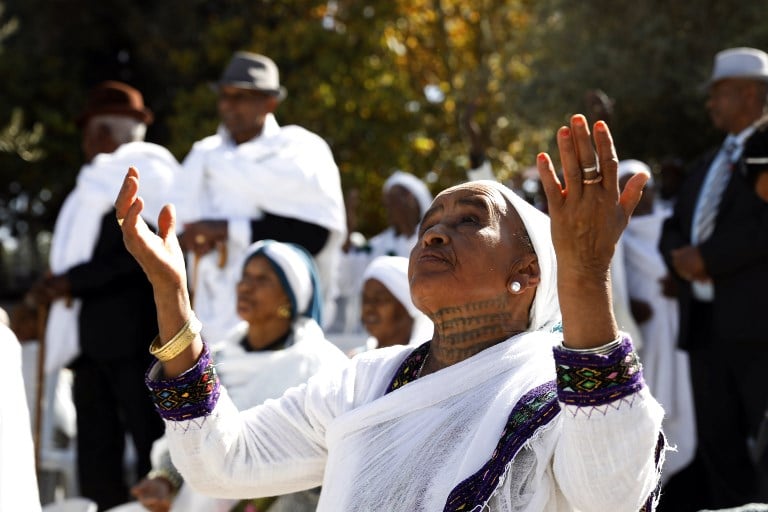
Prime Minister Benjamin Netanyahu on Tuesday praised the Ethiopian Jewish community on the eve of one of its best-known holidays, the Sigd festival.
The holiday “expresses the covenant of the Ethiopian Jewish community with our freedom, our Torah and our land, and especially with Jerusalem. I salute your great devotion to maintaining Jewish identity in exile over so many generations,” the prime minister said.
He said the festival, recognized since 2008 as an official national holiday in Israel, “has already become part of our common national heritage,” and said his government was pursuing “an uncompromising struggle against racism and discrimination, and also over-policing, which we are constantly fighting against.”
The holiday is celebrated on the 29th day of the Hebrew month of Heshvan, or Tuesday evening, precisely 50 days after the Jewish Day of Atonement, or Yom Kippur.

The two holidays are linked in the Ethiopian Jewish tradition: while Yom Kippur focuses on personal introspection and self-correction, Sigd focuses on collective atonement as a community.
It is also a holiday that celebrates the return from exile to Jerusalem, a key theme of the Ethiopian Jewish tradition over the centuries, which believes the community must repent — Sigd, like Yom Kippur, involves special prayers and fasting — in order to make itself worthy of the return to the holy city.
One of the key communal events in Israel surrounding the holiday sees thousands of members of the community and its rabbinic leaders, or kessim, gather on the promenade overlooking the Old City of Jerusalem in the capital’s Armon Hanatziv neighborhood. The kessim read from Psalms and other biblical passages, after which, the community breaks its somber ceremonies with food and dancing.
In 2008, the Knesset passed a law that made Sigd one of Israel’s official national holidays.

In his remarks Tuesday, Netanyahu gave his support to a key demand from Ethiopian Jewish leaders: to have their religious laws and rites formally recognized by the state rabbinate, and the kessim given posts in rabbinic courts.
“We, in the government, passed a decision to formalize the status of the kessim,” Netanyahu said. “I am very proud of it. We will integrate them as spiritual leaders in the religious services framework.”
Tensions between the Ethiopian Israeli community and law enforcement have been high since the June killing of a teenager by an off-duty officer, which sparked several days of nationwide protests. The fatal shooting of Solomon Tekah renewed accusations of police brutality and racism toward Israelis of Ethiopian descent.









The Times of Israel Community.