

Sorry not sorry: Author learns how not to let lack of apology sour a sweet year
In ‘The Forgiveness Tour,’ Susan Shapiro shares her experiences and those of 13 other diverse subjects across the US as she explores the tricky ins and outs of making amends
 Add ToI as a Preferred Source on Google
Renee Ghert-Zand is the health reporter and a feature writer for The Times of Israel.

According to the great 12th-century rabbi, philosopher and physician Maimonides, there are four steps to teshuvah, the Jewish approach to apology and atonement for wrongs committed.
First, one must verbally admit the wrongdoing and ask forgiveness of the person they hurt. One must resolve to not commit the same offense again. One must offer appeasement or make restitution. Finally, one must act differently if the situation ever presents itself again.
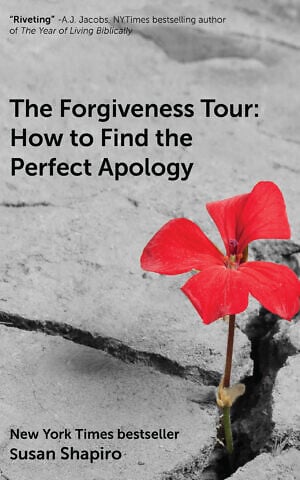
While theoretically it may not seem difficult to truly apologize, author Susan Shapiro says she discovered otherwise as she wrote her book, “The Forgiveness Tour: How To Find The Perfect Apology.”
The insightful amalgam of memoir and reportage published earlier this year is particularly resonant during the High Holidays as Jews ask for and seek forgiveness from God and fellow humans.
The book’s subtitle is a bit of a red herring, as it becomes evident that it is actually not easy to receive the exact apology one might be looking for. The question then becomes if or how it is possible to grant forgiveness in response to a lackluster or disingenuous apology — or none at all.
“The Forgiveness Tour” starts with Shapiro’s own struggle when there was no apology forthcoming from an individual close to her who hurt her. The narrative then moves on to the stories of 13 other people across the United States with different backgrounds and experiences, each presenting a different take on the book’s theme.

“The question I’d asked everyone was, ‘What’s the one apology you needed but never received?’ Based on my own problem, I was most interested in how to cope when someone hurts you but shows no remorse,” Shapiro wrote in an email interview with The Times of Israel.
A decade ago, Shapiro’s longtime therapist, who helped her stay emotionally balanced and kick her addictions, suddenly betrayed her. She had explicitly asked him not to take her protégé graduate student on as a patient, but he apparently went ahead and did so nonetheless. He offered no explanation and no apology.
Shapiro, who teaches writing at several universities in New York City, cut ties with the therapist and went into a mental and physical tailspin (she threw her back out while kickboxing out her frustrations) as a result of the perceived betrayal.
The falling out with the therapist was ultimately resolved in eight months, but what Shapiro learned during that time about apologies and forgiveness, especially from her physical therapist Kenan Trebincevic, spurred her to look into the subject yet further in the ensuing years.
Trebincevic is a Bosnian Muslim whose family were victims of ethnic cleansing by Christian Serbs in the Bosnian War. As Trebincevic strengthened Shapiro’s back, she encouraged him to write about his experiences. At first he was reluctant, but then it all came spilling out. Eventually, Shapiro coauthored his 2014 memoir, “The Bosnia List,” about Trebincevic’s return visit to his homeland two decades after the traumas that sent him into exile as a boy.
I was intrigued to see that holding a grudge could actually be healthier and that spite could be inspiring
“My odyssey helped me understand how significant apologies were, and how small my saga was. I was intrigued to see that holding a grudge could actually be healthier and that spite could be inspiring. Also that reparations to repair the damage done might have a stronger effect than words of contrition,” Shapiro writes in her book.
In other words, when it comes to apologies and forgiveness, one size does not fit all.
The personal stories the author presents (many belonging to her students, friends or colleagues) do indeed put her own into perspective. Among them is a young US military veteran struggling with addiction who is let down by the government and everyone in his life. Another is a Holocaust survivor, an old family friend. There is also a woman who takes care of her sick mother who did not protect her from sexual abuse when she was a girl. One story involves a young family devastated by the wife and mother’s drinking, and another is about a man who lost his entire family in a car accident caused by a drunk driver.
“I was most fascinated by the people who found ways to forgive without getting the words ‘I’m sorry’… Ultimately I learned how you sometimes need to compromise for family harmony or to keep someone you love in your life,” Shapiro said.
“As [my therapist] once told me, ‘You can be very right and very alone,'” she said.
Shapiro also weaves into the book a spectrum of views on the subject from clergy and experts of various faiths. Shapiro turns to her own Jewish tradition for guidance, including from her friend Rabbi Moshe Pindrus of the Ohr Somayach religious seminary in Israel. Peppering his conversation with biblical and Talmudic quotations, he tells her that there are no actions that are unpardonable, as long as the person properly repents.
“But what if there are no regrets or atoning?” the author asks the rabbi.
Pindrus explains that there is no obligation to forgive a person until they apologize. At the same time, one must not keep silent and despise the person who wronged them, but rather inform the other of their feelings and ask for an apology.
Shapiro said she was also fascinated to find that Judaism and Islam were “so aligned” on the need for true atonement and repentance for sins.
“I was confused by Christianity’s attitude about forgiveness when Jesus said, ‘Father forgive them, they know not what to do,’ while he was being crucified. At first it seemed to imply a blanket forgiveness for sins. But then the Reverend Dr. Morgan Roberts explained the concept of hell, where a sinner is sent forever if they don’t repent,” she said.
Shapiro said she was taken by a quote from Confucius: “Forget injuries, never forget kindnesses.”
“And the overviews of Buddhism and Hindu spoke to me, the idea that there’s a bigger picture I can’t see that would illuminate my myopic mindset and liberate me,” she added.
One of the most important things Shapiro learned in the process of researching and writing “The Forgiveness Tour” is that it is never too late to apologize or forgive. She has done this in her own life, and she has observed it among others — including celebrities and public figures.
While others were cynical about Justin Timberlake’s belated apologies to Janet Jackson and Britney Spears in February of this year for racist and misogynistic words and actions from a decade and a half ago, Shapiro published an article touting the benefits of high-profile people trying to make amends with those they have offended.
“Someone with a high public stature apologizing can create a new norm,” Shapiro writes in the article, quoting psychiatrist Vatsal Thakkar.
Shapiro has also cited Deborah Copaken‘s moving experience of finally contacting the man who 30 years earlier raped her the night before her college graduation. The man responded immediately and said he had no recollection of the event (he had blacked out from excessive drinking), and was deeply sorry for what he had done.
Suddenly, 30 years of pain and grief fell out of me. I cried. And I cried… And then, suddenly, I was cleansed. Reborn
“The fact that he’d done this to me and that I’d been living with the resulting trauma for 30 years was horrifying to him. He was so sorry, he said. He just kept repeating those words, ‘I’m so sorry,’ over and over,” Copaken wrote in The Atlantic in 2018.
“Suddenly, 30 years of pain and grief fell out of me. I cried. And I cried. And I kept crying for the next several hours, as I prepared for Yom Kippur, the Jewish holiday of forgiveness. And then, suddenly, I was cleansed. Reborn. The trauma was gone. All because of a belated apology,” she wrote.
Having come to the end of her “Forgiveness Tour,” Shapiro said she is ready for the High Holidays.
“I can now apologize better and more fully if I’ve hurt someone in my life. Even if the hurt was accidental or I don’t quite understand it. What’s important, I learned, is that I often have the power to heal estrangements with the people I care about if I can just get over myself, my pride, my myopic views and my ego,” Shapiro said.
“And then, of course, I have to forgive myself,” she said.









The Times of Israel Community.