

Making sense of those nuclear talks
Regionial newspapers vary in their interpretation of this week’s negotiations between Tehran and the P5+1
- See more Times of Israel on Google - add us as a Preferred Source
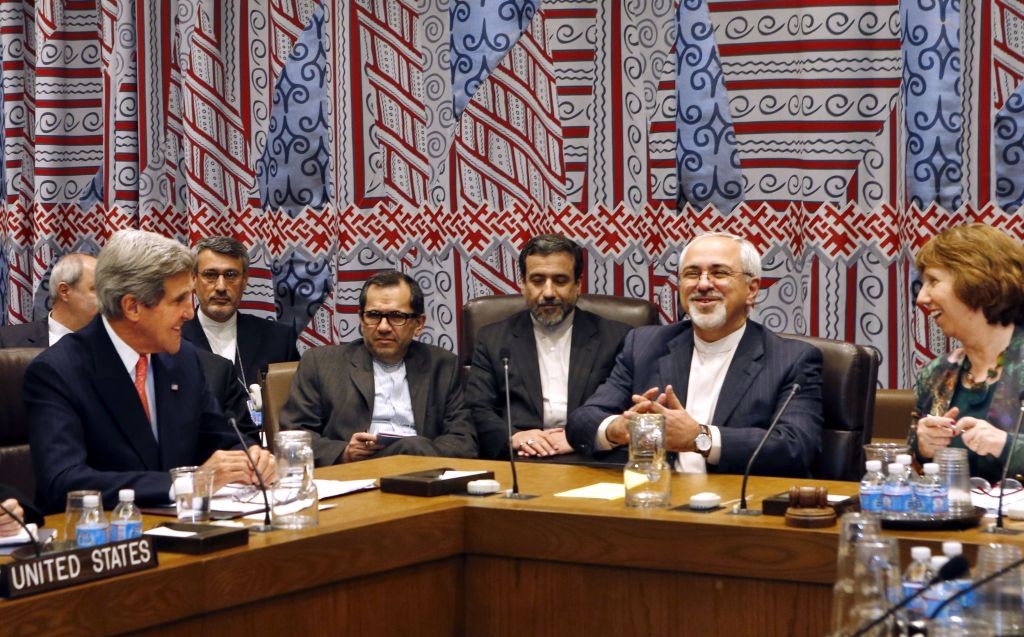
The negotiations between Iran and world powers are on all the front pages and op-eds of Arab dailies on Thursday. Opinions and interpretations on their economic and political implications in the region vary.
“The Geneva talks give the world powers plenty of time to study the Iranian proposition” reads the headline of Saudi-owned Al-Sharq Al-Awsat. The London-based pan Arab Al-Quds Al-Arabi relates in a slightly different tone: “Washington praises new Iranian nuclear proposition and Tehran will receive unannounced visits to its sites.”
In the London-based Al-Hayat the headline reads “Ashton considers the Geneva talks ‘the most elaborated’ and Zarif believes in ‘the beginning of a new stage.'”
Al-Quds Al-Arabi runs an editorial titled “Iran negotiations—and the absence of Israel and the Gulf states,” discussing some potential consequences and political developments in the region.
“The Iranian diplomatic attack began with a proposal the White House couldn’t have not praised…” states the writer. The article portrays Iranian President Hassan Rouhani as the pragmatic president of a population of which 65 percent lives below the poverty line.
“Negotiations [between Iran and the P5+1] were conducted and shall resume next month, but the most obvious absentee is Israel, as well as the Gulf states who feel isolated by the Iranian-Western rapprochement. Israel is afraid of the disintegration of the sanctions on Iran without the dismantling of the nuclear program. Israel blames Obama for laxity, evasion and procrastination in launching a war on Iran.”
The readers are told that “in its confrontation with the rapprochement between Tehran and the West, Israel is using the language of the past…”
The Gulf States — according to the analysis — feel threatened by Iran-US ties and specifically by the Russian-American cooperation on the chemical weapons issue in Syria.
“Russia announces that 50,000 Syrian Christians appealed for [Russian] citizenship, in order to protect themselves from the Western-supported opposition” says the front page of Al-Hayat. It moves on to report that “the government’s forces are approaching south Damascus and Geneva II raises disputes among the ‘coalition.’ The picture depicts Kurdish soldiers of People’s Protection Units featuring a women soldier among the men. The article argues that the government’s progress was made possible because the different factions are fighting each other ‘and especially among ‘The Islamic State of Iraq and Greater Syria’ and the Kurdish ‘People’s Protection Units’ in Syria’s north-east.
Has the Islamists’ experiment failed?
In an article written in the pro-Muslim Brotherhood Qatari news channel Al-Jazeera, the columnist Abd Al-Rahman Muhammad Farhana explores the failure of the Islamists in the Middle East. Farhana’s article is divided into four parts. First, he explains why the region’s peoples elected the Islamists. He then asks whether the Islamists failed to rule or were intentionally made to fail. The article ends with two sections — one discussing the Islamists’ future and the second discussing the promises and hopes in this future.
Farhana argues against “the weak paradigm” of the Islamists’ failure to rule. He argues that “those who repeat [the paradigm] are the Islamists’ opponents” and thus this assault happens within the existing political conflict.
Farhana says “the Islamists’ experience [ruling] has not ended yet — it was aborted by the military coup in Egypt” yet he predicts this is not the end and the Islamists rule again.
In Cairo, pro-Morsi demonstrators waving “pro-democracy” banners in English are protesting the new “Demonstration Laws” put forth by the current government, reports Al-Jazeera. The article quotes the new law forbidding any sort of public congregation and demonstration in the proximity of government facilities. The picture featured in the article shows peaceful female protesters waving pictures of Mohammed Morsi.







The Times of Israel Community.