

The art of (unmaking) the deal
Pundits agree Trump was in lockstep with Netanyahu in his opening salvo against the Iran nuclear pact, but diverge when it comes to praising, parsing or protesting the move
 Add ToI as a Preferred Source on Google
Joshua Davidovich is The Times of Israel's Deputy Editor
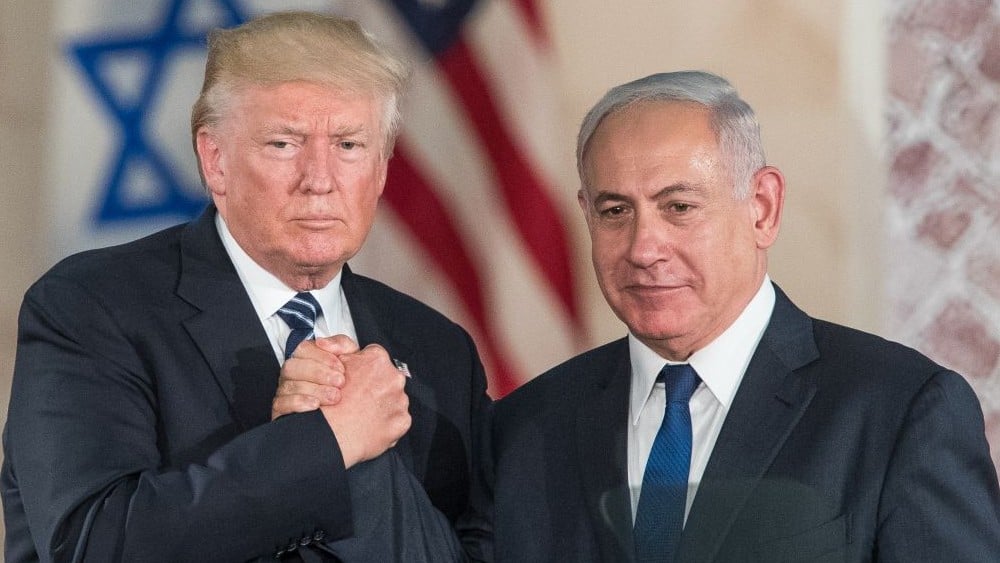
It came as a surprise to absolutely nobody, and Israeli papers are a day late (thanks to there being no Saturday edition), but pundits still have plenty to say about US President Donald Trump taking his first whack at the Iran nuclear deal, with commentary ranging from angry criticism to sober analysis to unbridled joy.
The latter comes courtesy of Israel Hayom, which has railed against the agreement as vociferously as Prime Minister Benjamin Netanyahu (for whom the paper is thought to have been a mouthpiece). So with Trump cranking up the guillotine ahead of what may be the deal’s beheading, the paper has almost nothing but adulation for the president.
“There’s a new sheriff in town, and he’s brought with him promises for a better deal,” editor Boaz Bismuth writes in a front-page analysis. “Trump decided, thumbing his nose at the world, to reconsider the heritage of his predecessor Barack Obama, who, it should be remembered, left us a world ‘quiet and calm,’ in which Syria is a ‘pastoral’ place. A few months ago, after an Iranian provocation with a ballistic missile test, Trump said several times that Iran is on notice. Perhaps they did not understand. Now, after the speech of Friday the 13th, perhaps they understand that the era of ‘an unconditional deal’ under Obama is no longer. Now they are in the era of ‘a deal under conditions,’ thanks to Trump.
It’s not all love for Trump and hate for Obama, though. The paper’s Dror Eidar also uses the opportunity to bash those critics and pundits who dared question Netanyahu’s decision to speak before Congress against the deal in March 2015, writing that they knew Netanyahu had the long game in mind all along and now it’s come to fruition.
“We wrote that Netanyahu’s battle wasn’t in vain, since he ‘paved the way for the next government to take a fresh look at the deal and ties with the ayatollah regime.’ We added that ‘We don’t know who the next president will be, but it’s hard to believe that somebody would continue to stick to Obama’s radical line.’ We knew there was a moral validity to Israel’s fight against the deal and against the evil it contained, but we could not predict the future,” he writes. “We only hoped. Every Israeli should be happy that our hopes came true.”
The paper’s nine-page package also contains a number of other commentaries, stories about Israel’s and Iran’s reactions and a transcript of Trump’s speech, but no actual straight news story on it.
Yedioth Ahronoth also does away with a straight news story (perhaps because of the assumption that readers will be up to date thanks to the day delay, though Haaretz does lead off with the news) and runs a flurry of analyses and commentaries. Still, unlike Israel Hayom, its pundits are much more critical of the decision, worried that it will make the world — and especially Israel — that much less safe, and asking how happy should Israelis really be that Eidar’s wishes came true.
“With his vacuous mouth, Trump turned Iran into a country with its back against the wall, with nothing to lose,” Washington correspondent Orly Azulay writes, donning her analyst hat. “It can still, if the deal is indeed canceled, put down iron blinds on its facilities and return with full motivation to its nuclear program, and blame the US that it’s because of them.”
Lest one think Azulay is in the minority, Nahum Barnea, in a reported analysis, notes that her fears are also the fears of Israel’s security authorities.
“The idea that has been formulated more or less in the defense system brass says this: The nuclear deal was bad for Israel, but as long as it was in place, the threat to Israel was not immediate. The deal gave the West 13 years from today to thwart the nuclear program,” he writes, noting that canceling the nuke deal would not address the other more immediate Iranian threats against Israel, or the fact that there are different forces at work in Tehran, including more moderate ones that can be swayed by financial deals. “The conclusion of Israeli security authorities is clear: There’s no room now to cancel the deal; American pressure needs to be used to thwart the missile threat and respond to Iran getting a foothold in the region. This pressure will align with [Iranian president Hassan] Rouhani and his supporters and with the world powers, including Russia, in one go.”
Despite what Israel’s security people say behind doors, the country’s official policy, formulated by Netanyahu, is 100 percent against the agreement as it stands, and in Haaretz both pundits Chemi Shalev and Barak Ravid note how Trump’s speech dovetailed with Netanyahu’s ideas and look at what the premier will now have to contend with thanks to that fact.
“You can just imagine Benjamin Netanyahu watching Donald Trump’s Friday night speech on Iran, lighting a cigar, sipping from a glass of pink champagne, a wide smile spreading across his face. The president of the United States was attacking Iran in terms that could have been formulated in Jerusalem, and possibly were. He was talking in fluent Bibi, in tone if not in delivery,” Shalev writes, poking several holes in facts and figures laid out by Trump.
Now that the speech has been given, the ball is in Netanyahu’s court, Ravid writes, expressing even-keeled hope that perhaps he can succeed.
“For Trump’s speech not to remain a mere morale-boosting cheer, Netanyahu must put aside his emotional conduct on the Iranian issue and engage in a professional, slogan-free, quiet and intimate dialogue with the Trump administration and with Western governments, chiefly Germany, France and Britain,” he writes. “A window of opportunity has opened for Israel to influence American policy and reach long term strategic cooperation with the US. This coordination is critical on issues like increasing oversight on the existing agreement and preparing for the day after, in terms of military action, preventing Iranian garrisoning in Syria and increasing pressure on Hezbollah, as well as forming regional alliances with Sunni states. This is exactly where Netanyahu’s test lies. Angela Merkel, Emmanuel Macron and Theresa May expressed great concern over the weekend over Trump’s speech. Without their support, there will be no chance of consolidating a significant step against Iranian subversion in the region, not to mention regarding the nuclear deal. An Israeli political initiative on the Palestinian issue or a willingness to advance Trump’s peace plan could also assist in achieving this goal.”
The nuclear deal isn’t the only thing in the news. On Yedioth’s front page, it plays second fiddle to the prime minister’s scathing attack on the chief of police, in which he accused him of being behind a series of leaks surrounding the corruption investigations against him (Netanyahu), after Channel 2 reported the prime minister would be interrogated by police again.
Not surprisingly, the paper, which is no fan of Netanyahu, doesn’t view the attack in the kindest of lights.
“It’s not clear what got the prime minister in such a froth. How does he say it? There was nothing,” writes an exasperated-sounding Ben-Dror Yemini, defending the police and trying to figure out what Netanyahu was thinking. “This was an item by Moshe Nussbaum that the probe was restarting and Netanyahu was invited to testify. This wasn’t even a leak, but an update on what was already a given. Nothing more. But Netanyahu, who just looks for excuses to start a war, wallows over the update as if it’s something big, as part of an attempt to claim that the source is one person, Lior Horev, who works as outside counsel for the police.”
Not surprisingly, Israel Hayom plays down the police-Netanyahu tiff, but more unexpected is Haaretz’s decision to do the same. Instead, the broadsheet plays up the fact that new Zionist Union head Avi Gabbay said he would not invite the Joint List of Arab parties to sit in a hypothetical government with his own faction.
“You see their behavior,” he’s quoted as saying in the paper. “I don’t see any [connection] between us that would allow us to be part of a government with them.”






The Times of Israel Community.