

Matchstick, Chantenay or baby: A kibbutz’s love affair with the carrot
Over 60 resilient and innovative years, Kibbutz Shluhot has built a little orange empire
 Add ToI as a Preferred Source on Google
Jessica Steinberg, The Times of Israel's culture and lifestyles editor, covers the Sabra scene from south to north and back to the center
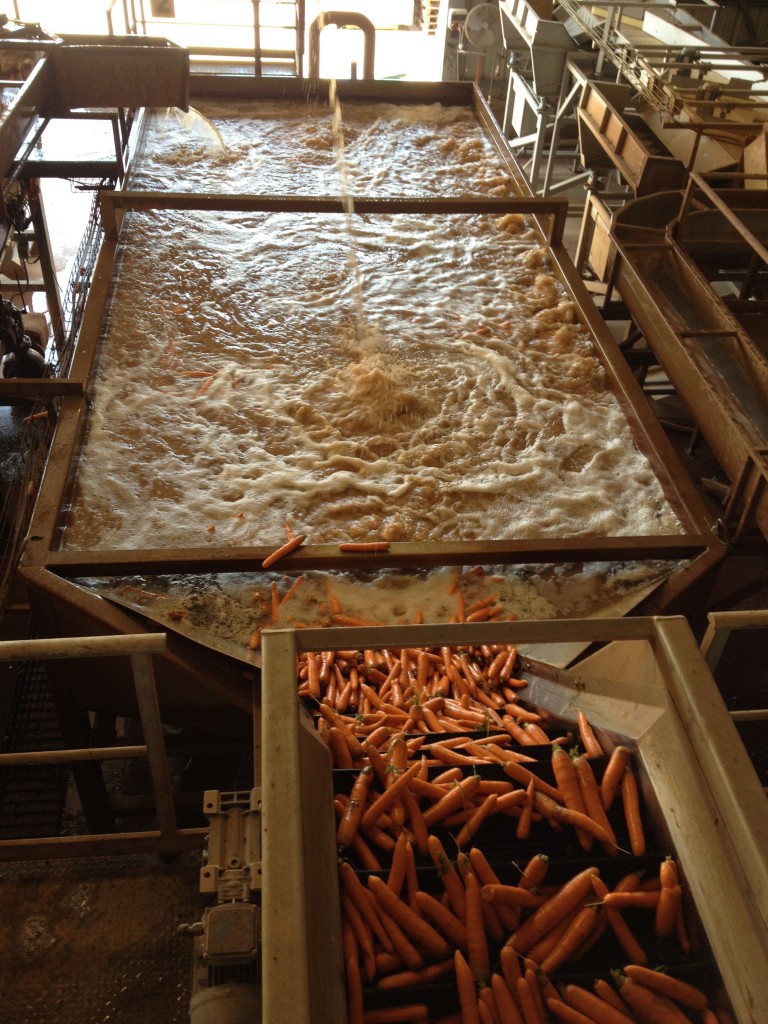
Yosi Kanner doesn’t appear to be the secretive type. But as he strides through a maze of platforms overlooking thousands of carrots being washed and sorted at his kibbutz in northern Israel, he stops to issue a warning.
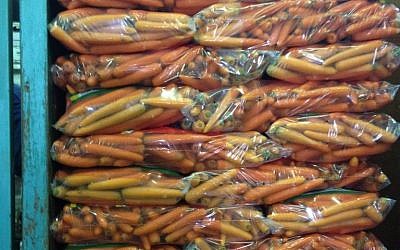
“Don’t write about that,” he said, pointing to computer screens hanging over several sorting tables, detailing which carrots go to which countries.
Asked for permission to view the plant handling Kibbutz Shluhot’s latest product, the baby carrot, he politely but firmly demurs.
“You can’t share all your secrets,” said Kanner, the graying, slight, and energetic general manager of Gezer Shluhot, Israel’s largest carrot producer.
Shluhot, located in the fertile and intensely hot Beit She’an Valley, is the source of 30,000 tons of carrots annually, 85 percent of them for export to Europe and Scandinavia. The kibbutz has grown carrots for more than 60 years, and Kanner has run the factory for 20 — an unusually long term for a kibbutz company CEO. A second-generation son of the kibbutz, born to parents who came to what was then Palestine by way of Austria and Poland, Kanner has always been around carrots.
When the kibbutz began cultivating the relatively common and inexpensive crop for its growing farming cooperative, it was 1949.
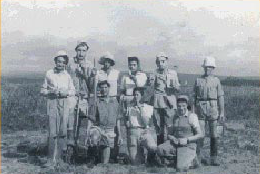
In those early days, Shluhot was one of many kibbutzim growing the sturdy carrot. But it was not until the 1970s, when the kibbutz bought its first combine, that its business expanded to 1,500 tons per year. The most significant change came in the mid-1990s, when Israel’s nascent peace negotiations with the Palestinian Authority brought about the Paris Peace Protocol which allowed for Israelis and Palestinians to enter one another’s markets. That meant Israelis had access to cheaper Palestinian carrots.
“That changed the whole market,” said Kanner. “So we had to figure out what to do, expand our business or close it altogether.”
The kibbutz decided to expand, putting more effort into local growth until it acquired its first direct export client in England.
That was in 2002. Within a matter of years, Shluhot was selling mid-size carrots to Russia, dainty Chantenay carrots and pre-cut matchstick carrots to England, and organic carrots grown by neighboring Kibbutz Sde Eliyahu (which has the necessary organic fields) to Germany.
Now, 10 years later, Shluhot has expanded its carrot production to 37,000 tons annually, with most shipped to Europe.
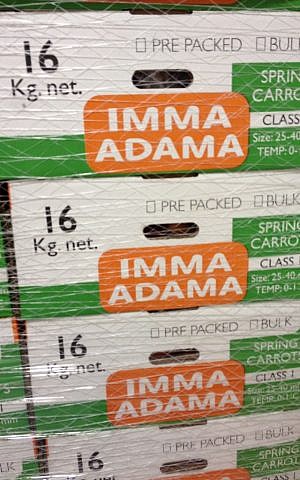
Each export destination has its own peculiarities. England usually wants the coordinates for the fields where the carrots are grown and advice as to what to write on the sticker, said British-born sales rep Helena Ravitz, with customers asking if the “carrots are from the Israeli part of the Occupied Territories or the Palestinian part of the Occupied Territories?” She then offers the complicated history of Israel in an email only for them to ask, “‘But what should I put on the sticker?’”
Russia, on the other hand, has had fewer demands, although the advent of European supermarkets in Russian cities is starting to change that.
The company’s entry into the organic market created another host of details, including the Germans’ scrupulous testing of organic products. If they find “even a trace of a chemical used in the field 50 years ago on a leaf, it’s not good enough,” said packing house manager Dalya Toren.
“It’s a risky business,” Kanner said of the organic sideline, but “it creates a richer range for us — it makes us sexier when we have all these kinds of carrots.”
And that is all prior to the baby carrots, the premier product that Kanner had been plotting for the last 12 years.
“He’s been dreaming about this since I met him,” Ravitz confirmed.
Baby carrots have been around since 1989, when they were developed by several farmers in Bakersfield, California. Called baby carrots for their size, they’re actually fully grown carrots, cut into two-inch pieces and peeled; hence their other name, cut-and-peel carrots. After the baby carrot market exploded in 1990, Kanner began reading up on baby carrots, traveling to carrot conferences and slowly realizing what kind of investment cut-and-peel carrots required.
http://youtu.be/8bhq_NL6jL0
“We were at the start of our expansion and it didn’t make sense to invest in this when we had just invested in our regular carrots,” he said.
They tried growing real baby carrots — that is, miniature carrots — but came up against several difficulties in their development and ended up marketing the short and stout Chantenay — a natural baby carrot — to the UK market instead.
It wasn’t until 2008 that Kanner was ready to think about cut-and-peel again, after adding another 10,000 tons to the factory’s overall production. He turned to Israeli food giant Strauss, which was already in the ready-made vegetables business, selling shredded cabbage, pre-washed lettuce and DIY salads. By 2010, Strauss and Shluhot were partners and with Strauss handling the marketing, the kibbutz invested “four or five million dollars” in Belgian cutting machinery that fashions what appear to be baby carrots out of regular size carrots, said Kanner. The first bags hit stores last November.

Sliced from the long and tapered Imperator carrot, the Israeli cut-and-peeled carrots are being sold in 400-gram bags. So far, the Israeli market is taking to the healthy snack even better than Kanner and his team expected, he said.
“We didn’t know if Israel would be more like Europe or the US — it was the billion dollar question,” said Kanner. “It turns out that Israel is more like the US, even more experimental than the US in terms of trying a new product.”
With baby carrots penetrating some 80% of the Israeli market, according to Kanner, the product appears to be a success.
With that challenge firmly in hand, Kanner can focus on his next concern: pondering who of the kibbutz’s younger residents will be taking over Gezer Shluhot from the older generation. With young families returning to live on their home kibbutz, he wants to be sure that this carrot company is here to stay.
The kibbutz has 180 members and additional residents as well — families who live on the kibbutz but are not voting members. Kanner identifies himself as a pragmatist, not a kibbutz ideologue, and believes there will eventually be a merger of the members and residents and that everyone at Shluhot will work either on or off the kibbutz and receive a salary. But he is nervous about the future — about how the business will be run once the kibbutz structure is fully privatized, changes that will alter the carrot business as well.
“Every business has to have a sense of ownership. Someone has to be the de facto owner,” Kanner said. “Who will take responsibility? Who’s going to take care of this place? You have to make sure that sense of ownership is retained.”
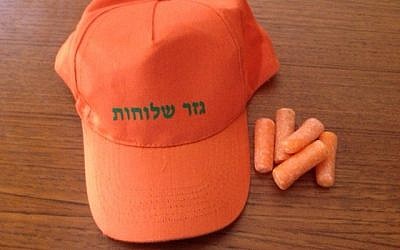
With those final words, Kanner puts on his Gezer Shluhot baseball hat — it’s orange, of course — and struts off for lunch in the communal packinghouse dining room.










The Times of Israel Community.