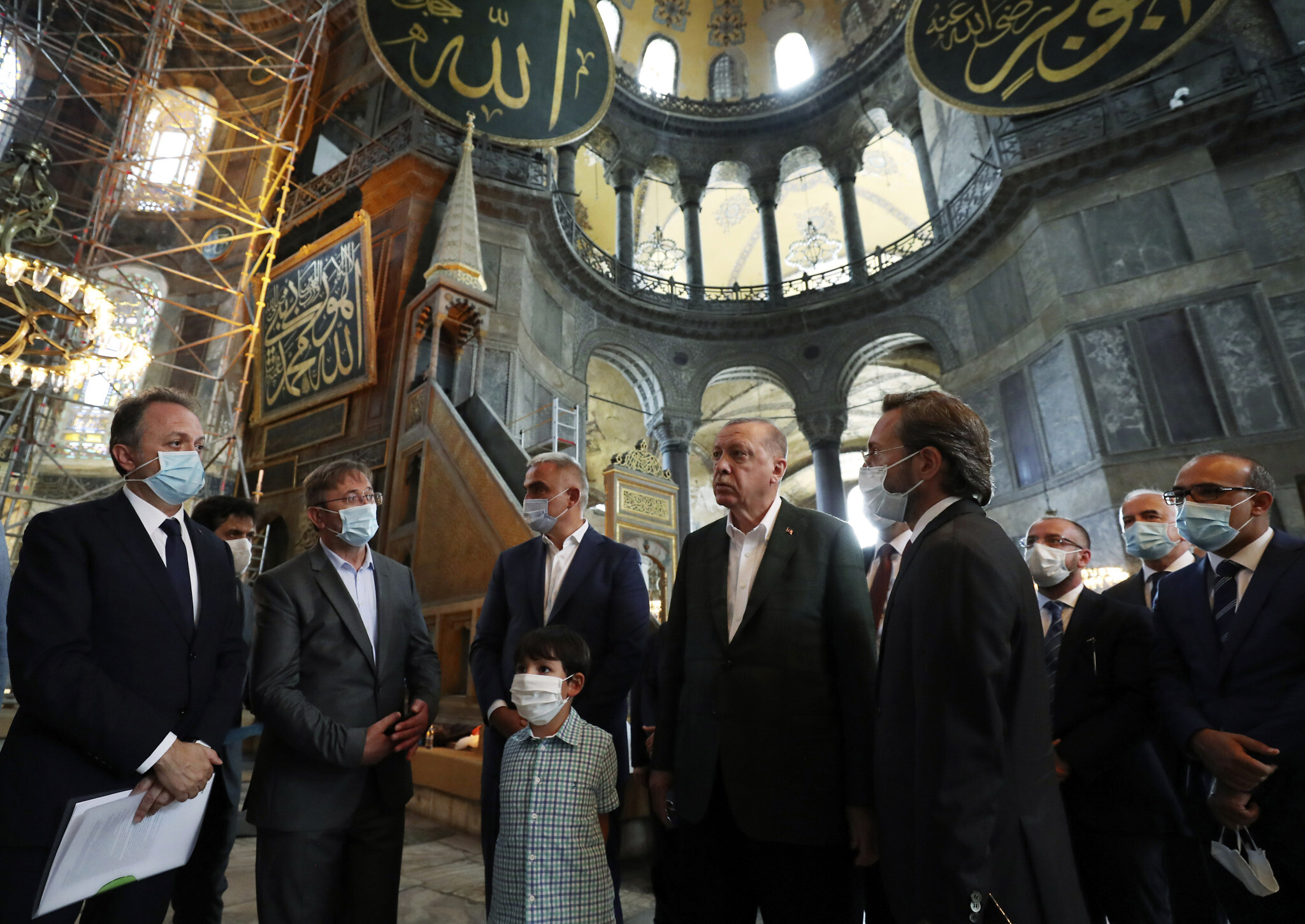
Turkey's President Recep Tayyip Erdogan, center, and other officials visit the Byzantine-era Hagia Sophia, one of Istanbul's main tourist attractions in the historic Sultanahmet district of Istanbul, July 19, 2020, days after he formally reconverted Hagia Sophia into a mosque and declared it open for Muslim worship, after a high court annulled a 1934 decision that had made the religious landmark a museum.(Turkish Presidency via AP, Pool)
ISTANBUL — Turkish President Recep Tayyip Erdogan paid a surprise visit to Hagia Sophia on Sunday just days before the first Muslim prayers are due to be held at the Istanbul landmark since it was reconverted to a mosque last week.
In a lightning visit billed as an inspection, Erdogan took stock of the conversion work, the president’s office said, providing pictures showing scaffolding inside the building.
Diyanet, the country’s religious authority, said Christian icons would be curtained off and unlit “through appropriate means during prayer times.”
“Our goal is to avoid harming the frescoes, icons and the historic architecture of the edifice,” Erdogan’s spokesman Ibrahim Kalin said in a television interview on Sunday.
It was unclear whether Erdogan planned to be among some 500 worshippers set to attend Friday prayers.
Get The Times of Israel's Daily Editionby email and never miss our top stories
Turkey’s top court paved the way for the conversion in a decision to revoke the edifice’s museum status conferred nearly a century ago.
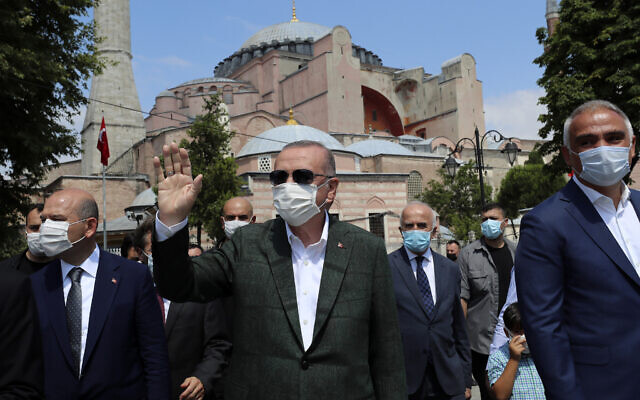
Turkey’s President Recep Tayyip Erdogan, center, salutes supporters as he visits the Byzantine-era Hagia Sophia, in the background, one of Istanbul’s main tourist attractions in the historic Sultanahmet district of Istanbul, July 19, 2020, days after he formally reconverted Hagia Sophia into a mosque and declared it open for Muslim worship, after a high court annulled a 1934 decision that had made the religious landmark a museum. (Turkish Presidency via AP, Pool)
The sixth-century building had been open to all visitors, regardless of their faith, since its inauguration as a museum in 1935.
Earlier this week, Diyanet said the building would continue to be open to all visitors outside the hours given over to prayer.
Advertisement
The UNESCO World Heritage site was built as a cathedral during the Byzantine empire but converted into a mosque after the Ottoman conquest of Constantinople in 1453.
It was designated a museum in a key reform of the post-Ottoman authorities under the modern republic’s founder Mustafa Kemal Ataturk.
Erdogan said last year it had been a “very big mistake” to convert the Hagia Sophia into a museum.
Help us report truthfully on social media
As a multimedia journalist, my job is to take the quality, fact-based journalism produced by The Times of Israel newsroom and make it accessible across every platform — from Instagram posts to podcasts to short-form videos.
This is how many, especially young people, consume news these days. But misinformation is rampant on social media. Our team at ToI produces accurate, responsible short-form reporting on Israel and the Jewish world.
If you believe in the importance of factual social media journalism, please consider joining our reader support group, The Times of Israel Community. Your financial support is essential to sustain responsible multimedia reporting.
We’re really pleased that you’ve read X Times of Israel articles in the past month.
That’s why we started the Times of Israel - to provide discerning readers like you with must-read coverage of Israel and the Jewish world.
So now we have a request. Unlike other news outlets, we haven’t put up a paywall. But as the journalism we do is costly, we invite readers for whom The Times of Israel has become important to help support our work by joining The Times of Israel Community.
For as little as $6 a month you can help support our quality journalism while enjoying The Times of Israel AD-FREE, as well as accessing exclusive content available only to Times of Israel Community members.
Thank you, David Horovitz, Founding Editor of The Times of Israel


 Add ToI as a Preferred Source on Google