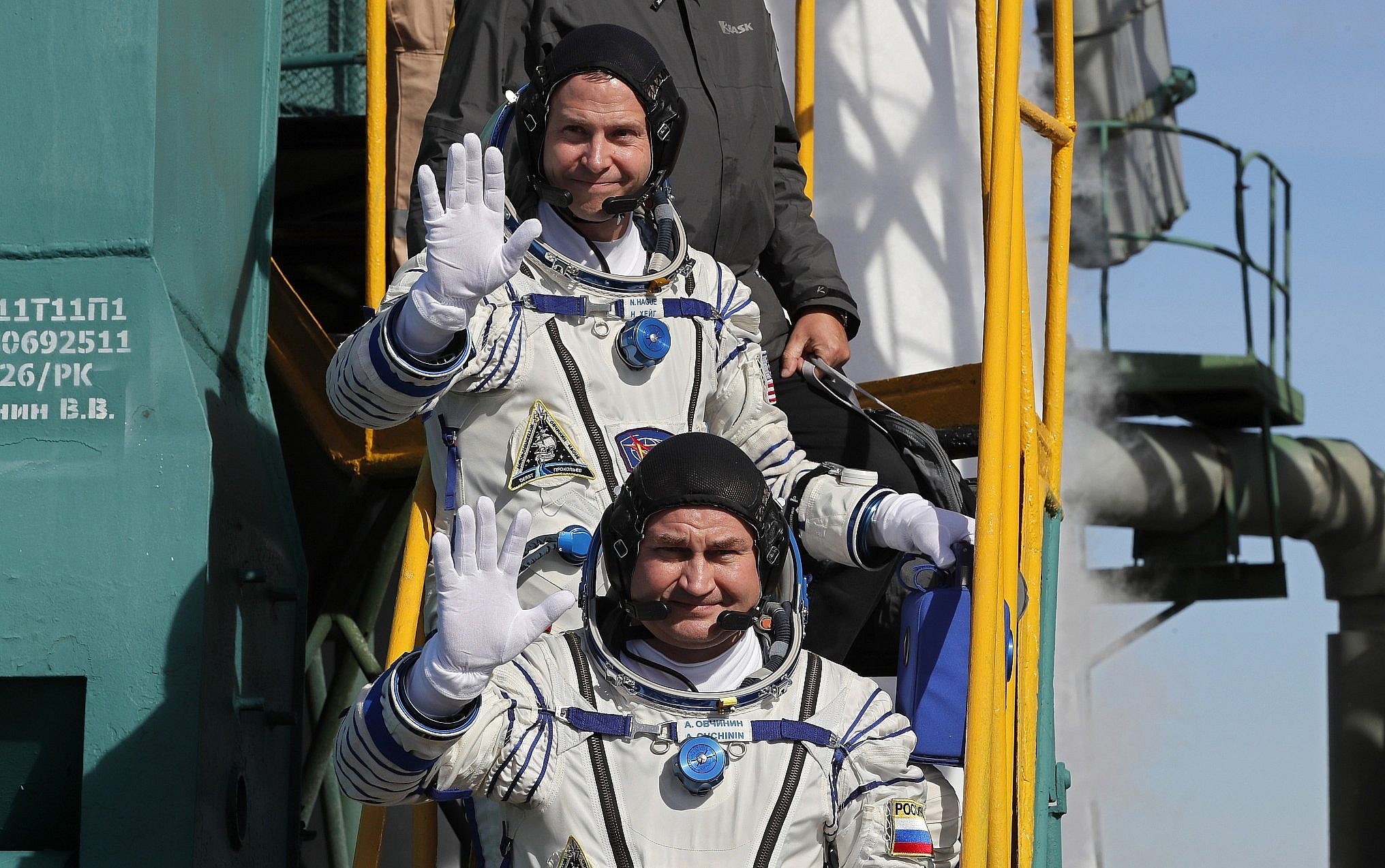
US astronaut Nick Hague, right, and Russian cosmonaut Alexey Ovchinin, crew members of the mission to the International Space Station wave as they board the rocket prior to the launch of Soyuz-FG rocket at the Russian leased Baikonur cosmodrome, Kazakhstan, October 11, 2018. (Yuri Kochetkov, Pool Photo via AP)
BAIKONUR, Kazakhstan (AP) — Two astronauts from the US and Russia were safe after an emergency landing Thursday in the steppes of Kazakhstan following the failure of a Russian booster rocket carrying them to the International Space Station.
NASA astronaut Nick Hague and Roscosmos’ Alexei Ovchinin lifted off as scheduled at 2:40 p.m. Thursday from the Russia-leased Baikonur cosmodrome in Kazakhstan atop a Soyuz booster rocket. Roscosmos and NASA said the three-stage Soyuz booster suffered an emergency shutdown of its second stage. The capsule jettisoned from the booster and went into a ballistic descent, landing at a sharper than normal angle.
The launch failure marks an unprecedented mishap for the Russian space program, which has been dogged by a string of launch failures and other incidents.
“Thank God, the crew is alive,” Russian President Vladimir Putin’s spokesman Dmitry Peskov told reporters when it became clear that the crew had landed safely.
They were to dock at the orbiting outpost six hours later, but the booster suffered a failure minutes after the launch.
Get The Times of Israel's Daily Editionby email and never miss our top stories
The Soyuz-FG rocket booster with Soyuz MS-10 space ship carrying a new crew to the International Space Station, ISS, flies in the sky at the Russian leased Baikonur cosmodrome, Kazakhstan, October 11, 2018. (AP Photo/Dmitri Lovetsky)
NASA and Russian Roscosmos space agency said the astronauts were in good condition after their capsule landed about 20 kilometers (12 miles) east of the city of Dzhezkazgan in Kazakhstan.
Search and rescue teams were heading to the area to recover the crew. Dzhezkazgan is about 450 kilometers (280 miles) northeast of Baikonur. Spacecraft returning from the ISS normally land in that region.
Advertisement
Help us report truthfully on social media
As a multimedia journalist, my job is to take the quality, fact-based journalism produced by The Times of Israel newsroom and make it accessible across every platform — from Instagram posts to podcasts to short-form videos.
This is how many, especially young people, consume news these days. But misinformation is rampant on social media. Our team at ToI produces accurate, responsible short-form reporting on Israel and the Jewish world.
If you believe in the importance of factual social media journalism, please consider joining our reader support group, The Times of Israel Community. Your financial support is essential to sustain responsible multimedia reporting.
We’re really pleased that you’ve read X Times of Israel articles in the past month.
That’s why we started the Times of Israel - to provide discerning readers like you with must-read coverage of Israel and the Jewish world.
So now we have a request. Unlike other news outlets, we haven’t put up a paywall. But as the journalism we do is costly, we invite readers for whom The Times of Israel has become important to help support our work by joining The Times of Israel Community.
For as little as $6 a month you can help support our quality journalism while enjoying The Times of Israel AD-FREE, as well as accessing exclusive content available only to Times of Israel Community members.
Thank you, David Horovitz, Founding Editor of The Times of Israel


 Add ToI as a Preferred Source on Google