

We were there. The Supreme Court did not tie the IDF’s hands on the Gaza border
Two former senior IDF officers: Baseless claims that the Court restricted open-fire rules before the October 7 attacks are merely a pretext to dodge a state commission of inquiry
 Add ToI as a Preferred Source on Google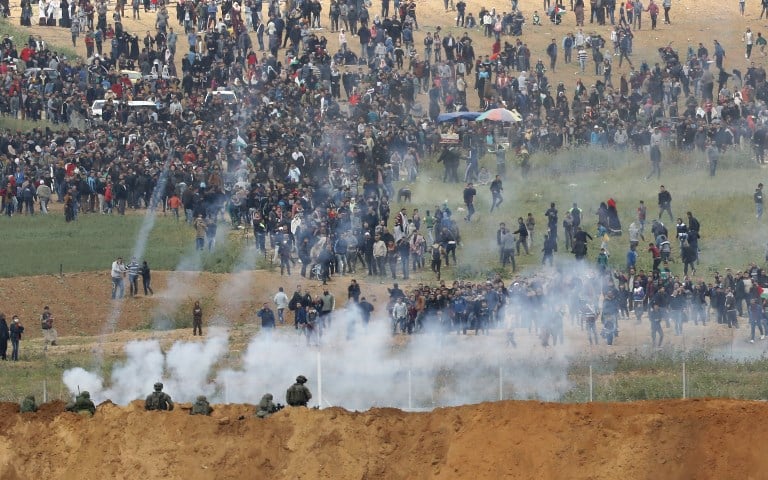
One of the central arguments raised by government ministers and others opposing the establishment of a state commission of inquiry into the October 7 massacre – whose members would be appointed by the President of the Supreme Court – is that the Court itself bears responsibility for the events because of the restrictions it allegedly imposed on the IDF’s rules of engagement directed at Gazan Palestinians approaching the border with Israel in the years prior to the war.
This is a severe accusation that, in effect, alleges the Court is to blame for Israeli civilian and military casualties. Given the gravity of this allegation and its use as a pretext to prevent such a critical, independent investigation into the October 7 massacre, we found it appropriate to set the record straight.
The Court case at the heart of these allegations addressed the rules of engagement that the IDF implemented with respect to the violent events organized by Hamas along the Gaza-Israel border in 2018 and 2019. These events – called the “Great Return Marches” by Hamas – included ongoing violent attempts by masses of Palestinians in the Gaza Strip (civilians and operatives) to sabotage and destroy Israel’s defensive security infrastructure along the border, penetrate Israel’s territory, and harm Israeli civilian security forces. We were personally involved in the IDF’s efforts to address these violent border events, serving as the IDF’s Head of the Operations Directorate, responsible at the time for the rules of engagement, and as the Head of the military’s International Law Department, providing operational legal support.
In early 2018, intelligence emerged that made clear Hamas’s intention to partake in the organization of violent mass marches of Gazan civilians toward the border with Israel, aiming to carry out attacks under their cover. The IDF prepared operationally to confront the challenge of repelling a crowd composed largely of civilians seeking to breach the border. As part of this process, the rules of engagement already in force at the time were reviewed. The conclusion reached by the operational authorities was that these guidelines provided the IDF with sufficient operational tools and granted commanders in the field appropriate operational discretion.
Beyond serving as a pretext to thwart accountability by avoiding the establishment of a state commission of inquiry, [the allegations] in fact reflect a rejection of the very concept of the rule of law.
The rules permitted, in certain operational circumstances, sniper fire directed at the legs of a person identified as a “central instigator” or “key rioter” in a violent riot that posed a clear and present danger to the lives and bodily integrity of Israeli civilians and Israeli security forces. This was authorized where, in the assessment of the senior commander in the field, incapacitating that individual was expected to deter the crowd approaching the border, and only after other, less lethal means had been exhausted and proven ineffective.
The implementation of these rules on the ground indeed proved effective. Although the riots along the border were violent, involved tens of thousands of civilians among whom armed operatives concealed themselves, and continued for approximately a year and a half, the IDF successfully fulfilled its mission of preventing mass infiltrations into Israel and harm to nearby Israeli townships.
At the same time, because of the terrain conditions and the operational circumstances, the use of sniper fire also led to widespread unintended harm to Gazan civilians, including children, at times when they were hundreds of meters from the border fence. This gave rise to severe criticism of IDF operational policy both within Israel and abroad, and in April 2018, human rights organizations petitioned Israel’s Supreme Court, challenging the legality of the rules of engagement and requesting that the Court invalidate them.
Related: Judiciary slams Levin for claiming High Court constrained IDF at Gaza border
In this context, it is important to note that the legal interpretation underpinning the rules of engagement, as formulated by the Military Advocate General’s Corps and approved by the State’s Attorney General, was not devoid of legal controversy, and many around the world – governments and external experts alike – argued that it contravened international law. This was because the rules permitted lethal fire against civilians even where those individuals themselves posed no concrete danger to the lives or bodily integrity of IDF forces, but rather because they were considered primary drivers of the violent riot that posed such danger as a whole, and because of the anticipated effect that incapacitating them would have in removing such danger.
IDF legal advisers were accused internationally of legitimizing an unlawful operational policy. Nevertheless, the State’s representatives defended the legality of the rule of engagement before the Supreme Court. When the Court held a hearing on the petition, we were both present in the courtroom to provide operational and legal support to the representatives of the State Attorney’s Office.
At the conclusion of the proceedings, the Court rejected the petitions and ruled that it could not be determined that the rules of engagement were unlawful. The judgment adopted the legal interpretation presented by the state in a precedent-setting manner. In other words, the Court did not intervene in the rules of engagement implemented by the IDF.
We would add that just as the rules of engagement did not change before the petition to the Supreme Court was filed or as a result of it, so too they did not change following the judgment. Over time, with changes in the nature of the violent events along the border, and as part of the operational lessons learned, the IDF implemented certain changes in the manner in which force was employed, with the aim of reducing harm to innocent Palestinian civilians without endangering our forces.
The bottom line is that the rules of engagement on the Gaza border were determined in accordance with operational needs. Military legal advisers assisted the IDF in creating the legal framework that would enable an effective response to those needs. The Supreme Court had no restrictive influence whatsoever on the rules. In fact, the Court’s ruling greatly assisted Israel in coping with diplomatic criticism and the challenges of delegitimization in the international arena, thereby contributing in practice to preserving the IDF’s operational freedom of action over time, as well as to the legal protection of IDF commanders and soldiers.
The allegations now being lodged against the Supreme Court are unfounded. Beyond serving as a pretext to thwart accountability by avoiding the establishment of a state commission of inquiry, they in fact reflect a rejection of the very concept of the rule of law – namely, that military operational activities are subject to legal rules that at times may also limit them. But limitations on the use of force, both ethical and legal, are an essential condition for the existence of a professional and ethical people’s army. Judicial review assists in this and contributes to the resilience of the IDF and, therefore, the security of the State of Israel.
—
Maj. Gen. (res.) Nitsan Alon served as Head of the IDF Operations Directorate during the Gaza violent border events in 2018.
Col. (res.) Dr. Eran Shamir-Borer is the Director of the Israel Democracy Institute’s Center for Security and Democracy, and previously served as Head of the International Law Department of the IDF’s MAG’s Corps, including during the Gaza violent border events in 2018.


The Times of Israel Community.