

Women stand up as one steps down
Weinstein sex abuse scandal continues to resonate in Israel with more revelations; veteran lawmaker resigns
 Add ToI as a Preferred Source on Google
Adiv Sterman is a breaking news editor at The Times of Israel.

The different focuses of the Hebrew-language newspapers reflect the numerous topics currently on the mind of the Israeli public, from sexual abuse to the departure of political rivals to investigations against the prime minister.
In light of the mounting allegations of sexual assault against Hollywood mogul Harvey Weinstein and as countless women around the world recount their instances of sexual harassment using the hashtag #MeToo, Yedioth Ahronoth, for a second day in a row, leads with a series of devastating accounts by Israeli celebrities who recall how they too suffered sexual abuse.
“He offered to promote me if I spent the night with him at a hotel,” writes sports broadcaster Miri Nevo of an unnamed top executive at a television station where she worked. “His expression at that moment said it all; I knew I would never get that promotion.”
Mika Almog, an author and a journalist, urges women to speak up and demand change in the public sphere.
“They will only hear us if we scream out together,” Almog writes. “The [#MeToo] campaign revealed not only that there is not one woman who did not experience some form of sexual harassment or abuse (ranging on a scale from the embarrassing and uncomfortable, to the murder of the body and the soul), it also revealed that when women unite against these crimes – as a group, a collective – we have amazing power.”

Almog adds that it is not fair to judge a woman for remaining silent in the face of abuse, but adds that it is society’s imperative to protect those who can’t raise their voice. The author concludes by urging women in positions of power to pave the way for more marginalized individuals in speaking against harassment. “We cannot let each other be alone, we must safeguard one another,” Almog says.
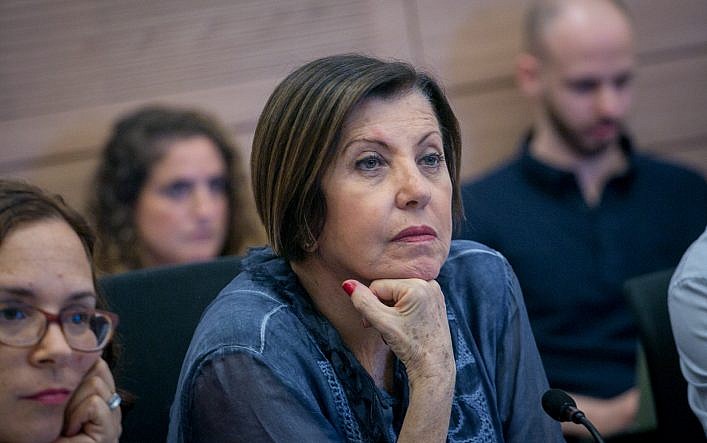
In Israel Hayom, the typically hardline columnist Chaim Shain bids a surprisingly heartwarming farewell to political rival and Meretz chairwoman Zehava Galon, after the left-wing parliamentarian announced her resignation from the Knesset yesterday in order to concentrate her efforts on enacting open primaries within her party.
“In Israel, it’s difficult to have an influence while sitting in the opposition,” Shain writes. Galon proved that if there is an issue worthy of attention and determination, there is no impediment to a small party advancing legislation. Shain praises Galon for standing up for her principles amid heavy backlash from her detractors, but also, sometimes, in the face of criticism from her natural allies.
“I do not agree with Zehava Galon’s stance on the essence of the State of Israel, its vision, and its path,” the right-wing writer acknowledges. “But nevertheless I have a deep respect for her integrity, her fairness, and her willingness to pay a price for ideals.”
Shain recalls how in the name of freedom of speech, Galon opposed a Knesset bill which would effectively bring Israel Hayom’s operations to an end, even as other figures on the left pushed to advance the legislation.
“The culture of disagreement is embedded in the DNA of the Jewish people, but I wish upon ourselves to have fair and honest adversaries such as Zehava Galon,” Shain concludes.
Meanwhile, in Haaretz, contributor Dan Margalit, who in recent months has been highly critical of Prime Minister Benjamin Netanyahu’s conduct with regards to the numerous investigations being conducted against him, argues that Netanyahu’s unprecedented attack on Israel Police Commissioner Roni Alsheich amounts, in essence, to a sort of confession.
Netanyahu suggested that Alsheich was behind a series of leaks from the two criminal investigations into alleged corruption by the prime minister and that the leaks had become “a tsunami” after the police chief appointed a political adviser, Lior Horev.
“If Netanyahu truly believed that [he was innocent], he would not attack the police chief in a way reminiscent of criminals, but would instead urge [Alsheich] and the attorney general to hasten the investigation in order to prove his innocence,” Margalit asserts. “Unfortunately for [Netanyahu], he was unable to deter Alsheich. The current police chief did not lose self-control and he is immune to fiery rhetoric.”
Margalit writes that he believes the prime minister will not be able to continue avoiding the reality of his situation for long.
“Netanyahu thinks his power will hold forever,” says Margalit. “But his government is deepening its delegitimization in Israel and abroad.”

Back in Yedioth, the daily covers the emergence of a mysterious app called Miriam which urges teenagers to commit acts of violence. The app presents a young girl asking players to help her find her way home, but while the story starts off on a fairly innocent tone, the virtual protagonist soon pushes users to become increasingly aggressive, all the while using scary effects and sounds in the background. The app even demands a payment at later stages for continued access to the game.
Following complaints by students and teachers about the game, schools were instructed by the Education Ministry to discuss the dangers that might come up while using phone apps.
“The ministry provides educational teams the tools and knowledge necessary in order to help students and guide them to use the internet in a wise manner, to impart to them proper behavioral norms, and to avoid dangerous behavior,” Shmuel Abouav, the Education Ministry’s director general, is quoted by Yedioth with regards to the Miriam app.








The Times of Israel Community.