

The newly silent prime minister
When Netanyahu kept talking about Iran, everyone become nervous. Now that he’s stopped, should we be even more concerned?
 Add ToI as a Preferred Source on Google
Raphael Ahren is a former diplomatic correspondent at The Times of Israel.
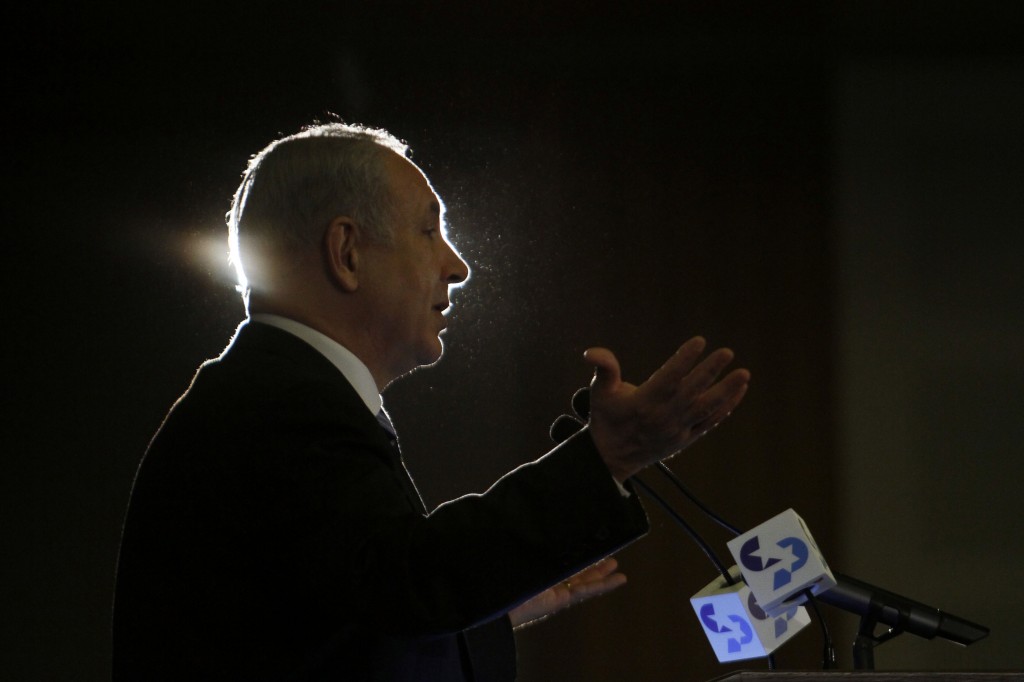
Sometimes saying nothing at all says everything. Could Prime Minister Benjamin Netanyahu’s recent radio silence on Iran be the calm before the storm?
Netanyahu is not usually a tightlipped politician, especially when it comes to topics he loves talking about. But during the last few days, the prime minister has become taciturn. He still likes to talk, but, strangely, he’s been avoiding controversial issues, especially his favorite topic: the Iranian threat. During a 30-minute speech Sunday night, when he had the ear of the local and international press, along with that of the world’s Jewish movers and shakers, he barely brushed against Mahmoud Ahmadinejad and his nuclear program.
“We face four great challenges,” he said at the annual gathering of the Conference of Presidents of Major Jewish Organizations in Jerusalem. “The first is nuclear. There is so much talk about it that I’m not going to bore you with more details, so I’ll move on with the next one.”
The crowd started laughing, but Netanyahu wasn’t joking. He went on to talk about what he sees as challenge number two, missiles and rockets aimed at Israeli cities from hostile neighbors.
One reporter looked up from his laptop in disbelief and asked: “Is he serious?”
In the entire speech, Netanyahu mentioned Iran only once, to say the government had rigged the last elections and denied the masses the right to liberty. He didn’t refer to the Hamas-Fatah unity government or Palestinian incitement against Israel — usually among his favorite topics. He also didn’t comment on the statements made by Gen. Martin Dempsey, the chairman of the US Joint Chiefs of Staff, who earlier that day had advised Israel against attacking Iran, nor did he say anything about his meeting that same evening with US National Security Adviser Tom Donilon.
Of course Netanyahu still believes that Tehran’s nuclear program is a threat not only for Israel but for the entire Western civilization. If analysts suspect that the increasing number of American military and intelligence officials visiting Jerusalem means they’re smelling a potential Israeli strike, what are we to understand from Netanyahu becoming suddenly so quiet about Iran?
Netanyahu knows how to keep mum when it will help strategically. He has kept relatively quiet on Syria and President Bashar Assad’s brutal crackdown on civil protests. As a Haaretz report described last week, the prime minister’s approach differs from that of Foreign Minister Avigdor Lieberman: While Lieberman increasingly feels Israel is morally obligated to condemn Assad, Netanyahu fears that by openly opposing the dictator he might weaken those who fight against him. Netanyahu thus has never publicly called for regime change.
But even back at home, Netanyahu seems hesitant to take a stand these days. In Sunday’s speech at the Conference of Presidents, he briefly mentioned the disagreement between Defense Minister Ehud Barak and Finance Minister Yuval Steinitz, who argued Sunday about how much money the state needs to pay to the military.
“What we see is such a huge transformation in our region,” he said, referring to the Arab Spring. “We know that we will have to spend a lot more to defend ourselves. And we have — we just increased our defense budget by 3 billion shekels, that’s a lot. But the defense establishment says we want more. This is like the joke about the rabbi: the Finance Ministry says we spent more, and [the Defense Ministry] says we want more. They’re both right.”
Is the prime minister conflicted? Being quiet for strategic reasons? When he talked constantly about Iran, it put everyone on alert. Now that he’s finally stopped going on about it, should we be more worried?




The Times of Israel Community.