

Ah! The generals!
Two ex-chiefs of staff lash out against Netanyahu, hurling down the gauntlet, while another two wade into a non-political organization ‘against fear’
 Add ToI as a Preferred Source on Google
Ilan Ben Zion is an AFP reporter and a former news editor at The Times of Israel.
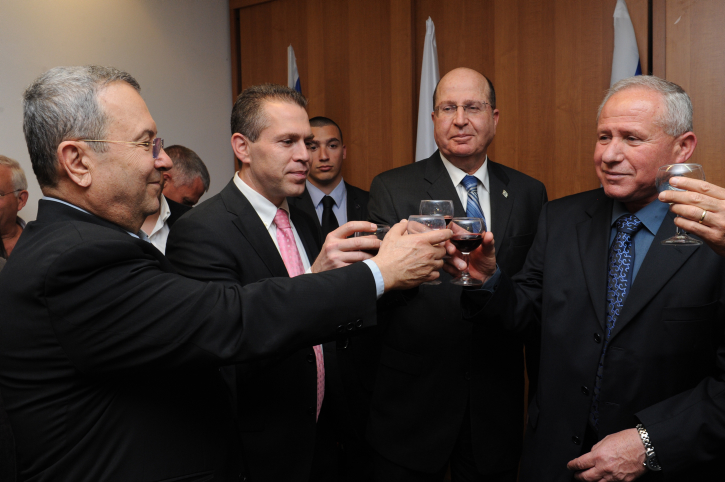
Friday’s front pages are brimming with photos of ex-IDF chiefs of staff, as Moshe Ya’alon and Ehud Barak bludgeon Prime Minister Benjamin Netanyahu at the Herzliya Conference and Gabi Ashkenazi and Benny Gantz dip their toes in politics. All four served under Netanyahu, and all four lashed out at him in one way or another on Thursday. For his part, Netanyahu channels the Greek playwright Aristophanes in his dismissal of stinging remarks made by former defense chiefs on Thursday: “Ah! the Generals! they are numerous, but not good for much!” as the Athenian wrote centuries ago.
“Generals’ rebellion,” reads the headline in Yedioth Ahronoth in its characteristic punchy style. “Ya’alon and Barak in a scathing attack on Netanyahu: He’s dividing the nation and bringing us to the edge of the abyss,” is Haaretz‘s, opting for a wordier but more dramatic approach. Israel Hayom takes the defensive, quoting Netanyahu in its clunky front page headline: “Ya’alon and Barak are out — and say the opposite of what they did in when they were in their position.”
In his speech, Ya’alon said Netanyahu’s government should “cease terrifying its citizens” and “blinding” the country with imaginary existential threats. He threw down the gauntlet to challenge Netanyahu in the next elections. Barak, speaking later at the same conference, called the government “weak, flaccid and noisy,” exhibited “budding fascism,” and charged that it had a “covert agenda” to scuttle the two-state solution.
Israel Hayom turns the story on its head, with its main coverage starting with the Likud party’s reaction to the “attack of the has-beens,” as it calls Barak and Ya’alon. “It would appear that this evening the Herzliya Conference turned into a primaries for the party of the disgruntled for the position of the savior of the Left,” the paper quotes an unnamed Likud source saying. “Those who found themselves out of politics stand behind every open mic before them and in fiery speeches say exactly the opposite from what they said while in office — the crux is to get some headlines in the press and keep in the public eye.”
Eclipsed by the former defense ministers’s tirades is Ashkenazi and Gantz’s enlistment in an educational movement aimed at “setting an agenda of hope and not fear, when fear is being sown from every direction,” Yedioth Ahronoth reports. Haaretz notes that the educational-social organization founded by former education minister Shai Piron is trying to unite secular and religious Israelis around common ground. Piron insisted in a Channel 2 interview that it’s “not a political movement, it has no aim to topple anybody, certainly not Netanyahu.” Israel Hayom gives it far less credence than the other two papers.
Coming to Netanyahu’s defense, Israel Hayom’s op-eds go on the offensive, with Dan Margalit calling Ya’alon’s and Barak’s comments “a declaration of war” and Matti Tuchfeld being as dismissive of them as Netanyahu.
“It seems there was never a speech delivered so dramatically and so full of self-importance, that was at the same time so irrelevant, as the speech of someone of who relevance is only a vague memory,” Tuchfeld digs at Barak. All the recent chatter about changing the government is moot, he goes on, smacking of propaganda, because “Netanyahu, with his new coalition of 66 MKs, will handily overcome the infantile hurdles that come in his path until the long break which will last until after the High Holidays; the feeling of elections, which some delude themselves is already in the air, will vanish without a trace.”
Netanyahu said nothing to debunk the charges leveled by Ya’alon and Barak, he only attacked them ad hominem, Yedioth Ahronoth’s Nahum Barea writes. He says their speeches “grew out of a certain feeling, a feeling of emergency, which is rising in many places in Israel.”
These may be the old elites detested by Netanyahu and his supporters, Barnea concedes, “but the outcry is earnest and true: much of what has happened here in the past year brings us close, as Barak said yesterday, to the edge of the abyss.”
What Barak and Ya’alon supported or didn’t during their tenures as defense minister (or in Barak’s case, prime minister as well) doesn’t detract from what they said Thursday “and doesn’t erase the writing they see on the wall,” Barnea asserts. “After a yearlong ongoing victory celebration, a drunken stupor, the government is starting to pay the price for its excesses, for its militancy. It’s paying it around the world and it’s paying it at home. Barak and Ya’alon are just the tip of the iceberg.”
Haaretz’s pundits have surprisingly little to say about the matter. Reporter Barak Ravid channels the founding father of Zionism Theodor Herzl with an analysis entitled “In Herzliya, real opposition to Benjamin Netanyahu was established.”
“Compared to the angry denunciations of Barak and Ya’alon, his other potential rivals — opposition leader Isaac Herzog, who still seems to be praying to join the coalition; Yesh Atid chairman Yair Lapid, who consistently refrains from attacking Netanyahu; and Kulanu chairman Moshe Kahlon, who falls in line with the prime minister’s every whim – look like utter political dwarves,” he writes.
“Barak and Ya’alon’s addresses should very much worry Netanyahu, politically,” Ravid says. ” Ya’alon and Barak are a part of a group that carries weight in the public Israeli sphere — from the right, center and left — that starts to gather, challenging Netanyahu and might start working, together or apart, to depose him. If Herzog, a relatively lightweight opponent, managed to bring more than 800 thousand voters, Netanyahu should be worried about competing against heavyweight candidates who know a thing or two about him and his weaknesses.”





The Times of Israel Community.