

Bleeding and leading
‘The face of war’ runs to the front page of Israel Hayom and most international papers, but is conspicuously missing from the rest of the Heebs
 Add ToI as a Preferred Source on Google
Ilan Ben Zion is an AFP reporter and a former news editor at The Times of Israel.
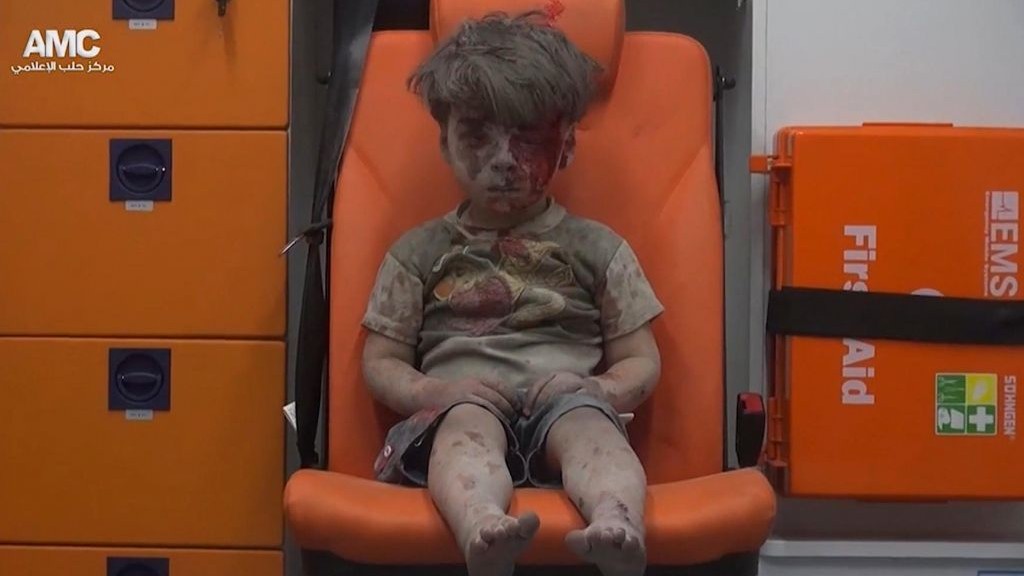
It’s Friday and the Hebrew newspapers unwind after a week of virtually no local news and kick back, relax and put together a smattering of stories that they pulled out of the mothballs for lack of any hard news. But whereas most international papers have the same image on the front page on Friday — that of a Syrian boy injured in Aleppo who has become iconic of the increasingly bloody and horrific conflict — just one Israeli paper follows suit.
For the sake of comparison, the photo of Omran Daqneesh is on the front page of Friday’s New York Times, Wall Street Journal, Financial Times, El Pais, The Times of London and a slew of other international and local papers. The front page photo in Haaretz, however, is from a New York Times article published earlier this week about the resurgence of malaria in Venezuela. Yedioth Ahronoth features a pile of wreaths laid across the grave of an Israeli composer buried Thursday.
The footage of Daqneesh, a Syrian boy pulled from the rubble of Aleppo who has flooded social media in the past 24 hours, is the centerpiece of Israel Hayom, in which it reports that the image has “disgusted the world — and may bring relief to the city.”
Since the stills from the video emerged online Thursday, the paper reports, Russia agreed in principle to a humanitarian ceasefire for two days and the European Union called for an immediate cessation of hostilities.
“If it weren’t for the video, it’s reasonable to assume that we wouldn’t be talking about Syria today,” Israel Hayom’s Boaz Bismuth writes. “Nor about the city of Aleppo or about the unfortunate children who live there.” Out of nowhere, Bismuth is suddenly the champion of human rights in Syria. But despite his exhortation that we all must make the future of children more important than anything else, his argument isn’t backed up by any concrete call to action or substantive suggestions. He merely bemoans the misfortunes of the innocents caught up in the bloody civil war in Syria and reminds readers that it is still going on.
Surprisingly, Haaretz punts the little boy to Page 14, and uses it only as a sidebar to its coverage of the Amnesty report which found that nearly 18,000 Syrians have died in government prisons since the outbreak of the civil war in 2011, many from torture and horrific conditions. Yedioth Ahronoth puts him on Page 9, calling the image of the child’s bloodied and stunned visage “the face of war.” Israel Hayom keeps up its bloody headlining by following up Syria coverage with an assassination in broad daylight in the city of Bat Yam, just south of Tel Aviv.
Israelis without citizenship, who have no access to medical care, bank accounts, legal employment or passports, some of whom are refugees, others who immigrated illegally and couldn’t return home, is the subject of Haaretz’s big Friday exposé.
“On the one hand, we can’t deport them from Israel,” the paper explains. “On the other hand, they aren’t wanted here and live in constant fear.” The paper profiles a number of non-citizens living in Israel who have no other citizenship and highlights the hardships they face trying to live normally in the country.
The paper also lends considerable ink to analysis of the newspaper’s favorite bugbear: Prime Minister Benjamin Netanyahu and his domination of Israeli politics. Netanyahu quashed an attempt by Transportation Minister Yisrael Katz to grab power in the ruling party; Yossi Verter writes several thousand words on it.
The paper offers rare praise — even if backhanded — for Defense Minister Avigdor Liberman for his initiative to engage Palestinian civic leaders in an effort to bypass Palestinian Authority President Mahmoud Abbas.
“Any dialogue, whether official or unofficial, between Israelis and Palestinians holds out hope for better understanding between the parties,” the paper’s editorial says.
On the other hand, it expresses concern about the fact that said conversations would take place while “the government is continuing to build in the settlements, arrest activists who aren’t suspected of terrorism just because of their political activity, try people for incitement when they make harshly critical statements about Israel on Facebook, and hold the bodies of dead Palestinians suspected of committing terror attacks in cold storage in defiance of rulings by the High Court of Justice.”
“For as long as Liberman’s initiative contains nothing of substance that is new, no ray of light that the Palestinians could grasp at to justify direct talks with the defense minister or his envoys, his idea will remain empty prattle,” it says.
With the Olympics in Rio coming to a close, Yedioth Ahronoth writes that the rhythmic gymnastics team is Israel’s final chance to bring home another medal, what would be Israel’s third in this year’s games. The rhythmic gymnasts are considered among the best in the world and Yedioth Ahronoth has no qualms about raising its readers’ expectations that they’ll be on the winners’ podium.
Their trainer is more sangfroid. “I think media is something determined from above,” Ira Vigdorchik tells the paper. “The training is the same training for a small tournament as the Olympics. There are the same demands and the same exercises. I don’t think about the medal but only about giving the maximum from myself and the best from the girls.”
Without anything to report on besides the fact that the gymnasts will be taking the mat Friday afternoon, the paper offers its readers profiles of the athletes.







The Times of Israel Community.