

Blinking and inking
Cautious optimism abounds for Shimon Peres and the fight he still has in him, and a US defense aid deal, which may have shrunk due to fighting
 Add ToI as a Preferred Source on Google
Joshua Davidovich is The Times of Israel's Deputy Editor
Not all big news is explosions, murder and mayhem. Sometimes the smallest of movements: opening eyes, lifting a hand, putting a John Hancock on a $38 billion check, can equal the biggest news of the year.
At least that is the case Thursday morning, as the press remains fixated on the minutiae of ailing former president Shimon Peres’s health – and in some cases will to live – accompanied by the official inking of a $38 billion defense aid package from the US to Israel.
While coverage is still full of tabloidy emotion, the papers attempt to strike a balance between news that Peres has made a slight recovery, including blinking his eyes and moving his arms, and the fact that he is not out of the woods yet.
“Worry and hope,” reads the main headline of Israel Hayom,.
“Cautious optimism – those were the two words repeated all through the day yesterday in answer to the question about Shimon Peres’s health,” the paper’s lede reads.
Even more optimistically, Yedioth Ahronoth declares the next 36 hours to be “critical” and quotes the head of neurosurgery at Sheba Medical Center, where Peres is hospitalized, saying that there’s a chance the former president won’t suffer any cognitive impairments, despite the stroke and brain hemorrhaging.
“According to him, it’s too early to say whether he will suffer motor impairment from the stroke, but the location of the part of the brain damaged can show that it’s possible that there was no cognitive damage,” the paper reports.
While Haaretz continues to stick to the dry facts and quotes from doctors on his slight improvement, in the tabloids, the focus seems to have shifted from cold hard medical reality to putting Peres’s survival in the hands of the elder statesman himself.
“My father never threw up his hands,” Yedioth Ahronoth screams across its front page, which is a confusing use of the idiom for not giving up, considering that lifting his hands was one of the few things Peres could do to show he is slightly on the mend.
“My father is a fighter and a man with extraordinary abilities,” the paper quotes Chemi Peres saying. “We have a long way to go but nobody is giving up. He’s a fighter and he will fight. And as he taught us his whole life, miracles happen.”
If it’s miracles they are looking for, Israel Hayom reports that among the well-wishers to join Peres at his bedside Wednesday was Rabbi David Yitzhak Grossman, an acquaintance of Peres, who beseeched heaven for his well-being.
“Peres opened his eyes, twice, looked at us, and so we said some Psalms together. It was very emotional. It’s interesting that everyone believes he can get better, which shows the glimmer of the Jewish soul,” the paper quotes Grossman.
It’s not the size of the package that counts
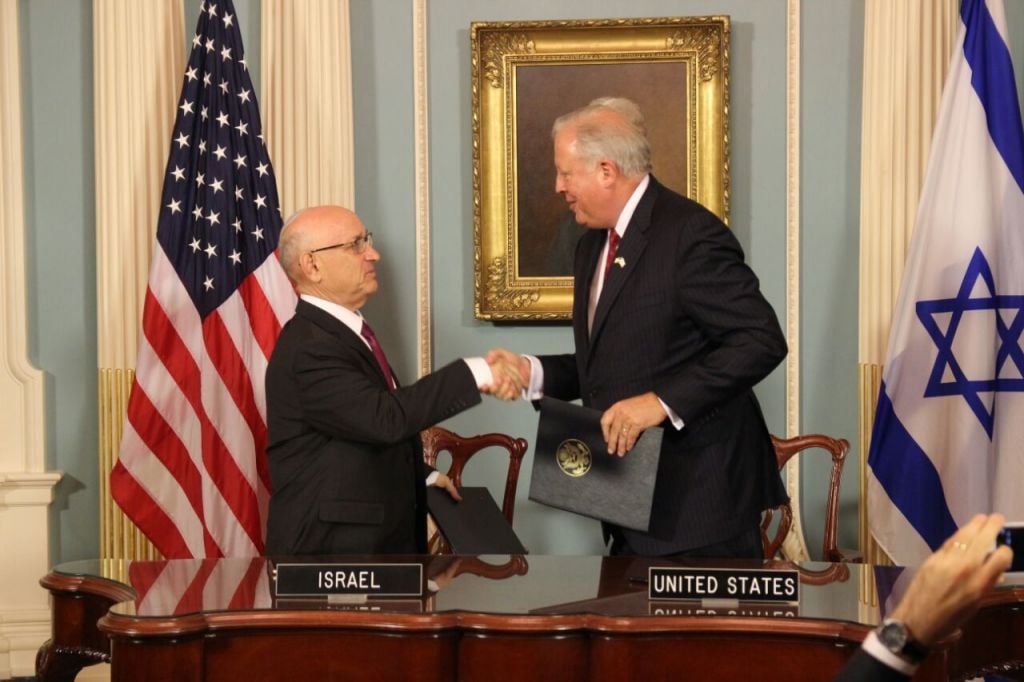
Sometimes praying isn’t enough, though, and you need to turn to non-deities for help, which Israel has shown it is adept at when it comes to securing defense aid from the US. Those skills were on full display Wednesday, as the two sides inked an agreement to up that aid money to some $3.8 billion a year for 10 years. Coverage, though, revolves not only on the massive size of the package, but whether it could have been bigger.
Giving an idea of just how much money that is, Israel Hayom spells out $38 billion, with all nine zeroes, across its front page.
If the paper’s attempt to play up the deal as a victory for Netanyahu were not enough, on the op-ed page Dror Eydar dredges up the uppity Jews of Sholom Aleichem’s fictional Yehupitz (really Kiev), whom he compares to those who complain Netanyahu would have gotten them more money if he just hadn’t been so stubborn over the Iran deal.
“Oy vey had he acted differently. What do these Jews of Yehupitz expect – who make peace with the Iranian threat to get a little more money? Where’s the spirit we had that created the state, captured Eichmann, sent soldiers to Entebbe and blew up Osirak – despite American and international protests? Oy oy oy, if only the prime minister hadn’t spoken in congress, Obama wouldn’t have been mad and we would have gotten more money. A disgrace,” he writes.
But in Haaretz, whose front page skips right over the news and leads in with analysis and commentary, Amos Harel takes a closer look at the deal and contends that Netanyahu’s actions added up to Israel losing out on more than just a few kopecks.
“The chasm between the headlines and the real numbers is huge. Nominally, Prime Minister Benjamin Netanyahu and his spokespeople are right. The agreement includes a commitment for $38 billion in aid over a decade, higher than the $31 billion in the current deal that ends in 2018. But it’s doubtful that this is a reliable comparison. At the insistence of the Obama administration, the new agreement is ‘all-inclusive’ – Israel has committed not to go behind the administration’s back to Congress to request more money,” he writes. “In other words, the real upgrade in the new ‘unprecedented’ agreement is around $100 million to $200 million annually compared with recent years, and that’s without considering inflation; neither the old nor new agreements account for erosion in purchasing power. But that’s small change compared with the $7 billion that many claim Netanyahu lost for Israel due to his performance on the Iranian nuclear agreement, his difficult relationship with President Barack Obama and the repeated delays in sealing the new agreement.”
Yedioth, which tries to strike a balance between pros and cons of the deal, quotes former national security adviser Uzi Arad basically confirming Harel’s analysis, with a doozy of a mixed metaphor.
“Bibi gambled and lost a historic opportunity,” he’s quoted saying. “The egg smashed on his face and Israel lost.”




The Times of Israel Community.