

Coalition to attempt to heal rift over new draft law
Shaul Mofaz has refused to meet with Prime Minister Benjamin Netanyahu, but Kadima says it’s in no hurry to leave the government
 Add ToI as a Preferred Source on Google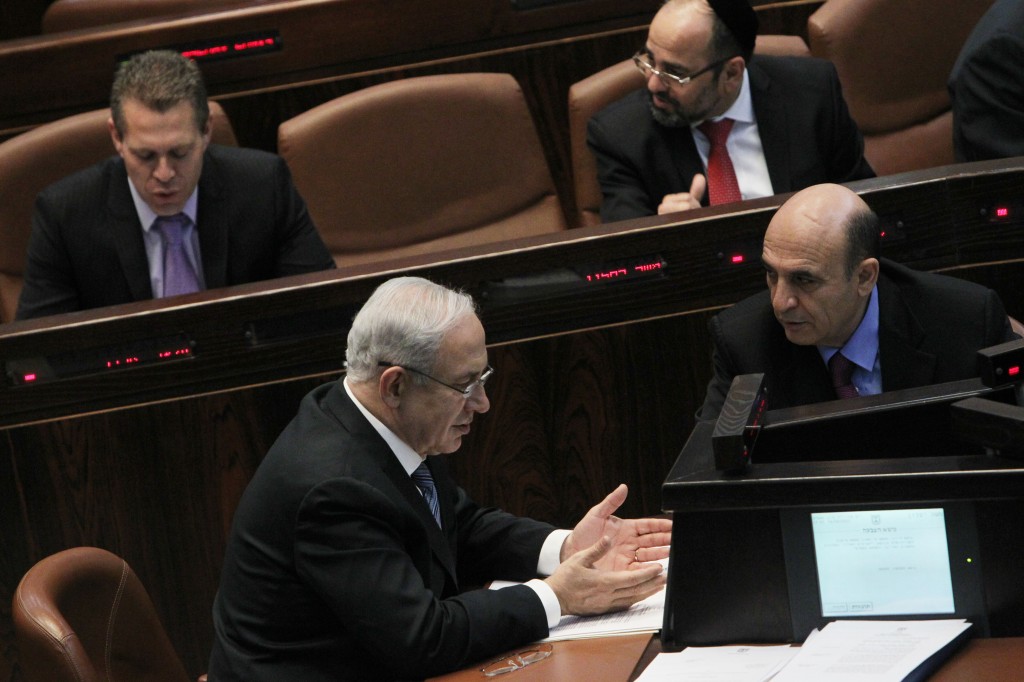
After two days of bickering and angry press conferences that included threats to unravel the national unity government, members of the governing coalition are to meet Thursday to attempt to settle their differences over the drafting of new legislation on universal conscription to military or civilian national service.
While Kadima chairman Shaul Mofaz, whose joining Prime Minister Benjamin Netanyahu’s government was contingent on the drafting of a law that would require equal enlistment terms for all citizens, refused to meet with the prime minister and threatened to leave the coalition, Ynet reported early Thursday morning that Kadima MKs would work throughout the day to prevent such a move. However, they added, any attempt by Netanyahu to take a “soft” stance on universal conscription would drive the party to bolt the government and work for early elections.
“If Netanyahu doesn’t adopt the Plesner Committee’s recommendations by Monday, Kadima must leave the coalition and call for early elections,” said Kadima MK Meir Sheetrit Thursday morning.
Netanyahu said Wednesday that he aimed to prepare a universal conscription bill, mandating Arab and ultra-Orthodox participation in national and military service, that would be acceptable to the coalition and applicable in practice.
Speaking in reaction to the publication of the Plesner committee’s recommendations regarding a replacement for the soon-to-expire Tal Law, Netanyahu said that “the ultra-Orthodox must integrate in military service, and Arab Israelis must integrate in national service, too.”
The so-called Tal Law was struck down by the Supreme Court earlier this year. For 10 years, the legislation had provided a virtual exemption from military or national service for ultra-Orthodox yeshiva students.
“The recommendations [of the Plesner committee] included important principles,” Netanyahu said. “My intention is to put forward a bill that includes Arabs and ultra-Orthodox [Israelis], which will win a majority in the Knesset and can be put into practice.”
“We are facing an historic change in Israeli society,” Netanyahu added. “The status quo can’t continue.”
Netanyahu’s comments came a full eight hours after an angry Mofaz had called a press conference accusing the prime minister of breaching coalition agreements by unilaterally dismantling the Plesner committee on Monday. Mofaz demanded that Netanyahu accept the recommendations of the defunct committee, which had been presented by its chairman, Yohanan Plesner, earlier Wednesday. Mofaz said the fate of the coalition was hanging in the balance, that “the ball is in the prime minister’s court,” and that Netanyahu would have to make up his mind in “a matter of days.”
Mofaz responded Wednesday evening to the prime minister’s statement saying that “now is the time for actions, not statements. For decisions not deceptions.”
“The prime minister’s statement evades the paramount challenge of fixing the illegality and injustice of granting a sweeping exemption to the ultra-Orthodox population,” Mofaz said. “The citizens of Israel expected clear statements by the prime minister. The servicemen and servicewomen expected a decision worthy of a leader, and historic and effective justice — but it appears as though they won’t receive it.”
The key recommendations included military service of 24 months or national service of 18 months for ultra-Orthodox conscripts; exemptions from service for 1,500 exceptional Torah scholars per year; and personal sanctions for those who avoid service. Plesner said a plan for national service for Israeli Arabs should be drafted and finalized by next March.





The Times of Israel Community.