

Countdown to new elections
It’s Lapid vs. Netanyahu vs. Livni. The question isn’t whether the coalition will crash and burn — it’s when
 Add ToI as a Preferred Source on Google
Marissa Newman is The Times of Israel political correspondent.
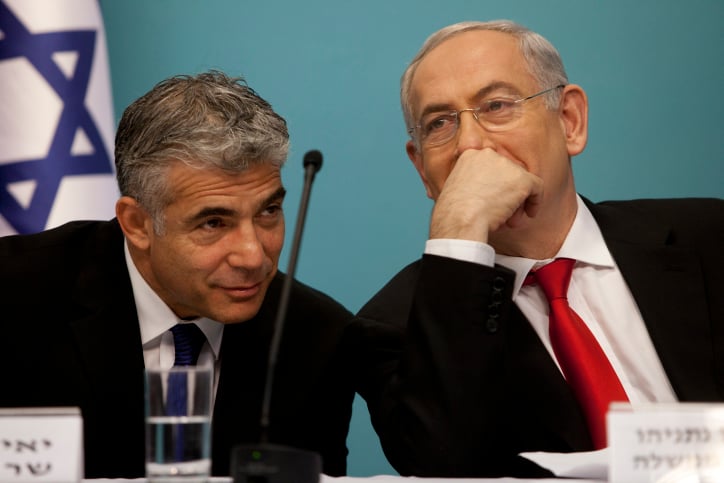
With increasing signs of intra-coalition strain, the Hebrew papers on Monday engage in one of their favorite pastimes – anticipating the dissolution of the government, and speculating when new elections will be held.
All three national dailies point to an imperiled coalition on Monday, but differ as to the source of tension: Haaretz and Israel Hayom point a finger at Finance Minister Yair Lapid, and spotlight reports that the ultra-Orthodox parties were approached by the prime minister to form a new coalition. Meanwhile, Yedioth Ahronoth pegs Lapid, along with Justice Minister Tzipi Livni, who sought to postpone the ministerial debate on the controversial “Jewish state” law in a move that was overridden by Netanyahu, as the sources of contention.
Haaretz characterizes the political situation as a “deep crisis,” centered around the annual budget. “Since last Tuesday, there has been a total disconnect between the finance minister, Yair Lapid, and the coalition head Ze’ev Elkin, and all efforts to advance the budget approval until now have failed,” it reports.
“Those in Netanyahu’s circle blame Lapid for attempting to undermine him and form an alternate coalition under his leadership even before elections.”
While the prime minister tried (unsuccessfully) to reach out to the ultra-Orthodox parties to reform the coalition, both Netanyahu and Lapid would have a hard time rebuilding the coalition without new elections, it reports, notably due to Foreign Minister Avigdor Liberman’s staunch opposition to including the Haredi parties or the left-wing Meretz party in the coalition.
The paper also quotes an unnamed senior politician criticizing Lapid for his threats to establish a new coalition.
“The finance minister ran to threaten Netanyahu that he has a coalition which would back him for prime minister, without holding negotiations to establish this process with us. This is not a serious threat, from a man who isn’t serious, who doesn’t understand how politics works,” he said.
Israel Hayom highlights the finance minister’s conciliatory remarks in a Channel 2 interview Sunday night, in which he backtracked on his statements entirely, and maintained that he was not interested in elections or reforming the coalition. But Likud MKs were largely unconvinced.
“In Likud, the response was: ‘Lapid, who says he doesn’t want elections because he knows he would lose in them, does not deny that he is trying to bypass the public’s wishes through a dirty trick that would make him prime minister through a shady political deal,’” it reports.
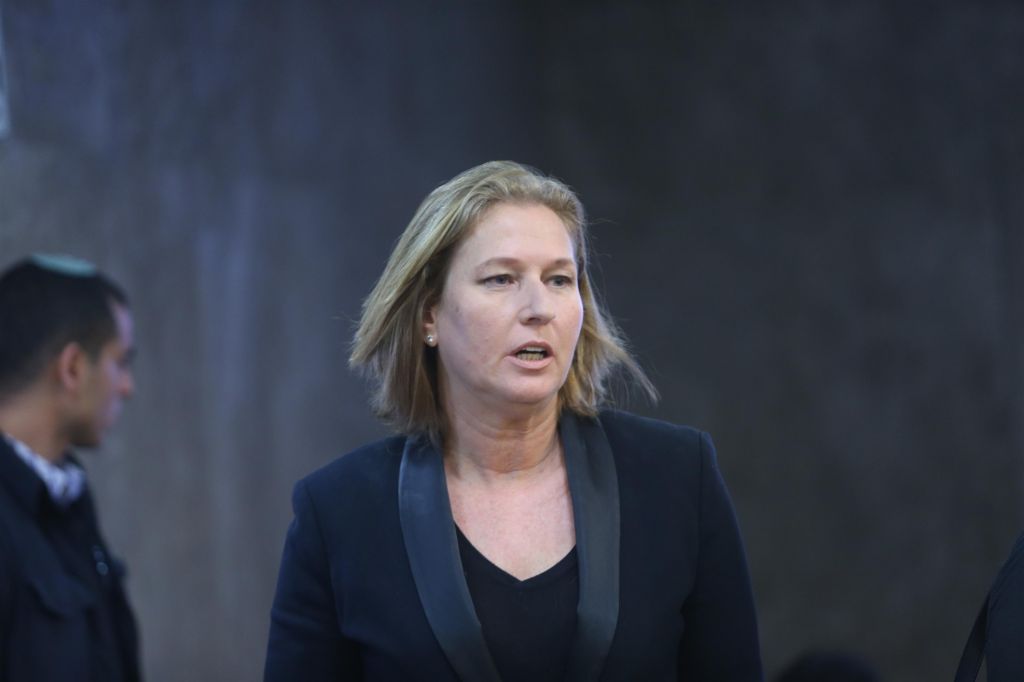
Over at Yedioth, the paper merges the maneuvering of Netanyahu and Livni over the “Jewish state” bill with Lapid’s ultimatum. “And it seems that the only big question left open is which of the series of crises threatening its [the coalition’s] stability will ultimately lead Israeli citizens to the polls,” it reports.
The paper writes that should the bill be submitted to the Knesset plenum, Lapid and Livni would be forced to support it under the coalition terms.
“Since the members of Yesh Atid and Hatnua have no intention to do so, it would be a danger to the government’s stability. Until today, despite the numerous crises the government has seen, it has yet to face a situation of the violation of coalition discipline, but Lapid and Livni’s parties have already announced that if necessary in order to thwart the Jewish state bill – they won’t hesitate to do so.”
Veteran columnist Nahum Barnea lists a series of bills that Netanyahu has supported in the past, and which he recently withdrew his backing for, or opposed (such as the Jewish state bill), and suddenly advocates.
“Has Netanyahu gone insane? Certainly not. He merely returned to his permanent ritual, which accompanied him during all elections, both those in which he succeeded and those in which he failed: when elections emerge, he has the irresistible urge to return to the foundations, to the most radical element among his pool of voters. If all the reform he supported, all the principles he believed in, all the commitments to his government and foreign governments, his image as the responsible adult burn along the way, so be it. Quiet, they’re voting.
“Especially now, when the right-wing is split, and the shrinking Likud is competing with the same voters as Bennett and Liberman. He must be more settler than Bennett, and more anti-Arab than Liberman – otherwise he wouldn’t be Bibi.”
Barnea writes that new elections could be helpful in “refreshing the agenda” and allowing the public to weigh in. But they don’t help if politicians suddenly “masquerade as other people,” he writes.
“The elections haven’t been officially announced yet, and already they reek of corruption.”





The Times of Israel Community.