

Exit polls show Israeli rejection of current Netanyahu coalition, but uncertainty on its replacement
Bloc of parties opposed to PM projected to win majority, but still doesn’t have path to replace Netanyahu unless its leaders violate campaign pledges not to partner with Arab parties, which are set to make unprecedented gains
 Add ToI as a Preferred Source on Google

Prime Minister Benjamin Netanyahu’s current right-wing coalition was repudiated by Israeli voters in Tuesday’s election, with exit polls indicating it fell well short of its original 64-seat majority in the Knesset, but the anti-Netanyahu opposition parties don’t appear to have an alternative government, unless key leaders of the bloc violate campaign promises against partnership with Arab-majority factions.
Exit polls from the three major networks showed the pro-Netanyahu bloc securing just 50 or 51 seats in the next Knesset, while the Jewish-led opposition parties won 51 or 52 seats — both blocs falling below a majority of 61 seats in the 120-member parliament.
The remaining 18 seats in the Channel 11, Channel 12 and Channel 13 exit polls went to the two Arab-led parties. This would be an unprecedented total for the Joint List and Ra’am, which currently hold just 10 seats in the Knesset. The two parties apparently benefited from the campaigns of Netanyahu’s Likud party and far-right National Security Minister Itamar Ben Gvir’s Otzma Yehudit party, which demonized them as national security threats.
The Arab-led parties also oppose giving Netanyahu another term, meaning that there is a clear majority of 70 seats in the Knesset opposed to the premier. But three of the four Jewish-led opposition parties have ruled out joining in a coalition with Arab-majority parties, so their path to a coalition would be foreclosed if they keep those promises.
Moreover, party leaders from across the political spectrum urged supporters to wait for the official results, which were only beginning to be counted overnight Tuesday-Wednesday and may not be finalized until Friday.
All three major networks’ exit polls had Netanyahu’s Likud as the largest party with either 24 or 25 seats — down from its current 32.
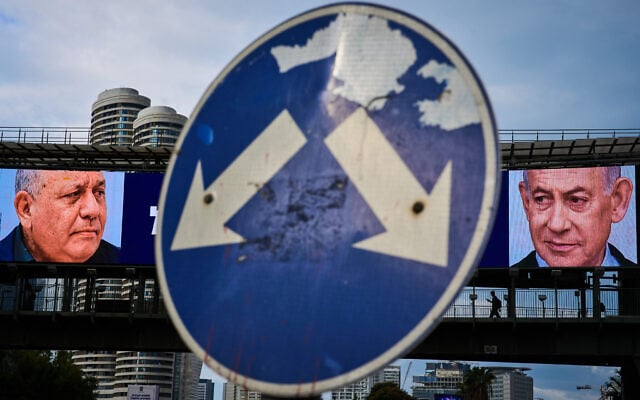
In second place was Netanyahu’s chief rival — Gadi Eisenkot and his Yashar party, which were projected to win 21 to 23 seats.
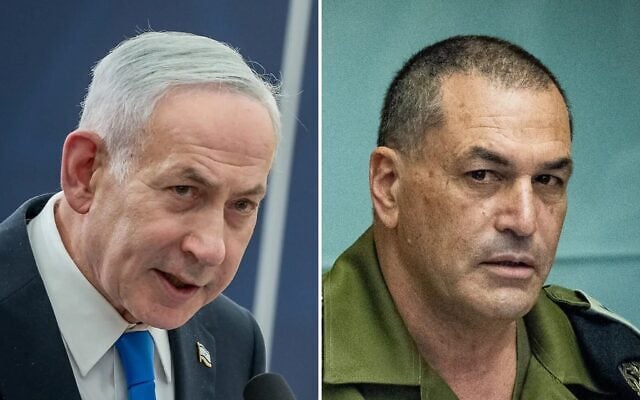
With Likud projected to be the largest party and Yashar projected to lead the larger bloc, both Netanyahu and Eisenkot will likely appeal to President Isaac Herzog for the chance to form a government, but the latter is expected to task the candidate seen to have the best chance at forming a government.
If neither is able to form a coalition, a repeat election would be called, with Netanyahu remaining as caretaker prime minister. The country endured a similar situation from 2019 to 2022, when it held five votes, with Netanyahu as prime minister for much of that time.
The election saw the highest turnout of any vote in the past quarter-century, with more than 77% of voters casting ballots. The Central Elections Committee will count those votes throughout the night and provide official figures as it tallies the ballots. The actual results often differ from exit poll projections, but unless there’s a drastic shift, the immediate outcome of the election for Israel’s voters is more uncertainty.
Main exit polls show similar tallies
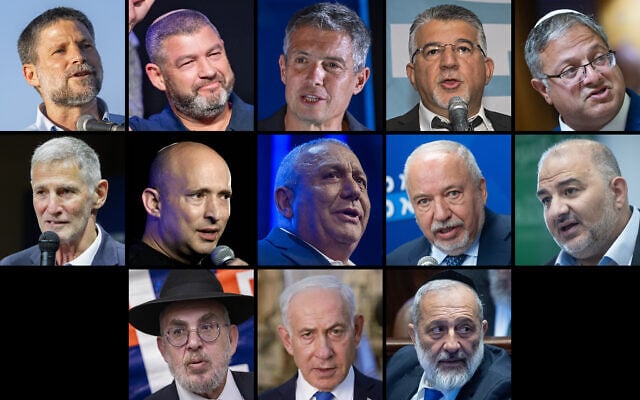
Channels 11, 12 and 13 all showed similar results in their exit polls, with Likud and Yashar in front, followed by nine smaller parties.
In third place is the opposition B’Yachad party with 12 or 13, followed by the Arab-led Joint List with 11.
Next was the left-wing Democrats with nine or 10 seats, the hawkish opposition Yisrael Beytenu with seven or eight, and the Arab-led Ra’am with seven.
That ultra-Orthodox Sephardi Shas party was projected to win six to eight seats, while the Haredi Ashkenazi United Torah Judaism was projected at six or seven seats.
The far-right Otzma Yehudit was projected to win six or seven seats, while its fellow far-right faction, Religious Zionism, was expected to win six.
Three other parties generated buzz but weren’t projected to have secured enough votes to cross the 3.25 percent electoral threshold: the right-wing People of Israel, the center-right Reservists, and the ultra-Orthodox Charedi Public party.
There were three other exit polls, two of them from pro-government channels, that showed a more favorable result for Netanyahu. The staunchly pro-Netanyahu Channel 14 showed his bloc winning 62 seats, with the opposition bloc at just 40 and Arab parties with 18. And the pro-Netanyahu i24 News showed Netanyahu’s bloc with 55, the opposition with 49 and Arab parties with 16.
Channel 16, a new network, showed Netanyahu’s bloc with 53, the opposition with 51 and the Arab parties with 16.
Netanyahu attracts votes — but at the expense of his base
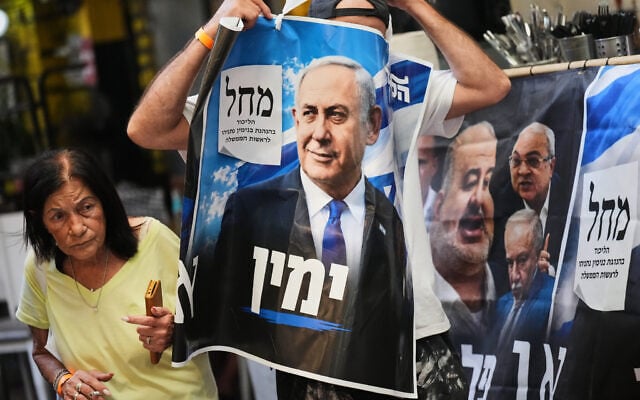
For years, polls have shown Netanyahu’s bloc, which won 64 seats in the 2022 election, failing to retain its majority. In the weeks and days ahead of the vote, Netanyahu made increasingly drastic statements, warning that the survival of the country would be at risk if he lost.
That alarmist campaign appears to have boosted his numbers, but the gain looks like it has come at the expense of his own camp. The exit polls from Channels 11, 12 and 13 mirror what most of their pre-election polls showed: neither side winning a majority, with a slight edge to Netanyahu’s opponents.

Dilemma for opposition parties
Shortly after the exit polls came out, Eisenkot hailed them as “a complete vote of no confidence in Netanyahu and the October 7 government by the Zionist majority and by most Israeli citizens.”
He was referring to the Hamas-led October 7, 2023, attack, which happened on Netanyahu’s watch.
“If these are the final results, this is a victory for Israel’s responsible Zionist majority,” he wrote on X.
Eisenkot pledged to act immediately to “implement the will of the people,” replace Netanyahu’s government, and establish “a Zionist government committed to universal conscription as soon as possible.”
How he will do that remains to be seen. He could push for a minority government that collaborates with the Arab-led parties, either by including one or both of them in the coalition, or relying on them to abstain from the vote on the new government, which would give him a narrow majority.
But Avigdor Liberman, chair of Yisrael Beytenu, and Naftali Bennett, chair of B’Yachad, have pledged not to rely on the Arab parties to form a government. They would have to break that promise to achieve a majority in the Knesset. Both previously sat in a short-lived government with Ra’am from 2021 to 2022.
Eisenkot, himself, has made statements that would appear to rule out a coalition with both the more Palestinian nationalist Joint List as well as the more moderate Ra’am.
Commentators have also suggested the possibility of a unity government, with some combination of parties from both blocs. But the opposition parties have vowed not to work with Netanyahu or the ultra-Orthodox parties.

Yair Golan, head of the left-wing Democrats, said on X that his faction is “ready to work with all our partners” to form a government. His post did not mention the Arab parties, but during the campaign, Golan repeatedly said the Democrats would be willing to partner with Ra’am.
“The public has spoken, it has fired the Netanyahu government,” Golan wrote on X, saying this was “a historic opportunity to establish a government of change in Israel, and we don’t intend to give it up.”
“We are ready to work with all our partners, to bridge the divides and take responsibility,” he wrote. “Now it’s our turn to do the work.”
Arab parties celebrate historic showing
Arab parties celebrated the projected result, which would see them take an unprecedented share of the Knesset. Mansour Abbas, who heads Ra’am and has pushed to be part of the next government, said figures from both political blocs had approached him amid the deadlock.
“Everyone is speaking with us, not just from the change bloc,” Abbas told Channel 12, suggesting that figures from the pro-Netanyahu bloc have also approached him.

Abbas signaled his willingness to join a government led by Eisenkot, but said it must first become clear that such a coalition is viable.
He acknowledged that “currently there aren’t numbers for a government,” with exit polls projecting 52 seats for the Zionist opposition parties and seven for Ra’am — two short of a 61-seat majority.
Footage from the Arab-led Joint List party headquarters, meanwhile, showed supporters clapping and cheering as exit polls by major broadcasters showed the party winning 10 or 11 seats.
Jubilant chants of “Go away Ben Gvir” could be heard in Arabic, with party chair Yousef Jabareen and other lawmakers and soon-to-be lawmakers joining in the jeers against the far-right national security minister.
Jabareen told supporters that his party “hopes to send Bibi, [Finance Minister Bezalel] Smotrich and the bloodstained government home.”




The Times of Israel Community.