

Digging through evolution for the key to peace
The author of a new book on decision making says it will take people looking beyond ethnocentrism for a true Israeli-Palestinian detente to emerge
 Add ToI as a Preferred Source on Google
LEICESTER, England — Back in 2008, Israeli Eyal Winter received a research grant from the German Science Foundation to carry out a laboratory study of ethnocentrism, the judging of people in other societies based on one’s cultural norms.
Along with Palestinian colleagues from both Bethlehem and Al-Quds University, Winter conducted an experiment that involved Israelis and Palestinians playing the trust game: a social experiment involving two players exchanging money based on trust.
It turns out Palestinians exhibited the greatest amount of generosity. On average they offered 66 percent of the money they had to the other players. Israelis gave only 36%.
Palestinian players saw these lower offers by Israelis as an expression of discrimination.
However, Winter, who is director of the Centre for the Study of Rationality at the Hebrew University of Jerusalem — one of the world’s leading institutions in the academic study of decision making — says he wasn’t convinced of such a simple explanation.
Individualism, says Winter, conflicts with traditional Islamic values. Generosity, on the other hand, is seen to be a noble characteristic that is a very prominent feature of Palestinian culture.

Helping each other is an important aspect of Judaism, says Winter, “but the fact you have an autonomy in your religion is generating something which is contradictory to collectivism.”
“This may be one of the reasons that Jewish culture was so prosperous in terms of inventions, science, scholarship and culture. It’s the appreciation of why individual ideas matter,” he says.
This trust experiment, Winter feels, proves that ethnocentrism is always present whenever differences in cultures exist. It also enables us to grasp the subtle differences between two cultures that live in close proximity.
Unfortunately, says Winter, failing to understand these differences has doomed several attempts to bring about peace between Israelis and Palestinians over the last few decades. Therefore learning how to overcome the perils of ethnocentrism, he claims, will eventually lead to reciprocity and altruism between both cultures.
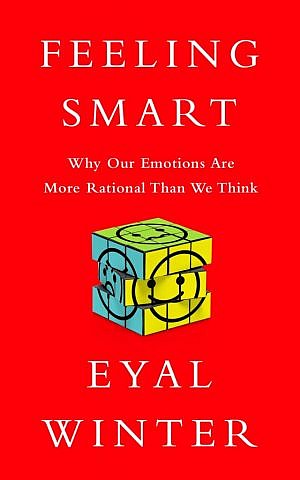
These are two subjects that Winter returns to several times in his latest book, “Feeling Smart: Why Our Emotions Are More Rational Than We Think.”
Over the course of the narrative, using a wide range of anecdotes, numerous mind games, and a variety of thought experiments, the author aims to convince his readers how our emotional and intellectual mechanisms work together to sustain each other. And, in some cases, he argues, they cannot be separated at all.
“We have evidence coming from both behavioral economics and neuroscience that refutes the argument that there are different blocks in the brain responsible for a different kind of reasoning,” says Winter, speaking to me from his office in the University of Leicester, where he is currently professor of economics.
Winter posits that emotions were formed, shaped, and developed during evolution to amplify our chances of survival.
‘At the time when our evolutionary traits were designed, we were basically living on the border line between life and death’
“At the time when our evolutionary traits were designed, we were basically living on the border line between life and death. Survival and reproduction is the ultimate objective [of evolution]. So the consequence of loss could be far more detrimental than of gains. This was then imprinted into our psychology.”
Evolutionary psychology is something Winter frequently cites throughout this book when speaking about decision making. And even though he appreciates just how important genetics are in forming elements of our personality, he also stresses how intrinsic human culture and experience is in shaping who we are, and what we become, over the course of our lives as human beings.
The full mapping of the human genome, for example, is something that Winter sees as a huge leap forward in humanity for figuring out what determines our personalities. But genes alone, he argues, cannot determine our behavior.
Genes alone cannot determine our behavior
“In the last few decades we were captured with this politically correct idea that we are all identical,” says Winter. “This was a reaction to the extremity that took place at the end of the 19th and the beginning of the 20th century: where people thought you become what you are because of which race you belong to. The truth is that neither view is correct.”
“The way we measure solidarity [in a society] is not by genes, but culture,” says Winter. “So people tend to show more solidarity when their cultures are similar.”
There may be a tendency, I suggest to him, for hyper politically correct individuals to label Winter’s ideas as racist, negative and insular.
But to prove how inaccurate such a judgment would be, Winter points out how similar Israelis and Palestinians are genetically, thus proving why the homogeneity of common goals and ideas are so important for a vibrant, stable and functional society.
It is not, he stresses, an argument based around a commonality of race.
‘Interestingly, Ashkenazi Jews are more similar to Palestinians than Sephardic Jews are’
“Interestingly, Ashkenazi Jews are more similar to Palestinians than Sephardic Jews are,” Winter explains, attempting to solidify his argument.
“So there is a huge similarity between Jews and Palestinians genetically. Or if you take Jews whose family originate from Poland, you find genetically there are more similarities between Jews and Palestinians, than between Jews and Polish people.”
“This demonstrates that the difference between [Palestinians and Israelis] is not about genes, but difference in cultures and ways of living.”
“I don’t think genetics by itself is hugely important in determining culture,” says Winter.
“We are different because of the choices that each of us is making. And we are lucky that we are different. These differences come primarily from the nurture part of who we are.”
‘We are different because of the choices that each of us is making’
In fact, one can actually take a very positive and optimistic message from Winter’s argument. If we can learn to respect each other’s cultures, and understand why, and where, the differences occur: building bridges — politically and socially — will be a much easier task.
But if we fail to acknowledge these cultural differences, negative feelings between opposing cultures will only deepen, thus fermenting existing animosities.
The current impasse between Israelis and Palestinians is a typical example of this, says Winter.
“As long as there is no interaction between the two communities, Israelis will think Palestinians are weird, and Palestinians will think Israelis are weird,” says Winter. A crucial aspect of getting a peaceful resolution is to get more “normal” exposures between Israelis and Palestinians.
“So for example Israelis visiting the West Bank and Palestinians visiting Israel. This makes each country become familiar with each other’s culture. Once each culture becomes more familiar with the other, eventually it becomes less intimidating and strange.”









The Times of Israel Community.