

Gallup: Romney closes five-point gap to tie with Obama
After debate success, challenger ties with president at 47 percent; 72 percent of Americans say he won the debate, ‘the largest [margin] Gallup has measured’
 Add ToI as a Preferred Source on Google
Haviv Rettig Gur is The Times of Israel's senior analyst.
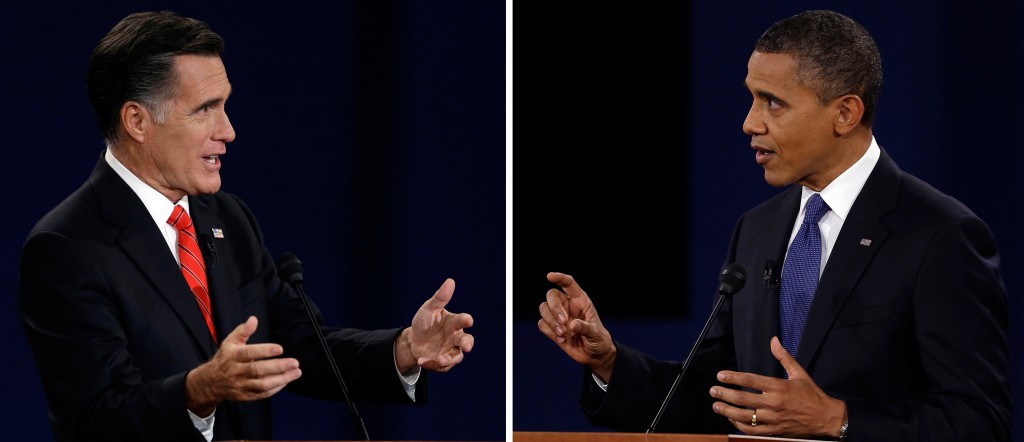
Republican challenger Mitt Romney has closed a five percentage point gap among registered voters to tie incumbent US President Barack Obama at 47 percent, according to a Gallup poll released Monday.
The figure reflects Gallup daily polling conducted October 4-6. The first of three presidential debates was held on the evening of October 3, with most pundits and a large majority of viewers polled saying Romney handily won the verbal spar.
“Registered voters’ preferences for president are evenly split in the first three days of Gallup tracking since last Wednesday’s presidential debate. In the three days prior to the debate, Barack Obama had a five-percentage-point edge among registered voters,” the organization said in a press release.
The tie is clearly an outcome of the debate, the Gallup figures suggest.
A Gallup survey conducted in the two days following the debate showed “roughly two in three Americans” had watched the debate.
Furthermore, a comparison of the three-day average for October 4-6 with Gallup’s usual seven-day rolling average indicates the jump for Romney took place after October 3.
The latest seven-day average “as of Saturday [October 6] interviewing shows Obama with an average three-point edge, 49% to 46%, among registered voters. This Sept. 30-Oct. 6 field period includes three days before the Oct. 3 debate, the night of the debate itself, and three days after the debate.
“Even on this basis,” the organization noted, “the race has become somewhat more competitive compared with before the first debate. Obama held four- to six-point leads in Gallup’s seven-day tracking results in the eight days prior to the Oct. 3 debate.”
Those who viewed the debate “overwhelmingly believe Romney did a better job than Obama, 72% to 20%. Republicans were nearly unanimous in judging Romney the winner. But even Democrats rated Romney as doing a better job than Obama, 49% to 39%.”
Gallup cautioned that the approval of Romney’s debate performance “may reflect the impact of news stories and media commentary — which mostly declared Romney as the debate winner.”
But it also said Romney’s 52-point margin “is the largest Gallup has measured. The prior largest margin was 42 points for Bill Clinton over George H.W. Bush in the 1992 town hall debate.
“Romney’s debate performance is also notable from the standpoint that US debate watchers judged Obama the winner of all three 2008 debates with John McCain,” the organization said.
The candidate who wins the national popular vote is very likely, but not certain, to be elected president. In the American Electoral College system, the presidential election consists of 51 separate statewide elections (including Washington DC), wherein the state’s entire Electoral College representation, determined by population size, goes to the winner of that state’s election.
Thus, George W. Bush lost to Al Gore in the popular vote in 2000 by over 500,000 votes, but won the presidency by five electoral votes, winning 30 statewide contests to Gore’s 21.
Similar Electoral College victories took place in 1876 and 1888, with the winner trailing by under 3% and under 1% respectively in the popular vote but winning the presidency.
The nationwide popular polls are thus not a guarantor of victory on November 6, but a stronger showing in popular polls, particularly in “swing states” in which neither party has a significant majority, is very likely to translate into increased Electoral College votes.










The Times of Israel Community.