

Morsi says sorry
Egyptian president issues apology for mistakes made in office; many Egyptians hoping military seizes power once and for all
 Add ToI as a Preferred Source on Google
Michael Bassin is a founding member of the Gulf-Israel Business Council, a co-founder at ScaleUpSales Ltd, and the author of "I Am Not a Spy: An American Jew Goes Deep In The Arab World & Israeli Army."
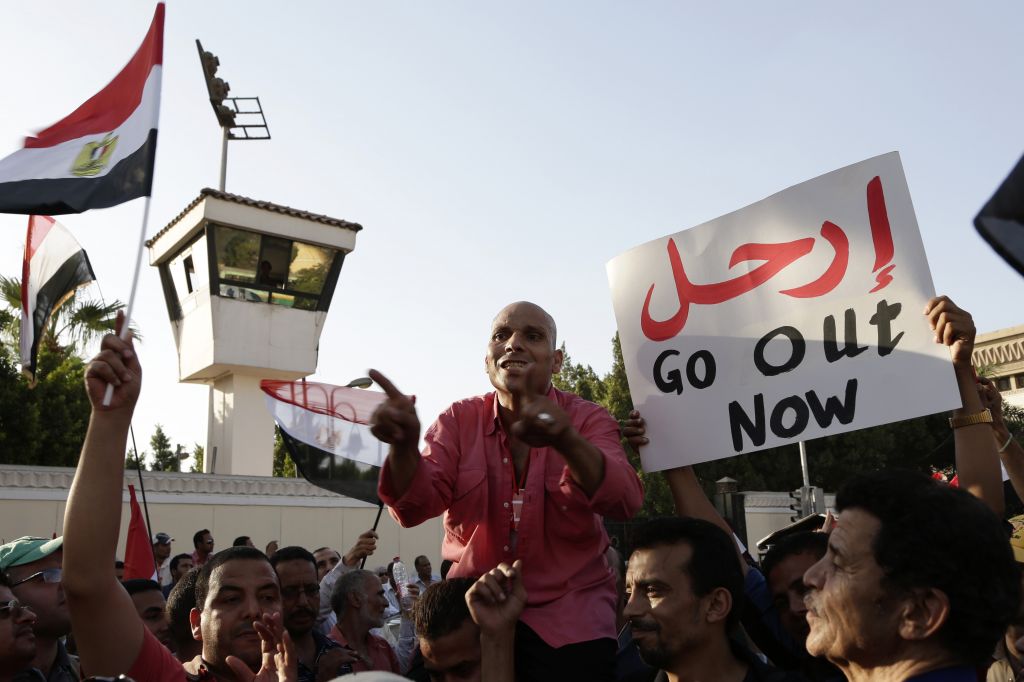
With Egyptians of all political stripes set to take to the streets in three days in what may end up being the largest and most violent protests in the country’s history, the embattled and bitterly divisive Egyptian president, the Muslim Brotherhood’s Mohammed Morsi, has been taking to the media to tell his countrymen that he’s sorry, Arab media outlets report.
The Doha-based media network Al-Jazeera reports that on Wednesday evening Morsi published a letter to the Egyptian people admitting that his administration has made costly mistakes since taking power nearly one year ago. He expressed fear of what will happen to Egyptian society when millions of his supporters and opponents face off after the weekend.
“We have succeeded in many things and stumbled in others,” Morsi says in his letter. “We inherited a very difficult situation. I wish I could satisfy the desires of everyone, but Egypt is facing many challenges.”
The Dubai-based media channel Al-Arabiya reports that Morsi also gave televised speeches defending himself and blasting the opposition. He criticizes the leaders of the National Salvation Front, the leading opposition movement in Egypt, for boycotting elections and for calling into his question his legitimacy from his first day in office.
“We have suffered decades of corruption and mismanagementת and I stand before you after having had only one year to enact change,” he said. Morsi went on to criticize Ahmed Shafiq, a former presidential candidate and head of the Egyptian Air Force, and members of the Egyptian judiciary, for ongoing corruption and embezzlement.
The reactions to Morsi’s letter and speech have been overwhelmingly critical.
“The president’s speech reflects a severe crisis and weakness experienced by the president and his inner circle, like they are under siege by the Egyptian people,” says Mustafa Bakri, a former member of the Egyptian Parliament. Bakri criticizes Morsi for his comments against Shafiq and Egyptian judges because of the lack of evidence presented.
“Morsi’s speech was not worthy to be made by a head of state,” writes Mamoun Fandy, a prominent Egyptian writer and political researcher. “Morsi’s speech reminded me of one of the later speeches made by [former president] Mubarak. It was totally detached from the opinions of the Egyptian street.”
Morsi’s speech and letter notwithstanding, there is no getting away from the fact that the Egyptian street is angry. As the temperatures rise with the summer months, demand for energy has sparked a fuel and electricity crisis. The Saudi-owned daily A-Sharq Al-Awsat reports that Egyptians are waiting for hours on end to fill up their cars with gasoline and desperately trying to ensure their generators do not fail.
The Egyptian government currently spends 25 percent of its operating budget on fuel subsidies for the population, but continues to deny there is any real shortage. While traffic remains at a standstill all over Egypt, angry Egyptians are threatening to cut off the major highways in Cairo to get the government to act. It is unlikely, however, that the government will take any major action due to the political crisis that is expected to erupt on June 30.
“Life has become unbearable,” one stranded Egyptian man said while he waited to fill up his gasoline tank. “People are trying to stock up on as much food and fuel as they can before June 30 because we know there will be disruptions. Right now there is the same feeling as there was before Mubarak was removed from power.”
That Mubarak was persuaded to leave power by the Egyptian military must be weighing heavily on the mind of President Morsi, Arab commentators suspect. As the Egyptian military deploys to all major population centers of the country to avoid a total breakdown of the state, many civilians are praying the army finally brings order .
The “Jerusalem Opinion” editorial of the London-based Al-Quds Al-Arabi opines that the military acted responsibly in handing over control of the state to civilian authorities in 2011 after it removed Mubarak from office. Since then, though, the military has been subjected to insults and disrespect by the Muslim Brotherhood leadership that took over.
Now that the Muslim Brotherhood-led government finds itself in a jam, the Egyptian army may respond to this crisis differently. It may assume power to prevent a political vacuum, with its leadership knowing full well that only it can provide Egyptians with the stability they so badly need.







The Times of Israel Community.