

Mourning ‘imush’
The funeral of slain mother-of-six Dafna Meir evokes sentimental responses and emotional reactions, including a controversial decision to boot Palestinians workers from settlements
 Add ToI as a Preferred Source on Google
Raoul Wootliff is a former Times of Israel political correspondent and Daily Briefing podcast producer.
After nearly four months of daily stabbing, shooting and car ramming attacks, mainly against blurry faced soldiers, front page headlines accompanied by tearful family members had gradually given way to less sentimental articles, buried deep in the pages of Israeli dailies.
Sunday’s deadly stabbing of mother-of-six Dafna Meir in the West Bank settlement of Otniel, and the funeral that took place on Monday, provided a bitter imperative for less cerebral coverage of the violent wave.
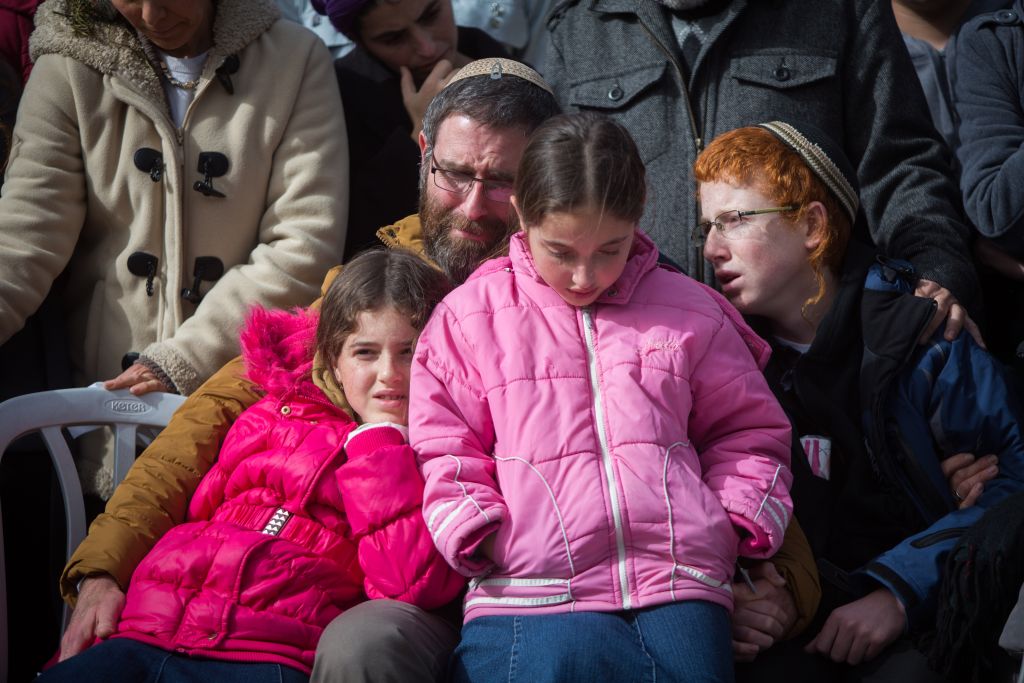
Using striking images of the weeping family sitting next to Meir’s shrouded body, and quotations from the emotionally charged eulogies delivered at the burial, the Hebrew media across the board gives prominence to Meir in Tuesday’s papers.
“Imush, it pains me that you won’t be at my wedding,” reads the large headline on the front of Yisrael Hayom, quoting Renana, Dafna Meir’s oldest daughter, referring to her mother with a Hebrew appellation best translated, if at all, as “mommy.”
Yedioth Aharonoth suffices with just, “Imush.”
Both run 17-year-old Renana’s full eulogy, peppering the inner pages covering the funeral with large quotes from the speech.
“I’m sorry I didn’t manage to help you during the hardest moments,” said Renana, who was home when her mother was murdered, as quoted in Yedioth.
“You left us with an enormous vacuum. We won’t drink tea at midnight any more… You won’t come with me to my wedding, to the army, to the delivery room,” highlights Israel Hayom.
The two papers fill the next five pages with personal accounts of Meir as told by her friends and coworkers.
Haaretz joins the tabloids in featuring on the front page the photo of Natan Meir sitting with his distraught and bewildered children, but instead of the eulogies, prominently carries reports of another stabbing — of a pregnant woman, Michal Froman, who was moderately injured in Tekoa on Monday — and the army’s decision to close West Bank settlements to Palestinian workers in the wake of the twin attacks.
“The IDF said this was not a ‘collective punishment’ against the workers, but that it was necessary in order to maintain order and to better supervise the workers inside the settlements,” the paper reports. “IDF Chief of Staff Lt. Gen. Gadi Eisenkot said Monday it was important that Palestinians be allowed to continue working and to make a living.”
Inside the paper, Haaretz’s chief military analyst Amos Harel expounds on Eisenkot’s words, delivered Tuesday at the INSS security conference in Herzliya.
“Eisenkot held fast to the security establishment’s position that collective punishment of the Palestinians should be avoided as much as possible. Work in Israel and the settlements directly provides a livelihood to some 120,000 Palestinians who support their families, and it is in Israel’s interest to preserve this. A return to closures, Eisenkot said, would be a bitter mistake, although that is exactly the method the IDF used in the West Bank more than a decade ago to suppress the second intifada,” Harel writes.
“Toward the end of his remarks, the chief of staff stated something that should be obvious: Under complex and sensitive circumstances, the role of the security forces is to preserve Israel as a democratic country, an island of stability with a powerful and moral army,” he adds. “Eisenkot did not go into details, but it seems that in the current public atmosphere, the very mention of democratic values in a speech by the army chief is worthy of attention. When so few politicians express themselves similarly – with the notable exception of Defense Minister Moshe Ya’alon – it seems Israeli society really does need the chief of staff to remind it of its core values,” says Harel.
Following its account of the Meir funeral, Yedioth Aharonoth gets to the decision to ban Palestinian workers from settlements on page six.
“The disgraceful murder of Dafna Meir in Otniel and the stabbing attack in Tekoa have raised fears among settlers and security forces and has reignited the discussion on how to protect West Bank communities,” the paper writes. ” The army decision is aimed at raising the sense of security for the residents and re-defining the rules for Palestinian workers. This will be the beginning of further security re-assessments.”
Israel Hayom’s Haim Shine doesn’t mince his words. He vows that the attack will not harm the resolve of the Israeli people, including those living in the West Bank.
“Having noticed that most of their attempts to harm IDF soldiers fail, the terrorists have now set their sights on Israeli women and children. But this will not work out for them. For many decades already, the people of Israel have stood strong in the battle to secure our right to live in our homeland. Every Palestinian inciter and terrorist should understand one fundamental fact: We are here to stay forever,” he writes. “No brutal act of murder will loosen our grip on our homeland. We are holding firm to it, just as it has always held firm to us and will continue to for eternity.”



The Times of Israel Community.