

Old folks, new low
Even as a spate of attacks has become a norm, two assaults on the elderly stand out in the press both for their location and their victims. At least the terrorists didn’t try to deport cats
 Add ToI as a Preferred Source on Google
Joshua Davidovich is The Times of Israel's Deputy Editor
Two lines were crossed on Monday, leading to major stories that dominate news coverage in the Hebrew-language print press Tuesday morning. One was the Green Line, which separates Israel proper from the West Bank, and has mostly separated the rest of the country from a spate of terror attacks (though there have been notable exceptions). The second line was the idea that even if you are the kind of person who is going to stab random strangers or soldiers to achieve political gains, kids and old people should be off limits.
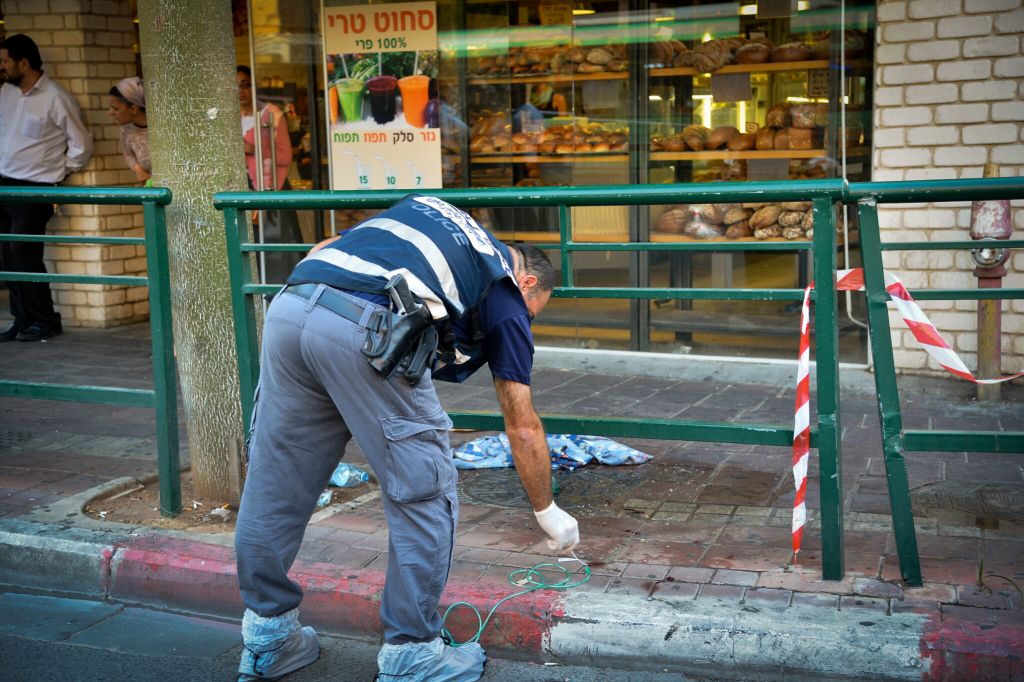
That idea apparently went the way of the “Cocoon” movie franchise Monday afternoon, as two senior citizens were among four people stabbed in back-to-back attacks in central Israel. Even amid a month-long wave of violence in which daily stabbings have become rote, those attacks stood out, both for their locations and targets.
Stills from a video showing the attack in Rishon Lezion, a working class Tel Aviv suburb, in which an 80-year-old woman was stabbed and seriously injured make the front pages of both tabloids Yedioth Ahronoth and Israel Hayom.
What can’t be seen in the pictures, though, are the recollections of the event. “When I was in Super-Pharm I heard screams of ‘terrorist, terrorist,’ and there was hysteria and I tried to call her but she didn’t answer,” the sister of victim Rachel Eizenkot, who was with her right before the attack, tells the paper. “One woman came from there and said they stabbed an older woman, and I started to worry because I feared it was my sister. I got to the scene, saw her shoes and immediately knew it was her.”
In Israel Hayom, the same woman is quoted recalling the moments she reached her wounded sister. “I told her ‘Rachel, I’m here next to you. Don’t worry.’ She heard me and was conscious, but she was pale as whitewash.”
In Netanya, where a 71-year-old man was stabbed a short while later, the focus of the story is not on the attack, but rather on the mob attack against the stabber, and a subsequent attack on those trying to attack the attacker, or as Yedioth terms it “the lynching that didn’t end.”
In Israel Hayom, Dan Margalit sides with those who stopped the attacker, explaining that “Anger – justified, lynching – no.”
“The public wanted to pour its wrath upon the two terrorists in Rishon Lezion and Netanya. The anger is understandable, but it’s not moral. It’s a dip below accepted norms. And it also sullies the name of Israel in the world,” he writes.
Sullying the country’s good name, or anybody’s, can be considered a form of incitement, or so it seems in the current climate, where the term has become little more than a buzzword slung at anyone who says something you don’t like.
Haaretz reports that a law lowering the bar for what is considered incitement speech, which the paper says will limit free speech, passed the Knesset on first reading. The paper reports that the law will mean prosecutors will no longer have to prove a direct link between what was said and a subsequent violent act. Needless to say, it doesn’t really jibe with the liberal broadsheet’s free-speech stance, not to mention lefty lawmakers.
“You are bringing forward an unnecessary and even dangerous stringency,” the paper quotes Joint List MK Dov Khenin saying.
Yet the paper itself can’t help but jump on the incitement bandwagon, accusing Justice Minister Ayelet Shaked of inciting against the left over a proposal which would force representatives of NGOs which receive funding from foreign governments to wear special badges in the Knesset.
“Beyond the hypocrisy emanating from the bill – after all, it’s well known that local and foreign tycoons directly influence decision makers and impact on government policies in accordance with their political and economic interests, and no one makes such demands of them – this constitutes a new stage in the incitement and delegitimizing campaign that the right is conducting against the left,” Haaretz’s lead editorial reads.
Purrfect storm
Everyone hates everyone, everyone is stabbing, or stealing, or lying or fussing and fighting. So it is any surprise that a story about a minister Uri Ariel and his wacky plan to transfer cats to some sucker third country as a form of population control has taken the Internet and the press by storm.
Yedioth, which let the cat out of the proverbial bag on the story a day earlier, follows up with a double truck package of the inevitable memes to pop out of this perfect storm of cats and utter insanity. Among the gems, which will be hereby explained, thus making them even funnier, is a picture of a cat wearing Jewish garb with the words “a Jew does not deport Jewish cats,” a play on the slogan from the Gaza evacuation days. Another picture shows 80s sitcom star and renowned kitty muncher ALF on the phone offering to take in the cats, and a third has a cat in a Mufti-like hat with the caption “and then I convinced Hitler to kill everyone,” a throwback to last month’s ridiculous story of the moment.
Columnist Einav Shiff isn’t only loling, but also tries her best to analyze why the story become such an internet sensation (as if the equation of cats + government stupidity = hilarity weren’t clear enough).
“The hysterical response on social media – it seemed like the meme-makers barely got up to the bathroom – isn’t only connected to the popularity of cats on the internet. It also attests to the importance of the affair: Israeli existence is bogged down in stories of corruption, injustice, racism, nationalism and a lack of security,” she writes. “From the dubious deals over the gas exploitation outline to stabbing attacks that occurred yesterday in the center of the country, that is the zany state of things which turned Ariel’s proposal into such an attraction.”









The Times of Israel Community.