

On Syrian border, Hezbollah faces its ‘hardest’ battle
Shiite group says it is fighting to secure the mountainous Qalamoun area ‘to protect Lebanon’ from jihadists
 Add ToI as a Preferred Source on Google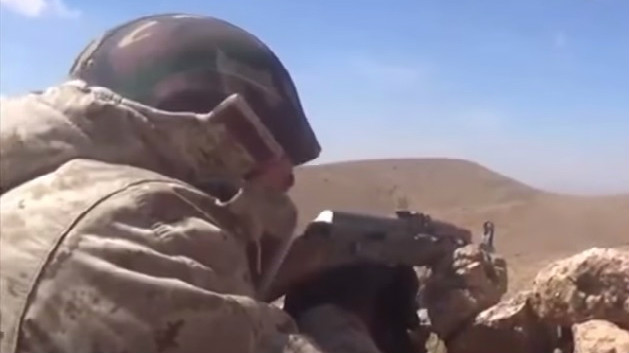
AFP — On a windy hilltop overlooking the mountainous Syrian border, a fighter from Lebanon’s Hezbollah says the battle against Syrian rebels in the area is among the toughest the group has ever faced.
The powerful Lebanese Shiite movement, a key ally of the government in Damascus, has fought across Syria in the years since an uprising began in 2011.
In the past two weeks, Hezbollah says it has secured around a third of the Qalamoun region, territory on both the Lebanese and Syrian sides of the porous border.
“This is one of the hardest battles we have fought,” said a Hezbollah fighter in Qalamoun, who spoke on condition of anonymity.
“Everyone knows that fighting in the mountains is the hardest kind of fighting there is, up there with fighting in cities.”
The area of roughly 386 square miles (1,000 square kilometers) is a landscape of imposing hillsides riddled with caves, and open valleys full of scrub and wildflowers.
“This is the most difficult battlefield in the Middle East right now,” nodded another fighter, dressed like many in the area in desert-tone camouflage.
The fate of Qalamoun is particularly important for Hezbollah, which has long defended its intervention in Syria alongside President Bashar Assad’s troops as key to the security of Lebanon.
‘To protect Lebanon’
In Qalamoun, that argument carries more weight because of the presence of jihadists from the Islamic State group and al-Qaeda affiliate al-Nusra Front.
The two groups have infiltrated Lebanon in the past, and last August briefly overran the eastern Lebanese border town of Arsal.
They are still holding 25 soldiers and policemen hostage, and have executed four captives.
“Our goal in Qalamoun is to protect Lebanon, and we’ve seen the evidence of the threat in Arsal and the other attacks on the border,” a Hezbollah military commander said.
In recent days, Hezbollah has provided unprecedented but carefully orchestrated media access to its fighters and positions in the Qalamoun region.
The tours begin with a briefing by a military commander, who uses a green laser pointer to illustrate on a projected digital map the necessity of securing the high ground to ensure line-of-fire sight over the area.
On the ground, an array of fighters lead convoys of journalists in SUVs across rocky terrain with little sign of life beyond a few birds and a scrambling lizard or two.
The trips include stops at bunkers captured from rebels, where Hezbollah is eager to show the remains of homemade explosives, and cautious interactions with fighters, many of whom preferred to observe the visitors from a remove, some smoking quietly.
The outreach is a new approach for Hezbollah, which has generally preferred to keep coverage of its involvement in Syria’s conflict confined to its official media outlets.
One member of the group said the new campaign was an attempt at both “psychological warfare” but also a form of public relations.
“This is psychological warfare that we hope will make the enemy afraid, but it’s also a way for us to send our message to say that we’re the good side.”
That assertion is contested by Syria’s opposition, which accuses Hezbollah of facilitating Damascus’s attempts to put down an uprising that began with peaceful protests and spiraled into a war after a regime crackdown.
But while Hezbollah is listed as a terrorist organization by Washington, it is now fighting against some of the same jihadist groups being targeted by US-led air strikes in Syria and Iraq.
Evidence of battle
The Lebanese and Syrian armies are conspicuous by their absence in Qalamoun.
Hezbollah members avoid comment on the Lebanese army’s role in the region, and insist Syria’s army leads the fight inside its country.
“We fight from the Lebanese side and they fight from the Syrian side,” a Hezbollah fighter identified as Hajj Nader said, standing several kilometers inside Syrian territory.
At several sites in the region, the evidence of battle was strewn on the ground.
Heavy machine gun casings and tubes that once held rocket shells lay alongside metal ammunition cases, their lids peeled back like sardine tins.
At some positions, Hezbollah fighters fired into the distance, and explosions they said were mines being cleared could be heard.
The fighters carried weapons including pistols, Kalashnikov rifles and at least one M4 mounted with a grenade launcher.
Some sported patches on their uniform invoking Shiite religious figures and Hezbollah’s leader Hassan Nasrallah.
“These aren’t required. Everyone puts on what they want. You see, we’re not an army, we’re just regular guys,” one fighter said.






The Times of Israel Community.