

Should they stay or should they go?
A last-ditch effort by Benjamin Netanyahu to salvage his coalition is given less-than-stellar chances to succeed, though some say the alternative may be worse
 Add ToI as a Preferred Source on Google
Joshua Davidovich is The Times of Israel's Deputy Editor
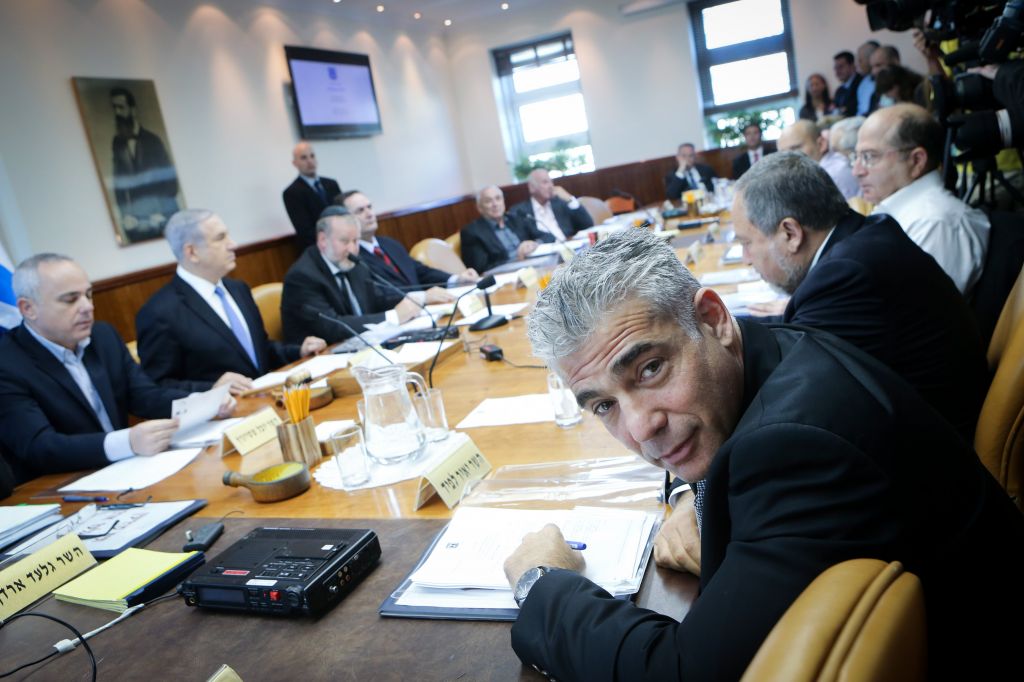
With the coalition imploding like a condemned ramshackle building, Israeli newspapers are mostly busy Monday morning previewing a fateful meeting between the two men who can salvage the government and keep it from becoming so much dust and rubble.
With Finance Minister Yair Lapid and Prime Minister Benjamin Netanyahu set to go man to man, it’s no surprise that the papers bear a striking resemblance to a boxing match card, though hopefully nobody will be taking off shirts or biting off an ear in this fight.
“Last effort,” heralds the top headline of free tabloid Israel Hayom, flanked by Netanyahu and Lapid looking their growliest. Yedioth Ahronoth, which plays the story amid a dog’s breakfast of other front page pieces ranging from war preparations to IDF brass infighting, also has a similar Netanyahu vs. Lapid package, with the headline “compromise or explosion.”
And over in Haaretz’s corner, a picture of a conspiratorial-looking Lapid (same as the photo above) at the cabinet meeting is accompanied by a headline that widens the affair, cluing readers in that Netanyahu will also be in talks with Justice Minister Tzipi Livni and Economy Minsiter Naftali Bennett in an indication of how deep the crisis has run.
Yedioth reports that the whole round of meetings, reminiscent of ones nearly two years ago as Netanyahu tried to form his nascent coalition, came at the behest of Foreign Minister Avigdor Liberman, who has been more than happy to play the adult amid the squabbling.
The paper gathers intel from all the different quarters, with a source close to Netanyahu saying that the prime minister is sick and tired of ministers not toeing the line and “attacking the government like members of the opposition.” Lapid’s associates tell the paper that the treasurer has no intention of letting Likud hold up the budget and keep billions from social affairs ministries, “making the middle class into hostages.”
Livni is expected to tell the prime minister that he’ll have to boot the “extremists” to keep her in the fold, and a final source sums it all up with a pithy “Netanyahu does not know what to do with the current situation.”
One man who thinks he has some idea what the prime minister should do is Israel Hayom’s Motti Tuchfeld, who admits the honeymoon between Netanyahu and Lapid has come to a dead end of mixed metaphors, but notes that the alternative to kissing and making up may be worse than continuing to share the same Procrustean bed.
“Elections are dangerous for Netanyahu in light of the polls, and even though he and Likud are leading, the next coalition would be worse than the current one. … Lapid’s political situation also isn’t exactly strewn with roses. In the next Knesset he could come back with only half his strength. This is true as well for Livni, who barely scraped over the entrance threshold.”
Haaretz reports that the even if the fateful meeting is successful, it won’t mean the end of bad blood in the cabinet. Rather, a source tells the paper, the meeting is just to see if they even have enough shared interests to continue to try to work together, and Likud operatives aren’t placing bets on that happening. “We’re closer than ever to elections,” a source close to the prime minister tells the paper.
One battle that is behind the prime minister and his advisers was over who to appoint the new head of the Israel Defense Forces. But while Gadi Eisenkot was officially chosen for the job on Saturday, tongues are still waging in the aftermath of the pick.
Yedioth reports that Northern Command chief Yair Golan, also thought to have been in the running but ultimately named as Eisenkot’s deputy, took himself out of the race, telling vetters that he saw himself as more of an assistant to the regional manager type, at least for now.
“It’s not the right order that they push me into the IDF chief of staff job,” he apparently told his interviewers. “As someone who worried about the image of the IDF, I think you need to choose from one of the two candidates who were already deputy chief of staffs [Eisenkot or Yair Naveh]. From a public perception view, I need to be deputy CoS. I am not ready to be chief of staff, and to prepare myself correctly I need to first be deputy chief of staff.”
While Golan thought Eisenkot was the man for the job, Haaretz’s Aluf Benn writes that his appointment leaves two “troubling” questions: Can he be more than a rubber stamp for the government, and is he able to lead the IDF to the promised land of needed reforms:
“Eisenkot isn’t known to have suggested any organizational, operational or budgetary reforms to solve the army’s most pressing problems: a budget that’s totally out of control and the widening quality gap between the air force, intelligence and cyber warfare branches on one hand and the ground forces on the other. Eisenkot conveys nothing more than continuity. … Eisenkot is also entitled to the benefit of the doubt; he might surprise us yet. But still, did Netanyahu, who is well aware of Israel’s economic and political situation, ask Eisenkot for a plan, a PowerPoint presentation or even a piece of paper with some preliminary ideas for resolving the IDF’s most pressing problems? And if not, why not?”
One of Eisenkot’s first tasks will be overseeing the transfer of the army’s main operations to a massive base being built in the south. That project is being held up, Israel Hayom reports, after the Defense Ministry claimed that it was stiffed by the Finance Ministry to the tune of NIS 9 billion. While Defense Minister Moshe Ya’alon point a finger at the treasury for holding up the project of “utmost national and security importance,” the Finance Ministry characterizes the delay as a “cynical” move by the Defense Ministry in a ploy for more money.
Unsurprisingly, local leaders in the Negev Desert, hungry for jobs, blame both sides for their bickering on the back of the southern man. “This is a terrible decision,” Negev regional council head Shmuel Rifman complains. “These power struggles between state bodies only give de facto justification and strengthen the hands of those who would want to cause the delay of the transfer surveillance and intelligence units which are so needed for the development of the Negev. My grandchildren also won’t see this happen.”
While the south is clamoring for industry, one sector it probably would be happy to see stay out is trafficking in women, which, Vered Lee writes in Haaretz’s op-ed page, is making a comeback in Israel:
“Anyone who does not want to see a rising wave of trafficking in women in Israel must encourage police to enforce the law by closing escort services, promote legislation to criminalize customers (such laws have the power to effect real change), impose more severe penalties on pimps and expand rehabilitation services for victims of prostitution.”








The Times of Israel Community.