

The 50th victim
The bodies in Orlando were still warm as a nasty political discourse set in, something Israel’s press is all too familiar with and all too willing to take part in
 Add ToI as a Preferred Source on Google
Joshua Davidovich is The Times of Israel's Deputy Editor
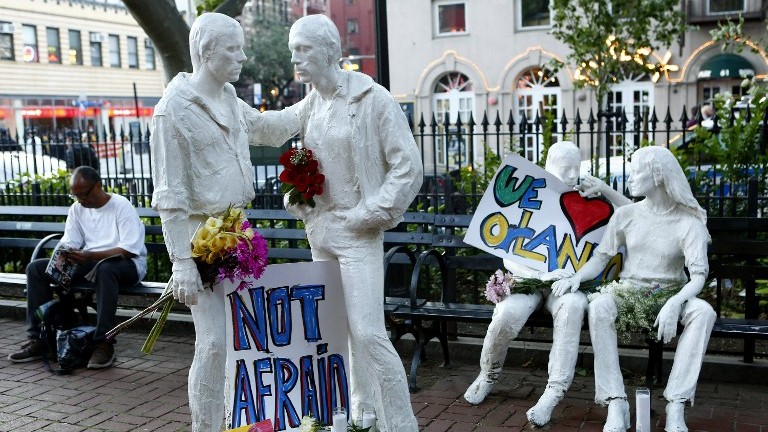
Perhaps it’s because of Israel’s own long, bleak history with terror and mass violence, or perhaps despite it, but as the world grapples with yet another attack, Israel’s press, its window to the world, displays a strange mix of sensitivity and snot-nosed “we told you so/look at the terrible way you are handling this.”
The net result Tuesday morning, the second edition since the Orlando massacre, comes off as distasteful at times, with the country’s two major tabloids leading the way, and conveniently forgetting how much they protest when foreign countries, particularly the US, butt into their domestic affairs.
Israel Hayom’s A1 headline, “The failures are uncovered” refers not to its own spectacularly ill-thought comparison yesterday of Orlando killer Omar Mateen to Tel Aviv shooter Nashat Milhelm, since they kinda look a bit similar, but to what it perceives as the US’s failure to stop the killer in time. No. 1 in line for blame by the paper is US President Barack Obama, who is excoriated on the front page and inside for failing to call the attack Islamist terror.
Yedioth and Haaretz are both a bit more sensitive in the way they display their coverage, but neither shies away from jumping straight into seeing the tragedy through the political overtones it has quickly become imbued with, particularly thanks to Donald Trump’s hateful rhetoric.
From a cartoon in Yedioth showing Trump riding a wave of blood to the White House to a gaggle of commentaries in both papers on the candidate’s response to the tragedy, papers take note and then some at the Israeli-style political bickering in tragedy’s wake that has apparently made its way to American shores as well.
תופס טראמפ על הטבח: זו הקריקטורה היומית שלנו, שאייר גיא מורד pic.twitter.com/KFJaiDCkOv
— ידיעות אחרונות (@YediotAhronot) June 14, 2016
Responding to Trump’s first nasty comments after the shooting, New Yorker editor David Remnick wrote a couple days ago: “It feels indecent on such a day to engage these comments of Trump’s at all. But their velocity, vapidity, and sheer ugliness reflect his character, his emptiness, and, most of all, the shape of the election campaign to come.” In those two sentences are contained the shift from America’s former self as a place where demagoguery was ignored and made into little more than a sideshow to its current iteration as a place where political bickering and hateful responses in the immediate aftermath become the norm, something Israel is all too familiar with.
So it is that Israeli papers easily pick up the baton and run with the story the way only they know how. Welcome to the club, Uncle Sam, it’s a nasty place to be.
Israel Hayom, champing at the bit to point fingers at its favorite enemies, makes like Trump and uses the tragedy to go full bore against Obama.
“Even a day out from the terrible massacre in Orlando in which 49 people were killed, US President Barack Obama still can’t say ‘Islamist terror’ when talking about the severe event,” the paper’s news story starts, dropping all pretense of balance and going on to cherry-pick details from a British tabloid description of Mateen’s apartment to prove its point. “In the pictures are seen around his house Quranic literature, a picture of the Al-Aqsa Mosque, a sword, and Star Wars paraphernalia. In addition in his apartment were books on the Arab world including a book called ‘Being Palestinian Makes Me Smile” by Amer Zahr.”
Just as Israel Hayom ignores all the Disney and Marvel paraphernalia and any signs that Mateen may not have been an Islamic State terrorist in favor of its larger narrative, commentator Boaz Bismuth accuses Obama of doing the same thing to pretend that Mateen had nothing to do with radical Islam:
“Obama is turning into more and more of a mystery. Despite all the things uncovered until now around the massacre in Orlando, including the oath the attacker took to the Islamic State during the incident and the fact that the Islamic State took credit, Obama is still not convinced,” he writes. “From the point of view of the US president, there’s still no proof that Mateen took orders from outside the US. But here is his mistake. He needs, especially these days, to speak clearly. True, it’s not clear if Omar Mateen acted by order or by influence – but what does it matter? The spirit of IS has reached America.”
But in Yedioth, Yoaz Hendel pens an op-ed writing that giving IS credit where credit is not due is just what the terror group wants, and just the kind of thing that will help Trump, pictured above in the aforementioned cartoon riding a wave of blood.
“IS doesn’t have any assets but recognition. People filmed cutting off heads, massacres of women and children and proud killings of gays. On the day of the Orlando shooting, several dozen Muslims were massacred in Syria. Nobody cared. But when you talk about an incident on US soil, IS wins in the battle for recognition. It’s exactly in that in which it has an opportunity to wield influence over the whole world,” he writes. “A deadly attack on the eve of election would boost Trump’s poll numbers. When Obama can’t say what the source is – radical Islam – the pushback by the American public will be all the stronger. Trump as president would change the democratic world. He’s already changed the political system around him. I don’t know how he’ll do it, but I’m worried, a Jew like me always worries.”
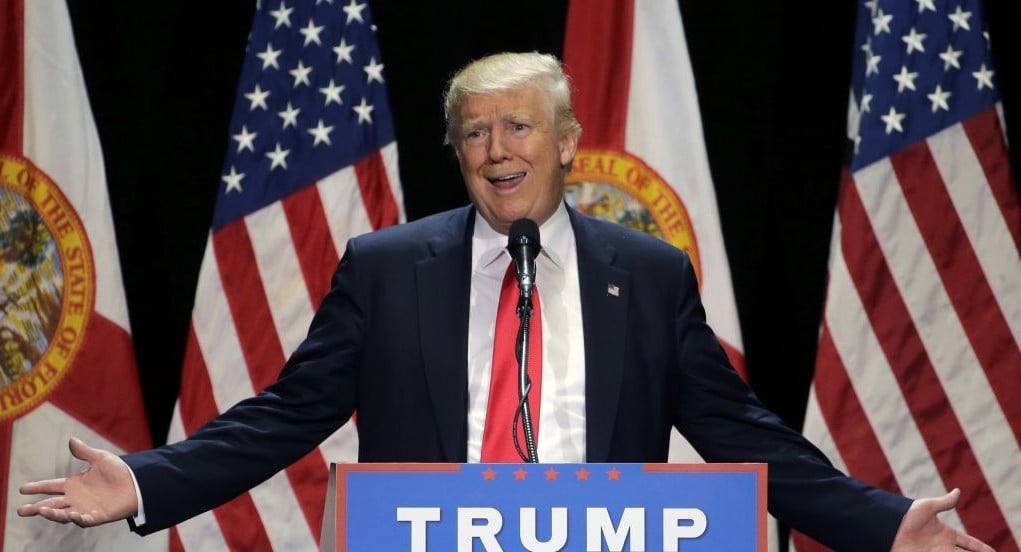
Even more worried is Haaretz’s Chemi Shalev, who also expresses concerns more terror will give Trump the election, but accuses most Israelis (not even just the ones named Boaz Bismuth) of being hunky dory with that.
“Donald Trump speaks a language that most Israelis are very familiar with. With him there are good guys and there are bad guys and nothing in between. As he made clear in the written speech he delivered on Monday in Massachusetts, the identity of the people most responsible for the recent carnage is well known: their names are Obama and, much more so, Hillary Clinton,” he writes. “If Islamic-tinged terror returns, if the summer and fall of this election year are stained with American blood … Trump could triumph and take the White House, despite his ill-advised statements, his creative factual assertions and his shoot-from-the-hip solutions. Democrats should rightfully be concerned about such a scenario. Many Israelis might be happy, of course, but so will the leaders of ISIS and their disciples.”
‘No place feels safe’
If Israeli public discourse is familiar with making tragedy political, it’s also overly familiar with transmitting the grief and sadness that comes with a massacre such as this one. Both Yedioth and Haaretz dispatch correspondents to Orlando to report from the scene, and both come away with a view of a city shattered by grief.
Yedioth’s Tzipi Smilovitz does her best Don DeLillo impression, seeing Orlando as a post-modern idyll, where terror struck the most mundane of locales, transforming it into a landscape of death, destruction and sadness.
“In the daytime Orange Avenue looks like it’s trying to come back to life, and not succeeding. The silence still screams, the whole area around the club is closed, cars cannot come through, and workers can only go around some of the streets in the area,” she writes. “The junk food joints are open, and at a McDonald’s on the corner sit three men, ripped, tattooed, straight as can be, not taking their eyes off the TV, which is broadcasting the names of the victims, and not even trying to hide their tears.”
In Haaretz, Ilene Prusher falls into the trap of viewing Orlando as just a massive tourist hub theme park (I used to live in Orlando. It’s much, much more diverse and complex).
“It seems as terrorism landed in Anytown, USA. The presence of Disney, Universal, other major theme parks and convention centers make this a city that is as quintessentially American as Washington, DC. Americans are covering it as if the heart of their nation was attacked, and in some senses, it was,” she writes.
Yet Prusher, a former war reporter who knows her way around a complex story, excels in portraying what the attack means not for the city, but for the gay community, which sees the Pulse club as a community hub.
“It’s hard enough for gays and lesbians to feel safe enough to come out. Typically the first place you’ll go and try to be yourself is a nightclub,” she quotes social worker Morgan Acevedo, who works with the LGBTQ community, as saying. “There, you can be around people who will let you be who you are and not judge you. Now, there’s nowhere to feel safe.”





The Times of Israel Community.