

100 years after Balfour, Britain still shaping the region, say pair of authors
In front of Jerusalem crowd heavy with British accents and wit, Elliot Jager and Azriel Bermant share ups and downs of Zionist-British relations and where the alliance stands today
 Add ToI as a Preferred Source on Google
Since the release of the Balfour Declaration 100 years ago, Britain has repeatedly found itself in the middle of a Middle East tug-of-war between Arab and Israeli interests.
How this pull has shaped the relationship between Britain and Israel was the topic of discussion at a Times of Israel event with authors Azriel Bermant and Elliot Jager on Tuesday evening at Mishkenot Sha’ananim in Jerusalem.
The event was produced by the Sir Naim Dangoor Center for UK/Israel Relations and moderated by journalist Matthew Kalman.
The experts discussed the historical significance of British-Zionist relations based on research each conducted while writing their recently published books.
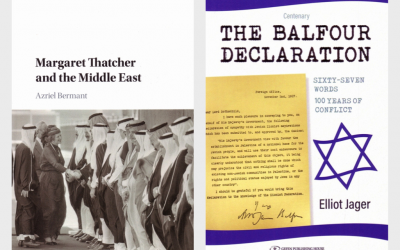
Author Elliot Jager’s book, “The Balfour Declaration: Sixty-Seven Words – 100 Years of Conflict,” is a look into the personalities and interests of the characters who brought about the short statement that legitimized the idea of a “national home for the Jewish people” in Palestine.
Tel Aviv University lecturer Bermant’s book, “Margaret Thatcher and the Middle East,” reveals new findings on Margaret Thatcher’s relationship with Israel based on recently released British and Israeli documents.
Thatcher is often remembered for being the first British premier to visit Israel in 1986 and for her warm relations with the Jewish community. Bermant shared why a deeper look into Thatcher’s Middle East policy exposes a more complicated legacy.
Why still talk about Balfour?
In front of a heavily British expat crowd in an auditorium located in one of Jerusalem’s oldest neighborhoods adjacent to the Old City, the authors brought new insight and anecdotes to the Balfour Declaration’s familiar history.

“I think we are still talking about a Balfour Declaration because to this day, the idea of a national home for the Jewish people is opposed by the Palestinian Arabs,” Jager said, noting the Palestinians’ recent proposal to sue Britain for issuing the Balfour Declaration in 1917.
Bermant said it’s not just those against the Balfour Declaration drawing attention to the document, but that the statement remains a point of pride for both Israel and Britain.
Marking the centenary anniversary of the Balfour Declaration this year, Netanyahu flew to London for a celebratory dinner with British prime minister Theresa May in November.

“Both Israelis, the British, and in particular, Palestinians, have drawn attention to this anniversary,” Bermant said.
“For Palestinians, Balfour is the original sin, while for Israelis, it’s a source of pride and something they’re very happy to make a lot of. Britain sometimes finds itself in an awkward position because on the one hand, the May government speaks of it with pride but over the decades, Britain has been very uneasy about the Balfour Declaration,” said Bermant.
Certainly at the time, said Jager, the decision to publicly support the idea of a Jewish state was rather profound and due largely to the Jewish community’s perceived influence.

“It was World War I. Anything was worth trying,” Jager said. “There was this sense that the Jews had this unbelievable influence in Russia and the United States. [President of the Zionist Organization] Chaim Weizmann didn’t do anything to dissuade them from believing this nonsense.”
Jager said that Christian Zionism also played a role in encouraging Lord Balfour and Lloyd George, the letter’s main sponsors, to support the notion of a Jewish state, noting that both were Bible-reading Christians.
Eventually, Jager said, new and less sympathetic characters came into power after WWI, causing many British officials to backtrack their early support of the Jewish state.
This shift in attitude, Bermant said, culminated with Britain’s 1939 White Paper which limited Jewish migration into Palestine.
Thatcher: More complicated on Israel than remembered
Fast forward to the Thatcher years and the relationship between Israel and Britain had fewer extremes, but still had its moments of turbulence, Bermant said.
Thatcher served as prime minister from 1979 to 1990. “There is a paradox of Thatcher. She comes into office with a strong support of record for Israel,” Bermant said.
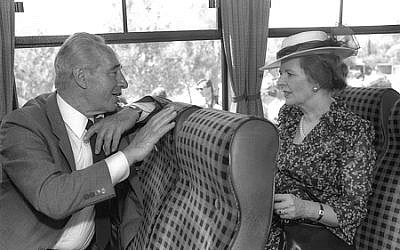
“Initially, she was very robust on Israel and very hostile to the PLO. Yet at the same time, strangely enough, within a year of becoming prime minister, she endorses the EEC Venice Declaration,” Bermant said, a landmark statement from the European Economic Committee in 1980 endorsing Palestinian self-determination, recognizing the PLO and condemning Israel for settlement building.
This created major tension with Menachem Begin, Israel’s prime minister at the time, Bermant said.
“Yes, Thatcher was sympathetic to Israel — but she also had a very strong need for strong relations to the Arab world,” Bermant said, citing Thatcher’s close relationship with Jordan, Egypt and Saudi Arabia.
Does Israel ask too much?
Today, the authors agreed, the history of Balfour and the Thatcher era, shows that even the closest of allies are ultimately led by their own national interests, and Israel should not expect otherwise.
“We have these ridiculous expectations that [other countries’] relationship with us will be romantic. Why do we do that? I don’t know,” Jager reflected.
Yet, particularly now that Britain is in the process of severing ties with the European Union post-Brexit, its role in shaping the region might not just be historical, Bermant said.
“Israel may actually come to depend more on Britain in the years to come. It is important to recognize Britain’s role [in the Middle East] and I hope Britain can have a positive role to bring about the peace process,” Bermant concluded.
Upcoming events
Sunday, March 18
“Kipat Barzel” English Premiere
Creator Avner Bernheimer interviewed by Jessica Steinberg
7:30 p.m., Jerusalem Cinematheque
Produced along with Nefesh B’Nefesh
Tickets NIS 50 HERE (NIS 60 at the door)
Wednesday, March 21
Becoming Israeli: The Hysterical, Inspiring and Challenging Sides of Making Aliyah
Moderator: Sarah Tuttle-Singer
Panel: Akiva Gersh, Talya Amira Woolf and Shira Pasternak Be’eri
8 p.m., Beit Krinitsi, 64 Krinitsi, Ramat Gan
Produced along with the Ramat Gan City Council
Tickets NIS 15 available HERE
To make sure of your seats and to be the first to hear about all our events, join our priority mailing list. Email the word “subscribe” to: events@timesofisrael.com









The Times of Israel Community.