

A year after war, Gaza border residents brace for next round
Southern frontier communities still coping with loss, say repeat of hostilities inevitable as long as Gaza remains unrehabilitated
 Add ToI as a Preferred Source on Google
ESHKOL REGIONAL COUNCIL – The summer of 2015 creeps in slowly but assuredly by the Gaza border. Less than a year after rockets and mortars sent residents running for shelter during Operation Protective Edge, an uneasy ceasefire between Hamas and Israel has brought about a tentative calm for the hardest hit communities.
Indeed, the quiet hum of small-town life and the pastoral open fields that abut the border-fence might fool a visitor into believing that this area had been spared the worst of the past three bouts of fighting in five years.
In the Eshkol region, bordering the southern half of the Strip, kibbutz pools brim with frolicking children supervised by their doting mothers; Thai workers covered from head to toe from the scorching sun idle during the hottest hours under citrus trees; cows lazily munch away uninterested in local politics — and on Friday nights, 18 and 19-year-old soldiers pack the local pubs and clubs on their weekend furlough to ogle members of the opposite sex – enticed to the area by the relaxed atmosphere and cheap alcohol.
It seems like all is back to normal.
But the picture is deceiving. Residents tell a different story of a shared, perpetual weariness as they count down the months — or days to the next round of this seemingly intractable conflict. As they settle back into a precarious routine, many fear a repeat of hostilities, and soon.
In Magen, a kibbutz 4 kilometers from the border, piles of building material sit uncollected beside almost every house, as government contractors complete thousands of bomb shelters to enable residents to reach cover in the 15 seconds that it takes a rocket from Gaza to hit their communities.
While many welcome the move, others say the shelters point toward a policy of containment and a subtle hint that local residents should buckle down for the long term – or leave.
Adele Raemer, an English teacher living in Nirim – which saw two of its members killed by a Hamas mortar in the waning hours of the war – told the Times of Israel via email that the Kibbutz is trying to rebuild, but members are struggling to cope with the loss.
“We’re feeling very vulnerable. We are a community in mourning, trying to rebuild our feeling of safety here after losing two of our friends. We have been working very hard to strengthen the community and make this a place where families can feel secure in having their children run around freely again,” Raemer said.
“Two families who rented here left. A family who are members have taken a year off and moved to a moshav nearby. Aside from that, 11 families have asked to become members (young families),” she added.
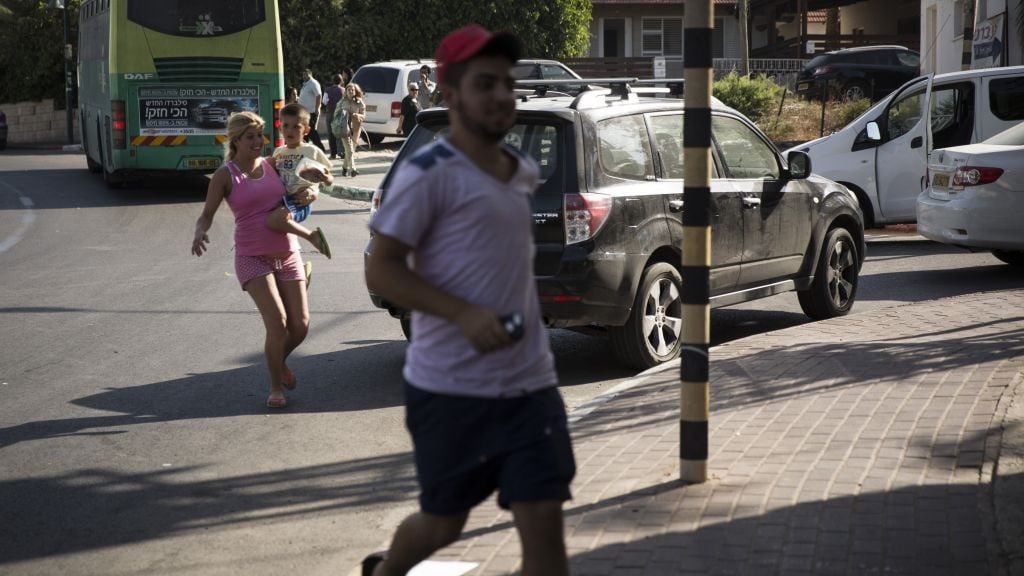
Raemer, whose house was hit by shrapnel during the war, remains cautiously optimistic that an eventual agreement with Hamas can be reached.
“I have faith in our government being capable of achieving a long-term political solution — if it decides that that is what it wants. A military solution will never be able to protect us 100%. Infiltrators get through on a daily basis (the vast majority are just looking for work or to be thrown into an Israeli jail so they can have 3 meals and a mattress) and the threat of the tunnels is always looming,” Raemer said.
“Most of my friends here understand, as do I, that as long as Gazans have nothing to lose, nothing to live for, they will only have what to die for. As long as they are raising their children in rubble, they will be raising another generation of Israel-haters. Until Gaza is rehabilitated and reconstructed, our homes will remain under threat,” she said.
Cat and mouse
For the communities immediately straddling the border, their proximity to Gaza puts them in range of Hamas tunnels, and mortar fire – which affords no 15-second warning.
One veteran of Magen described in an analogy the difference between living in his kibbutz – beyond the reach of mortars (and hence with a 15-second alarm) – and living in a community by the fence, such as Nirim.
“In a scientific experiment, researchers applied electric shocks to two groups of mice. To the mice in group ‘A’, they sounded a bell before every electric shock. The mice in group ‘B’ however received no forewarning. Researchers discovered that those mice in group ‘A’ that received an alert before their shocks in the form of an alarm coped far better, had lower stress levels and lower heart rates than those in group ‘B’ – who became extremely tense and anxious because they didn’t know when to expect the next shock,” he said.
“We in Magen, with our 15-second warning, are the mice of group ‘A’. We feel slightly safer with our siren. Those living closer are in group ‘B’. It’s far more difficult for them to cope mentally,” he said.
Uri Roset, a political science professor and lifetime resident of Magen, told me that each round of warfare leaves locals increasingly demoralized, but that he sees no solution to the conflict, and Hamas, in his opinion, is the lesser evil of the more extreme Islamist sects vying for power in the Strip.
“There’s a feeling of vulnerability because operations such as Protective Edge take place every two years and that has an accumulative effect [on us]. The deterrence we achieved is temporary, so we don’t know how long this [quiet] will last,” Roset said.
“There is no way to achieve peace with Hamas, which is a movement based on a radical, even anti-Semitic ideology. I speak Arabic and listen in to Hamas broadcasts,” he said.
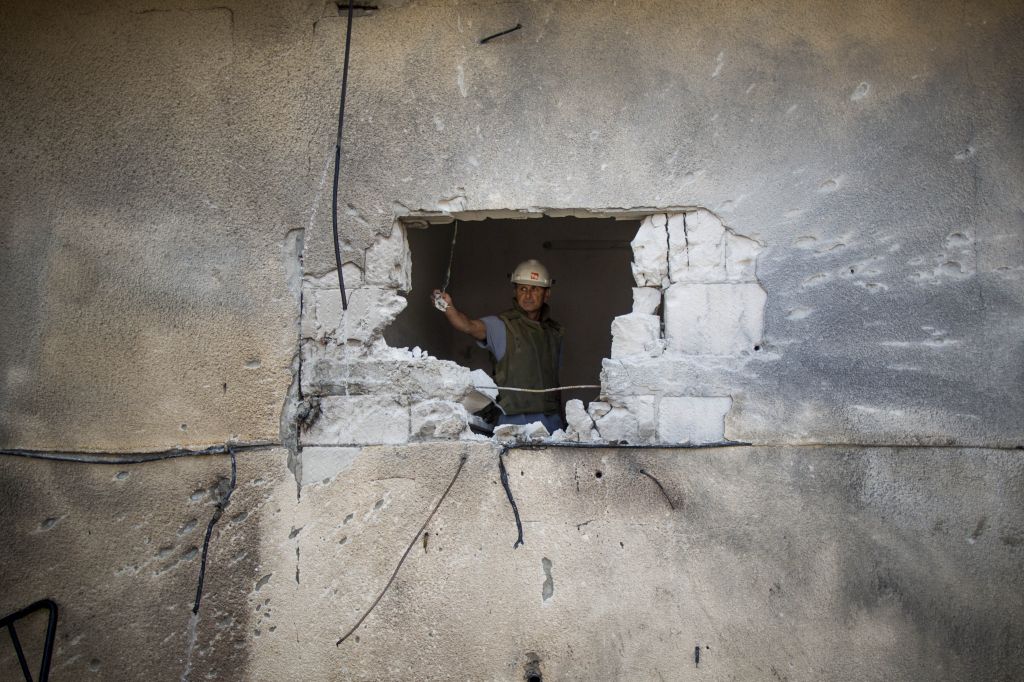
Given its proximity to Gaza, border communities can easily tune in to Hamas radio and local stations sounding endless loops of Koran readings.
“There is no willingness to recognize Israel [on the other side],” Roset said, but he added that his greater fear is a takeover of the Strip by other radical jihadist organizations such as Islamic Jihad or the Islamic State.
“Those organizations, unlike Hamas, cannot be deterred and the result will be endless rocket fire that may force us to retake control of the Gaza Strip, something that will have catastrophic consequences for Israel,” he said.
In Roset’s opinion, Israel must strive for a long-term ceasefire with Hamas and improve living conditions in the Strip so that Gazans “have something to lose and will put pressure on Hamas to maintain the calm.”
Leaning left
Despite bearing the brunt of Israel’s wars with Hamas, Gaza-border kibbutzim interestingly lean left on the political spectrum. In the 2015 elections, the center-left Zionist Union and far-left Meretz party garnered a majority of votes in nearly every single locality abutting the Strip.
In Nirim for example, 88 percent of voters picked Zionist Union or Meretz. In Magen the numbers were similar – 82% voting left. In Nahal Oz, the closest community to Gaza, in which 4-year-old Daniel Turgeman was killed by a mortar during the war, 65% voted for one of the two left-wing parties.
In nearby, larger towns however, such as Sderot, Netivot and Ofakim, the numbers were flipped, with right-wing parties – especially Likud — taking a clear majority at the ballot box.
The reason behind the political divide is historical. The kibbutzim by the border were established by left-leaning youth movements such as HaShomer Ha’Tzair in the 1940s and 1950s. Towns like Sderot however, began as transit camps populated initially by North African and Middle Eastern Jewish immigrants whose descendants form the traditional Likud voter base.
But in light of the current situation, Roset believes that traditionally leftist kibbutzim are starting to move rightward as well.
“In the kibbutzim there is a movement towards the [political] center stemming from a recognition that it is impossible to reach a peace agreement with Hamas, and that Abu Mazen doesn’t have the ability to reach an agreement on behalf of all Palestinians,” Roset said, referring to Palestinian Authority President Mahmoud Abbas.
“This does not prevent us from criticizing the policies of Benjamin Netanyahu. But the assumption today — even among leftist kibbutznikim — is that it’s necessary to manage the conflict even-handedly (and perhaps make additional transfers of land to Palestinians in the West Bank), but that it is almost impossible to solve [the conflict] and reach a permanent agreement,” he said.
While elections may find them on different sides of the fence, residents of Sderot feel no less traumatized than their counterparts in the nearby farming communities and lean right in the view that the current deadlock proffers no other political alternative.
“In this area specifically, fear won out. The fear that a left-wing government might not protect us like a right-wing government beat back the thought that perhaps a shuffle at the top might lead to a change in the results,” said Bar Pariente of Sderot, who grew up and lives in the town and studied in its local college.
“When people who have experienced trauma see the growing hatred in the world and the rise of new terror groups [who want to eliminate us], fear wins out. I don’t think we’re on the right track, because you can’t repeat the same action and expect a different result — especially when I see the recurrence of rockets in recent days,” Pariente said, adding that “I hope, anyway, in spite of the recent elections, this time something will change.”
Even though Pariente noted that she would “never” consider leaving Sderot – “my home” – she indicated a growing sense of despair in the town, as residents prepare themselves mentally for a return to fighting.
“We’re feeling overwhelmed because for more than a decade we’ve been under continuous threat. We have a generation of children who don’t know what it’s like to play soccer outside or sit with friends in the park, because there’s always that fear that at any moment a siren will go off,” Pariente said.
“When I was little, my parents would tell me: ‘When you grow up, you won’t have to go to the army because there will be no more wars,’” she said.
“I’ve seen my fair share of wars and I served in the army, and unfortunately, I don’t see a situation where I can repeat that sentence to my own children. My greatest fear is that my children will grow in this same reality for decades and nothing will ever change,” she said.








The Times of Israel Community.