

After four die in Gaza onslaught, some ask if Iron Dome still as effective
IDF reports 86% success rate for rocket defense system, only slightly lower than in 2014 war, but relatively high death toll raises concerns terrorists learning to overwhelm it

 Add ToI as a Preferred Source on Google
Sam Sokol is a former political correspondent at The Times of Israel. He was previously a reporter for the Jerusalem Post, Jewish Telegraphic Agency and Haaretz. He is the author of "Putin’s Hybrid War and the Jews"

JTA — After the weekend’s fighting between Hamas and Israel, some Israelis have raised questions about the strength of their country’s missile defenses.
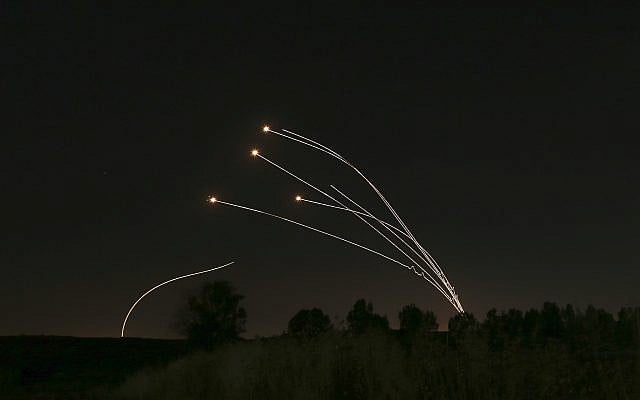
Over the course of the weekend, Hamas and Islamic Jihad launched nearly 700 rockets and mortars at Israel, killing four people and injuring more than 200. Israel’s Iron Dome missile defense system intercepted 240 of the 690 projectiles fired from Gaza.
The number of rockets that Iron Dome failed to intercept and the four Israeli fatalities sparked inquiry about the effectiveness of the missile defense system, and whether Hamas and Islamic Jihad have found a way to thwart the system.
Hamas was quick to declare that it had achieved victory by overwhelming Israeli defenses with concentrated barrages of projectiles.
“The Qassam Brigades, thanks to God, succeeded in overcoming the so-called Iron Dome by adopting the tactic of firing dozens of missiles in one single burst,” a spokesman for Hamas’s Izz ad-Din al-Qassam Brigades said in a social media post. “The high intensity of fire and the great destructive ability of the missiles that were introduced by the Qassam [Brigades] … succeeded in causing great losses and destruction to the enemy.”
The number of Israeli civilians killed in the two-day conflict was only one fewer than during 2014’s Operation Protective Edge, a struggle of nearly two months, when Palestinian factions lobbed more than 4,500 projectiles at Israeli cities.

At the time, the Israel Defense Forces said that its Iron Dome batteries had managed to knock down 90 percent of the rockets within their coverage zones — a rate of success which was disputed by some critics. The IDF claimed a similar level of success this time, too, telling reporters that it had achieved an 86% success rate and that only 35 projectiles landed in populated areas.
However, Maj. Gen. Yaakov Amidror, a former national security adviser and retired head of the Military Intelligence’s Research Department, said Iron Dome had gaps in its coverage, especially when it came to short-range rockets landing within a few kilometers of the border.
“We don’t have enough time to intercept it,” he told the Jerusalem Post.
Amidor also said that in the case of a car hit by an anti-tank missile near Kibbutz Yad Mordechai on Sunday, killing its Israeli driver, Iron Dome wouldn’t have helped.

“From the point of view of the system, this was an open area without people. We don’t intercept such rockets,” he said.
A former deputy military intelligence chief, Brig. Gen. Meir Elran, said that while “Iron Dome has proven to be an effective means of saving lives, which also improves the flexibility of decision makers in Israel,” it is clear that the system as currently constituted cannot provide Israel with sufficient protection in the event of a wider conflict.
In an article published by the Institute for National Security Studies in Tel Aviv several weeks before the outbreak of hostilities, Elran warned that “the number of available batteries (some operated by reservists) cannot suffice as a response to the threat, even one characterized by sporadic fire against the Israeli depth. In a full-scale conflict the [Iron Dome] system would be required to cover primarily military installations and vital national infrastructures,” which would mean that there would be gaps in the system’s coverage of residential areas.
“During a broad and protracted conflict,” Elran wrote, there is a “danger of multiple, simultaneous events that stretch the capacity of response systems.”
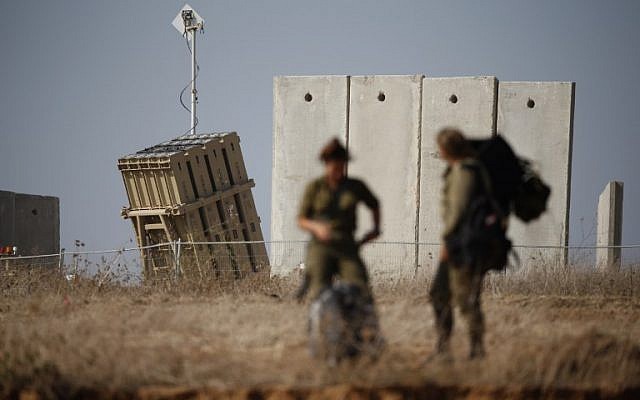
The IDF has been beefing up its systems. The business daily Globes reported that the army has been working on improvements to Iron Dome intended to deal with just the kinds of barrages used over the weekend, as well as against the kinds of short-range projectiles used to target communities along the Gaza border. In mid-April, the IDF concluded an air defense exercise combining its Iron Dome and Patriot missile batteries.
Overall, the presence of Iron Dome has allowed Israel additional flexibility in choosing when it wants to escalate conflicts. The system reduces the need to send infantry troops into Gaza to stop missile fire against population centers.
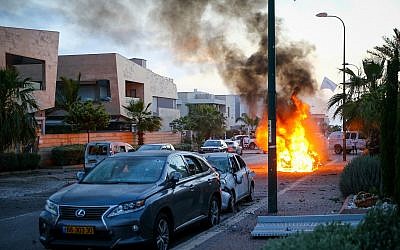
Despite this weekend’s death toll, Iron Dome acquitted itself well, Times of Israel military correspondent Judah Ari Gross told JTA. The higher than usual level of civilian casualties can be attributed to a combination of bad luck, the intensity of the barrages and Hamas’ use of heavier rockets with larger payloads. Such projectiles can intensify the damage when they do get through.
“In one barrage, they fired 117 rockets toward Ashdod. One got through. Is that overwhelming the system?” he asked. “You can say, yes, it is — especially as that one killed an Israeli civilian — or no, that’s a 99.1% success rate.”
The missile that did get through in Ashdod killed Pinchas Menachem Prezuazman, a 21-year old Israeli-American who was hit by shrapnel while running for cover. Even with a high level of interceptions, with enough metal flying, some are bound to get through, Gross said, adding that it was unclear exactly how the IDF had calculated its claimed 86% interception rate.
Asked for comment, the IDF said that it was unable to provide information on Iron Dome’s performance or how it calculates interception rates because it was short-staffed due to Tuesday evening’s Yom Hazikaron, or Memorial Day, commemorations.
Uzi Rubin, one of the pioneers of Israel’s earliest attempts at missile defense, told JTA that based on the publicly available data, it appears that the Palestinians “tried to tax the system as much as they could, but the system as a whole held well.”
“Eighty-six percent is not much less than the 90% during [Operation Protective Edge], and remember this time most of the fire was concentrated on the area around Gaza, which is short range and harder to defend,” he said.
Israel doesn’t just rely on the Iron Dome to keep its citizens safe. Phone apps warn of incoming missiles, and bomb shelters and “safe rooms” are ubiquitous, if not always well-maintained. In his article Elran suggests that “existing plans for improving public and private shelters should be implemented in other parts of Israel.”
Elran also urged the Home Front Command and municipal leaders to get on the same page when it comes to closing schools and opening public shelters, “issues that continue to be disputed.”
Residents of southern Israel had differing opinions as to the effectiveness of the IDF’s missile defenses.

Raymond Reijnen, a Dutch immigrant whose house in Kibbutz Nahal Oz was hit by a rocket as he hid in its bomb shelter with his wife and children on Saturday, said Iron Dome’s effectiveness has been exaggerated.
“Everybody thinks [it’s] great, but every mortar they fired at the kibbutz landed and didn’t get intercepted,” he said. “Iron Dome is a bandage to keep the people feeling safe and protected. Don’t get me wrong, it’s a great system, but its capabilities are highly overestimated.”
On the other hand, Adele Raemer, a resident of Kibbutz Nirim on the Gaza border, said she did feel safer than in previous escalations now that the system was being deployed to protect areas closer to the frontier previously left exposed.
“We’ve only had Iron Dome for about a year,” she said. “As a resident, I do feel more protected now that we have [it].”








The Times of Israel Community.