

Works of passion sung at a site of passion
Israel Opera’s 5th production at Masada fails to incorporate the iconic landmark, but the desert location still excites
 Add ToI as a Preferred Source on Google
Melanie Lidman is an AP reporter and former Times of Israel reporter
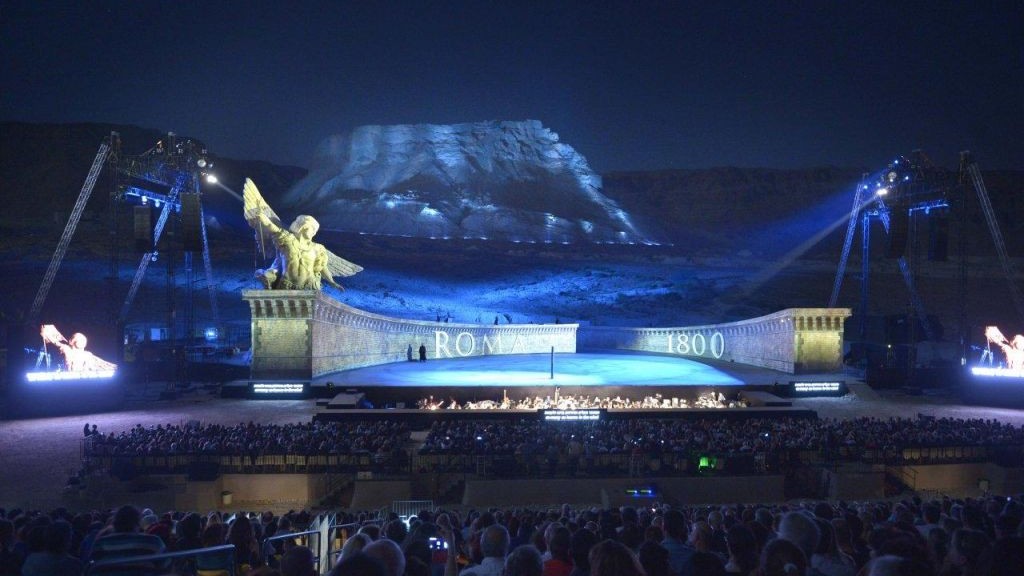
Heroic tragedies all dabble in the same themes, regardless of historical setting or protagonists.There’s passion, there’s stubbornness, a dash of morality, forbidden love, more passion, and the inevitable death. Since so many operas are heroic tragedies, Masada seems a most natural place to host a massive outdoor operatic production.
The ancient desert fortress has it all: history, war, an eloquent narrator, zealots, tenacity, passion, death to preserve honor. For the past six years, the Israeli Opera has hosted a signature event each June at Masada. It has performed “Nabucco” (2010), “Aida” (2011), “Carmen” (2012), and “La Traviata” (2014). There was no opera at Masada in 2013 due to the government’s failure to approve a state budget, leaving the opera’s government funding in limbo.
This year the opera is doing a double production, with four productions of “La Tosca,” Puccini’s bloody tale of deception and lust set in Rome in June 1800, and two of “Carmina Burana,” a riotous collection of ancient Latin and German poems about hedonism and sexuality.
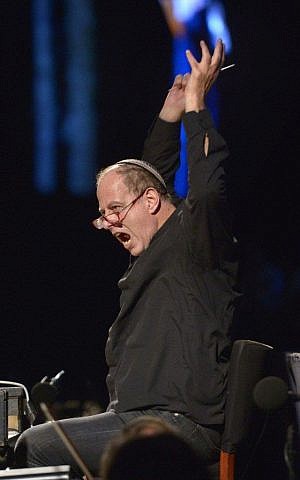
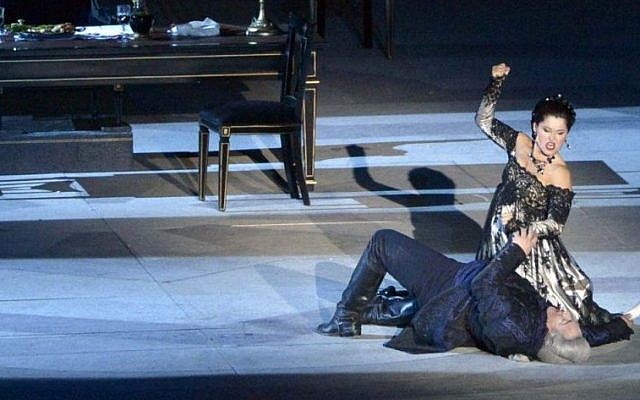
The Tosca production has all of the hallmarks of previous years: an expansive set, an impressive pit orchestra led by virtuoso Daniel Oren, detailed costumes that flutter in the desert wind. But unlike previous years, where the hulking mountain of Masada provided a backdrop for creative lighting effects, this year the mountain was largely ignored.
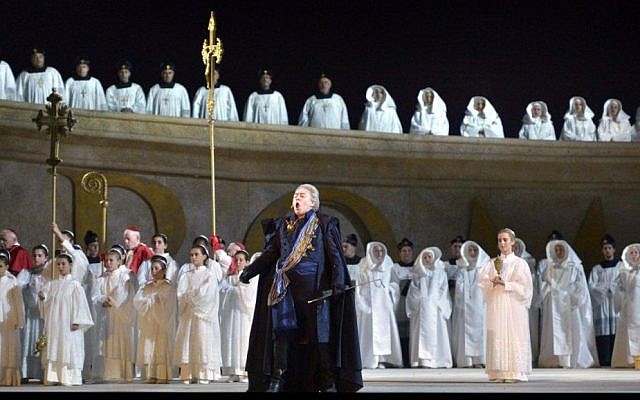
La Tosca had many opportunities to engage with Masada — the mountain and the location. The opera’s military-like procession of Roman priests and nuns featuring more than 200 cast members was probably the first time this area saw so many Roman Catholic crosses since the Crusaders camped around the back of the mountain 2,000 years ago. The opera celebrates people who dedicate their lives to the cause of liberty and justice embodied by the French Revolution, even at the cost of their own lives. But even in the final moment (spoiler alert: everybody dies. It’s an opera, what did you expect?) when the heroine La Tosca flings herself off of a wall, committing suicide in the height of passion, grief, and honor, the mountain was barely given a passing glance before the lights came up for the final bow.
Israel Opera’s general director Hannah Munitz said this was a conscious artistic decision. “With La Tosca, we tried to make it more like an opera, instead of a production,” she said prior to the dress rehearsal on Tuesday. “We wanted it to be elegant and classic with very high standards. This year, we are using Masada a little less. It will be like a theater, just enlarged.”
‘This year, we are using Masada a little less. It will be like a theater, just enlarged’
“On the one hand, this is a really grandiose opera set, but on the other hand we know that this opera has a lot of intimacies,” said Michael Ajzenstadt, the Israel Opera’s artistic administrator. “You have to find the balance between the intimate moments and the majestic moments on the stage when it’s full of people.”
One of the major benefit of outdoor opera festivals is that it makes opera more accessible to the general public. The opera comes out of the theater, where it can feel forbidding and stuffy, and into nature, where people who may not know about opera feel less intimidated. Open-air opera festivals around the world, including Masada, attract people who are not opera buffs.
The 2,200 square meter stage at Masada is so enormous that there are TV monitors displayed at each end showing conductor Daniel Oren, so performers can see him from every part of the stage. This means that when there are only two people on stage, the singers get swallowed by the sheer size of the set. It may be the stripped down version that opera fanatics love, but for the uninitiated, that artistry gets lost in the size of the stage.
“Most moments, the way [La Tosca] is written, you have two people on the stage, or when you’re really lucky you have three,” said Ajzenstadt. “It’s about a personal, powerful confrontation between this trio of characters, two men who are fighting each other, in a way, for the love of this woman.”
La Tosca has only one chorus scene, just before the end of the first act. More than 200 performers, including the Moran Youth choir, slowly filed out in a solemn procession to fill the stage. It was a dazzling display of colors and costumes and notes soaring to the heaven beneath the stars. When the song ended, fireworks burst into the sky. It was transcendent. But it was only one song.
For those who wanted the lights and the color and the big chorus scenes, Israel Opera had a simple solution: it would host two different operas.
For the opera buffs, there’s a true-to-the-book version of a Puccini classic. For those looking for a spectacular explosion of color, there’s “Carmina Burana,” a scandalous, riotous production featuring many pyrotechnics and real flames, an enormous, kinetic set that is colorfully lit, and a stage often filled to the brim with dancers in outlandish costumes.
“Those who will see ‘Carmina Burana’ will see a totally different approach,” said Ajzenstadt. “There is a balance between the two. One will be really gigantic fabulous lighting good for the outdoors and Masada in particular. One will really concentrate on the story, on the music, on the period.”
The two separate productions allow the Israel Opera to bill the Masada events as a true festival and provide an extra incentive for international tourists to come. There are about 3,000 international tourists coming specifically for the Masada Opera, according to the Tourism Ministry, which is also one of the major sponsors of the event. Ajzenstadt estimates that at least half of the audience at “Carmina Burana” will also attend “La Tosca.”
“Carmina Burana” runs about an hour, while “La Tosca,” with a half-hour intermission, stretches for three and a half. One problem is that Carmina Burana will only be performed on Friday nights, nixing the performance for religious theater-goers.
Religion also played an interesting role in La Tosca. Religious Jewish members of the Israeli Opera objected to wearing crosses as part of their costume, so they had special props made with a capital “T” instead of a Catholic cross.
The mountain of Masada may not have been utilized to its full potential this year. But the desert itself is a major protagonist in the production, forcing creative solutions and fostering a bit of uncertainty, which makes the opera more exciting.
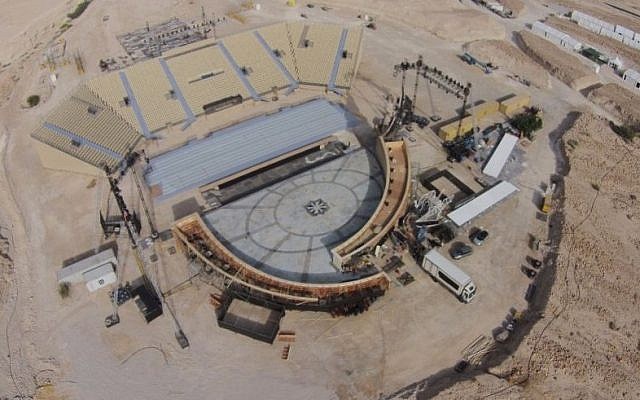
In past years, the desert wind has taxed vocal cords and challenged the 2,500 people who build the opera village each year from scratch. The logistics of opera in the desert are staggering. The refreshment stands expect to serve 300,000 liters of water over the course of the performances, or about five liters per person per night. The stadium seats 6,500 people, and tickets run from NIS 400 in the nosebleed section to NIS 1,300 in the orchestra. The area is so large that soloists actually take a golf cart from their dressing room trailer to the stage.
The weather is always a challenge, but this year performers and technicians struggled even more when a surprise downpour, unseasonable for this time of year, soaked the stage for half an hour during rehearsal. Sustained, strong winds for a few days before the performance also damaged some parts of the set.
“Opera is an art form that should be performed acoustically,” explained Ajzenstadt, the artistic administrator. “But we have to amplify outdoors. We are lucky that we have amazing sound technicians, but we can work and create amplification to the utmost point and then the weather comes and plays havoc with it. Wind comes and does bad things to amplification. One of the reasons we start performances late at night is that the heat and the wind are less strong at this time.”
After the festival ends, the entire village is disassembled and every trace of construction is removed from the national park, until the next year. This was one of the conditions imposed by the National Parks Administration and the Tamar Regional Council, since the area is a protected national park.
“Each year you get more experience,” said Munitz, the general director. “Every year we are improving everything that we have control over. Then, of course, there are things like the weather, which we have no control over.” And that’s exactly what makes it exciting.
“Tosca” will be performed on two Thursdays, June 4 and 11, and on two Saturdays, June 6 and 13 at 21:30. “Carmina Burana” will be performed on two Fridays, June 5 and 12, at 22:00.
French edition editor Stephanie Bitan contributed to this report.







The Times of Israel Community.