

Asylum seekers face expulsion to other countries
Interior Ministry draws up motion to deport Sudanese and Eritrean migrants, bypassing Supreme Court
 Add ToI as a Preferred Source on Google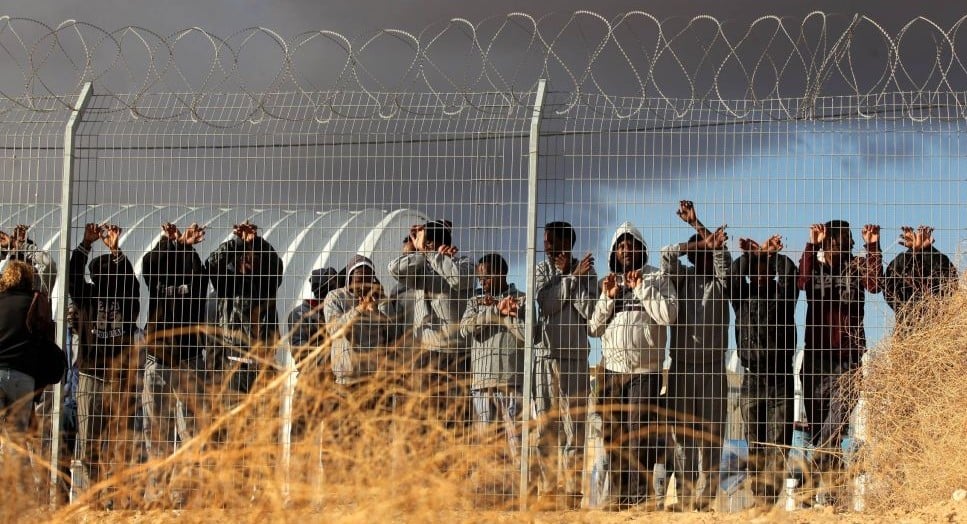
The Interior Ministry is expected to enforce a measure that would see asylum seekers evicted to third-party countries in Africa, or, if they refuse, imprisoned indefinitely.
Until now, Israeli authorities have pressured asylum seekers — or “illegal infiltrators,” as the government terms them — most of whom are Eritrean or Sudanese nationals, to leave the Jewish state via a slew of measures, including incarceration in minimum-security facilities and incentives such as cash grants and free tickets back to their home countries.
No asylum seekers have been deported without signing a declaration that they were leaving Israel of their own free will.
The new bill, however, seeks expel asylum seekers detained in the Holot detention center, with or without their consent, to uninvolved third countries in Africa, the names of which have yet to be formally announced. One unnamed source told Haaretz Tuesday that the destinations would most likely be Rwanda and Uganda.
Holot is an “open” facility in southern Israel that is currently home to some 2,500 African asylum seekers. Inmates are required to check in during morning and evening hours but are free to leave during the day. The maximum detention term in the facility is mandated by law as 20 months.
Initially, migrants whose application for refugee status has yet to be processed will not be slated for eviction until a court can mull over their appeal.
Refusal to leave would lay the grounds for indefinite incarceration in the Saharonim prison, near Israel’s border with Egypt.
Interior Minister Gilad Erdan said that deported refugees will be secure in a third country, where they will not face reprisals for desertion or for traveling to Israel, which is considered an enemy state in Sudan, and which has no relations with Eritrea.
“The move will encourage infiltrators to leave the State of Israel in a safe and dignified manner and will effectively fulfill our duty toward the citizens of Israel and south Tel Aviv, who will be able to return the fabric of life they were used to,” Erdan told Channel 2 news Tuesday.
“They will receive fair treatment in [the designated] countries set to absorb them,” he said.
The bill received backing from the Justice Ministry and Attorney General Yehuda Weinstein, although sources indicated that it was likely no action would be finalized until the appointment of a new interior minister in the wake of this month’s election.
Authorities indicated that Israel would fund plane tickets, temporary accommodation and allowances to all prospective deportees.
Those who agree to leave will be given 30 days to pack and organize their affairs. Those who refuse will face a hearing that could result in further incarceration, a statement released by the Interior Ministry read.
Expulsion to a third country is largely unprecedented in the Western world. Italy and Australia signed similar agreements with third-party countries — Italy with Libya and Australia with Malaysia — but both proposals were shot down by local courts. In both cases, courts ruled the bills inconsistent with international law and the 1951 UN convention on refugees — to which Israel is also a party.
Thus far, Israel has recognized only four Eritreans and Sudanese nationals as official asylum seekers, out of a total of 5,573 who applied for that status.
A Supreme Court injunction in September 2014 declared the detention of asylum seekers for an unspecified amount of time as unconstitutional and ordered the Holot facility closed by December 22. The court granted the government three months to find an alternative policy before it repealed the law completely.
In light of that ruling, Prime Minister Benjamin Netanyahu, together with the Interior Ministry, made new amendments to the law in November that allowed for illegal immigrants to be detained for up to 20 months without trial — a change that, in effect, allowed Holot to remain open.
Over the course of 2014, 8,500 migrants residing in Israel left the state of their own volition, 7,000 of them back to their home countries, and 1,500 to other countries that granted them asylum status. Some have complained that after they returned to their home countries they were harshly abused.









The Times of Israel Community.