

Bedlam erupts in Supreme Court as pro-government activists try to force their way into Oct. 7 inquiry hearing
Pro-Netanyahu mob chants ‘Judge the judges’ outside hearing on coalition’s refusal to establish state commission of inquiry; judges indicate preference to delay ruling till after election
 Add ToI as a Preferred Source on Google
Jeremy Sharon is The Times of Israel’s legal affairs and settlements reporter
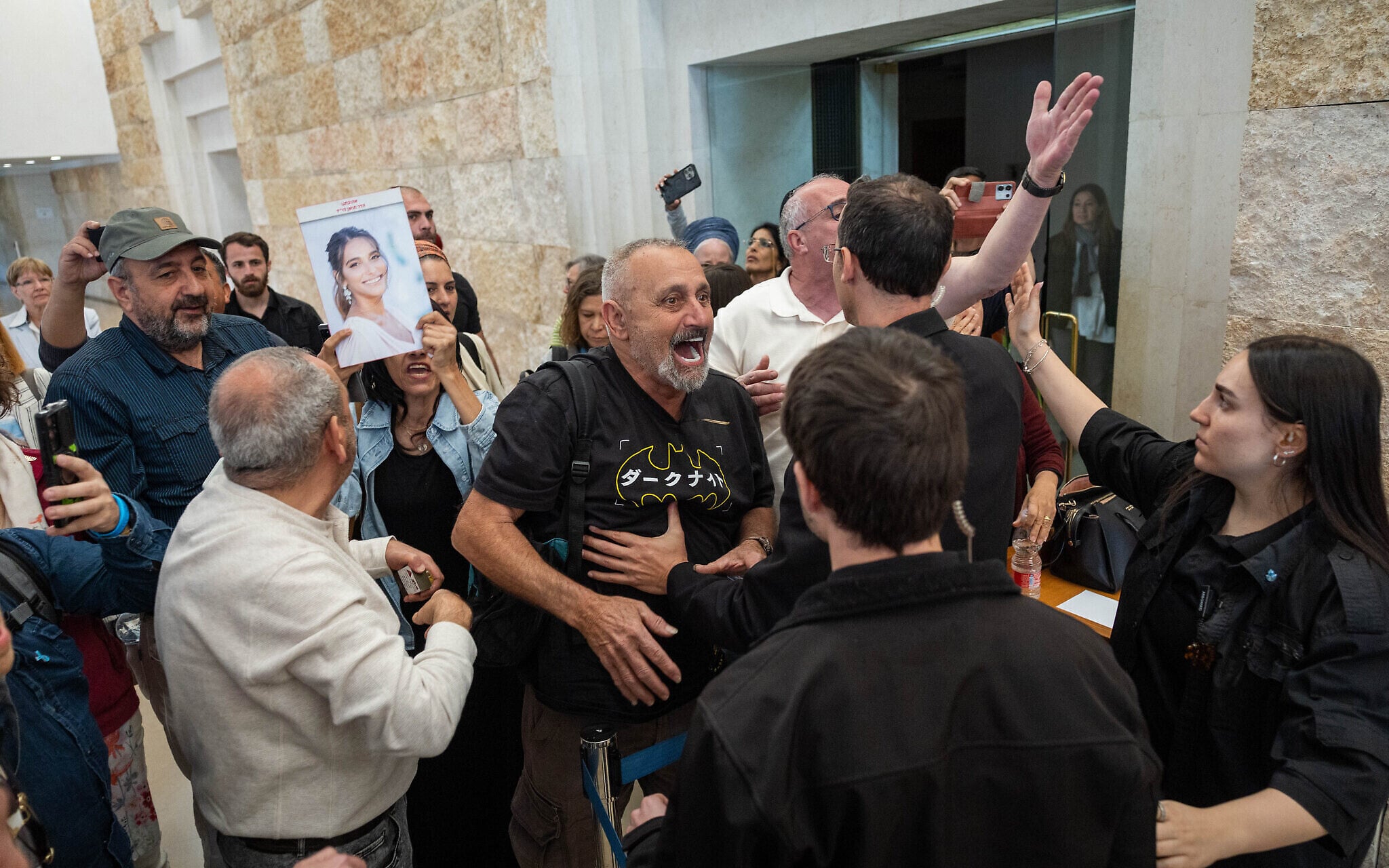
Events at the High Court of Justice devolved into chaos on Thursday after at least one individual sought to break into the courtroom, and a pro-government mob massed outside demanding access, as a hearing on petitions demanding a state commission of inquiry into the October 7, 2023, invasion and atrocities was being conducted.
Court security advised the justices to evacuate the courtroom, and proceedings were suspended for some 20 minutes.
Most High Court hearings are held with an audience present, but the court had decided on Wednesday night to bar the public, precisely due to “concerns of interruptions, disturbances, and outbursts” that would make the hearing impossible.
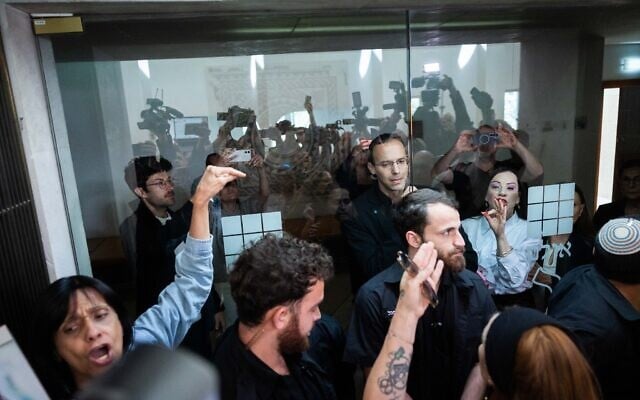
Some two hours into the hearing, a woman tried to force her way inside and, after she was ejected by court security, a mob of pro-government supporters converged outside the courtroom, demanding to be let in and chanting “Judge the judges.”
The attempted break-in followed ugly scenes outside the Supreme Court building as bereaved families on different sides of the political aisle engaged in mutual recriminations over who was responsible for the October 7 disaster, when invading Hamas-led terrorists killed some 1,200 people and took 251 hostages.
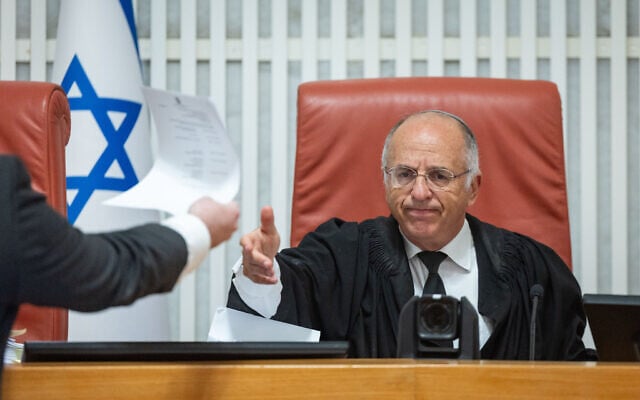
The verbal battles continued inside the building and even inside the courtroom itself. Bereaved family members supportive of the government accused the court of responsibility for the Hamas invasion, after two family representatives were allowed to speak by Supreme Court Deputy President Noam Sohlberg.
During the hearing itself, the justices were highly critical of the government’s failure to appoint any form of investigative committee into the catastrophic events of October 7, and expressed astonishment when the government’s lawyer stated that a commission of inquiry could only be established after Israel is victorious on all fronts of its current wars.
Nevertheless, Solhberg and Justice Yael Wilner asked the representative of the attorney general’s office pointedly if it would not be better for the court to wait until after the pending general election to make a ruling on the issue, and expressed concern over the public legitimacy of a court-ordered commission of inquiry.
“The elections are very close, and we want public trust in this committee. If we have come this far, should we leave it to the government after the elections?” asked Sohlberg.
Prime Minister Benjamin Netanyahu’s government has steadfastly refused to establish a state commission of inquiry, the only available independent public forum with investigative powers, into the October 7 disaster.
It first argued that an investigation could not begin while the country was still at war, but then later claimed that a state commission would be biased against it due to what it alleges is the liberal bent of Supreme Court President Isaac Amit, who would appoint the members of the committee. The government has not made this claim in court, however, instead arguing that only the cabinet or Knesset is empowered to establish a state commission of inquiry — therefore excluding the possibility that the court may order such an investigation.
Critics have repeatedly accused the government of trying to shirk responsibility for allowing the massacre to take place on its watch.
On Thursday, the attempted break-in to the courtroom was roundly denounced by opposition leaders who accused Netanyahu and other cabinet ministers of ultimate responsibility for the morning’s events due to the government’s “incitement” against the court and its judges.
The incident began when a woman entered through the outer door of the courtroom and was then ejected back through it by a security guard. She did not succeed in passing through the internal door to the courtroom itself.
A mob of protesters then gathered outside the outer doors, which were locked by guards, with the crowd chanting anti-court slogans, including “Judge the judges,” and calling Amit “a dictator,” as well as demanding to be let into the hearing.
One woman was seen rattling the door of the courtroom during the uproar before being stopped by the security guards.
During the incident, court security guards entered the courtroom and told Sohlberg he needed to halt the hearing. The justices were then asked to leave the courtroom and go to their offices.
The hearing was suspended for some 20 minutes to enable court security to assert control over the situation. Sohlberg restarted proceedings with a terse statement confirming the justices had left the hall due to the attempted break-in.
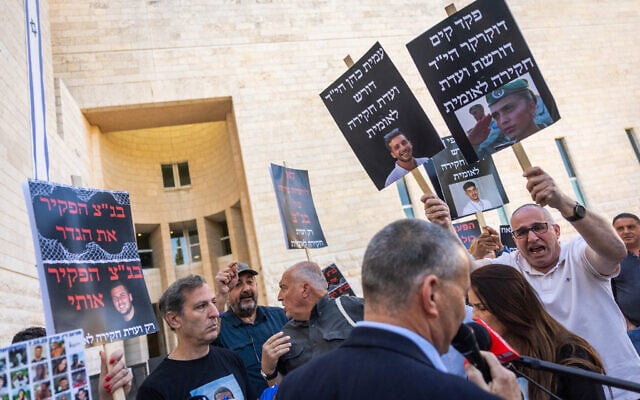
Before the hearing began, families on opposite sides of the political divide, all of whom lost relatives on October 7 or during the subsequent war, staged protests outside the Supreme Court and shouted at each other over the question of how the October 7 catastrophe should be investigated.
Footage from the scene showed bereaved families supportive of the government accusing those demanding a state commission of inquiry of seeking a “whitewash” for responsibility over the October 7 attack, and accused them of “having opened the gates” to the massacre.
Families on the other side of the political aisle insisted that it was the government that was trying to avoid responsibility for the disaster by refusing to appoint a state commission, and called on the High Court to ensure that an independent investigation into the Hamas invasion and massacres is established.
Inside the courtroom, the justices were strongly critical of the government for its failure to establish any form of inquiry into the worst-ever invasion of the State of Israel.
The government’s lawyer, Michael Rabello, insisted that the court does not have the authority to order the government to establish a state commission of inquiry since the law empowers the cabinet alone, or the Knesset, to make such a decision.
But the justices reminded Rabello that in previous cases of a similar nature the court has said that it may be able to intervene in “extremely irregular and rare cases.”
“All the rulings of the High Court establish that the court has the authority to intervene in irregular and extreme circumstances. Is this an irregular situation?” Justice Yael Wilner demanded of Rabello.
Following on from Wilner, Sohlberg was scathing in his judgment of the government’s handling of the issue.
“Is the decision of the government not extreme?” asked Sohlberg, in reference to the government’s refusal to establish a state commission of inquiry, alongside its failure to pass its own legislation enabling the establishment of a politically appointed commission of inquiry.
“In practice, nothing has been done. Is this not an extreme situation? What part of the government’s conduct hasn’t been extreme up to this point?” Sohlberg demanded.
Rabello nevertheless persisted with his line of argument, and even went so far as to say that any commission of inquiry should only be established after the current wars on all fronts have been won, leaving some of the justices astonished.
“The time is not yet ripe to establish an investigative committee. We are now in a very fragile ceasefire. I was afraid that we would not be able to get to the hearing,”Rabello said, adding, “The main thing right now is that the State of Israel will win the fighting on all fronts.”
Wilner appeared aghast at Rabello’s comments, asking, “Only after the war ends will we investigate what happened three to four years ago?” and described his assertion as “a bombshell.”
But the justices nevertheless appeared to be cautious regarding the wisdom of intervening in such a combustible and controversial issue ahead of the upcoming elections.
“There are very heavy prices at this time to a judicial order to establish a state commission,” said Sohlberg.
“The elections are very close, and we want public trust in this committee. If we have come this far, should we leave it to the government after the elections?” he asked
Justice Yael Wilner made similar comments, saying, “Maybe it should be left to the public. The public will have its say in the elections.”
Wilner also tried to suggest a compromise agreement between the attorney general and the government, proposing that the basis of the government’s bill for a politically appointed commission of inquiry be used to establish a committee of inquiry immediately without the necessity of actually passing it in legislation.
Yonatan Berman, representing the attorney general, appeared highly skeptical of such a proposal, insisting that only a state commission of inquiry is suitable for investigating a catastrophe of the magnitude of October 7.
The hearing ended after some five hours of debate. The justices did not make any concrete efforts to formulate a compromise, with Sohlberg stating simply that the judicial panel needed to further study the issue.








The Times of Israel Community.