

Daveed Diggs leaps to Broadway stardom in ‘Hamilton’
How the son of a white Jewish mother and African-American father connected to the ‘everything’ presented in the hit multi-genre musical
 Add ToI as a Preferred Source on Google
Reporter at The Times of Israel
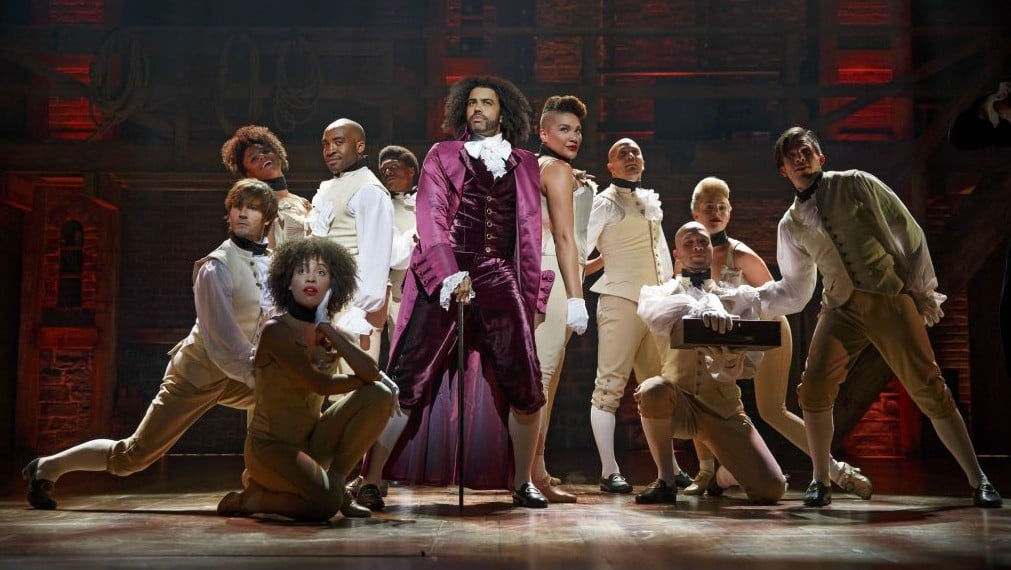
NEW YORK – There is a moment in “Hamilton” when Daveed Diggs delivers the fastest lyrics in the fastest song in Broadway history: 19 words in 3 seconds.
It’s a display of verbal athleticism that Diggs executes with the precision of a snare drum. It’s a talent he’s honed over many years as a freestyle rapper. But it’s not a skill Diggs ever thought he’d bring to Broadway, let alone to the roles of two historical giants: Thomas Jefferson and the Marquis de Lafayette. Then he saw the play Lin-Manuel Miranda was writing.
Based on the Ron Chernow biography, “Hamilton” tells the story of Alexander Hamilton, an immigrant orphan possessed with soaring ambition who wrote his way out of poverty into the ranks of the founding fathers.
Diggs, 34, knew playwright Miranda from the latter’s hip-hop improv and theater group Freestyle Love Supreme. So though he never considered himself a song and dance man per se, Diggs couldn’t resist.
“When I saw everybody singing their parts I knew I loved it and thought it was totally brilliant. I wasn’t sure who exactly the audience was, but I knew I wanted to be a part of it,” Diggs told The Times of Israel from his dressing room inside the Richard Rodgers Theater.
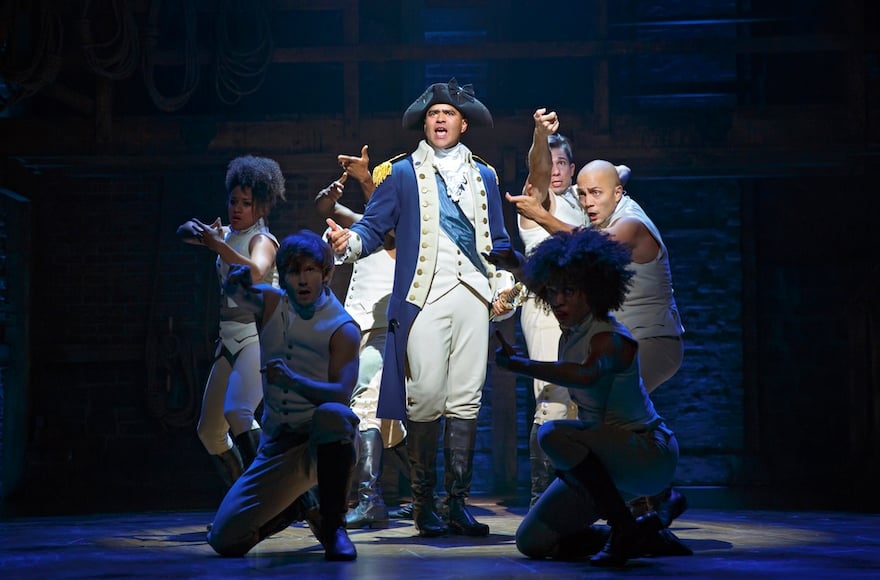
“The first time I actually worked on it and saw Chris Jackson sing as George Washington and watched Lin start embodying Hamilton I was like, ‘Okay, this is really important. This actually does change everything,’” said Diggs.
By everything Diggs means the way “Hamilton” recounts early American history.
Men and women of color portray all white characters. And while frequently described as a hip-hop musical, it’s much more: The score is infused with jazz, R&B, pop, and even a dash of British invasion music (think the Monkeys and the Beatles).
The result is a high-energy musical production that makes the story of America’s birth accessible to audiences of all colors, backgrounds, said Diggs, the son of a white Jewish mother and African American father.
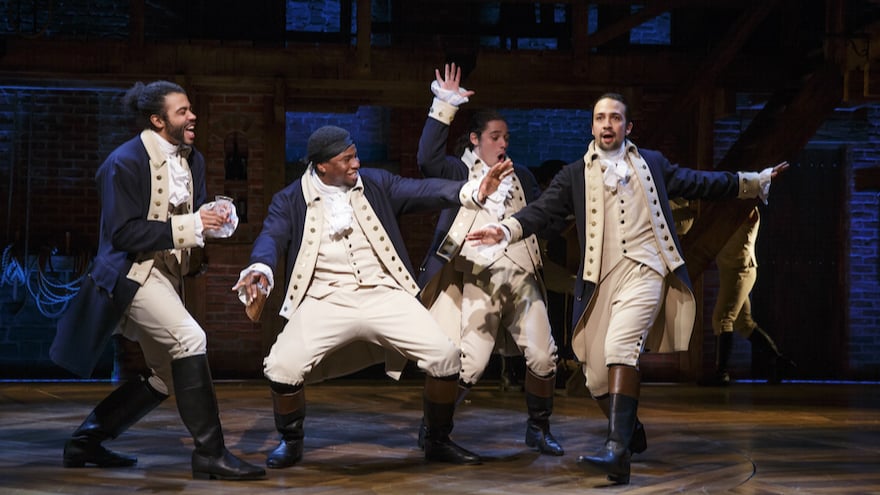
Yet, while issues of identity are essential to “Hamilton,” Diggs didn’t especially think about it growing up in Oakland, California.
“I was riding the bus to Hebrew School and then going with my other friend to buy E-40’s rap tapes on the corner. Out there the communities are so close together and everybody is multiracial,” Diggs said.
‘I was riding the bus to Hebrew School and then going with my other friend to buy E-40’s rap tapes on the corner’
“You don’t have these sort of these divisions that you find out are more palpable as you get older. College was the first time I felt I really had to choose who my friends were. That upbringing aids me in being at ease in whatever skin I’m asked to be in,” said Diggs.
In less than an hour Diggs will walk from his dressing room down the narrow staircase – where racks of costumes stand on each landing — and make his entrance dressed in the blue and buff uniform of the Continental Army.
It’s a far cry from the first costume he remembers wearing. Back in seventh grade Diggs played the part of a baby in his middle school play. Costumed in bib and diaper he had one line: “Ice cream. Ice cream.”
“Our theater teacher was a great, great teacher, and he definitely changed my life, but he used to write these awful plays. At the time they were probably not awful, but in hindsight they were just not good,” Diggs said.
Still he liked acting and continued with it throughout high school. Because he ran track in the spring he never did musicals, only dramas in the fall. Outside of school he and his friends used to write plays and, perhaps as a harbinger of things to come, perform sold out show after sold out show.
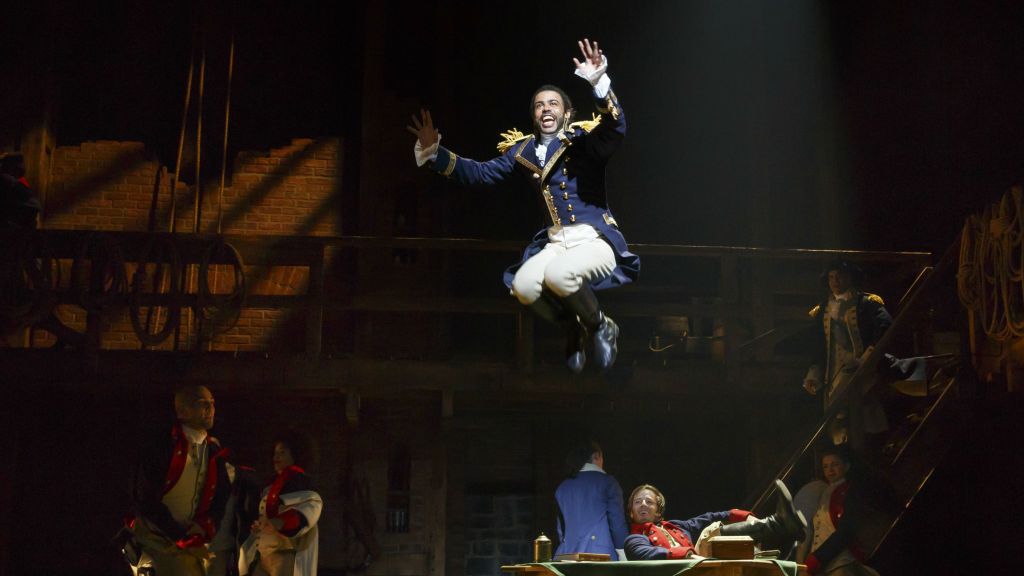
“We thought we were amazing. That’s the great thing about being a teenager. You think you’re a genius. The plays probably weren’t better than the teacher’s plays but we’d sell out every time,” Diggs said.
In retrospect Diggs said he realizes the quality of the play wasn’t as important as what performing and writing gave him.
“The important thing about performance, particularly for kids at that age, is you fancy yourself to be the first person to ever to do it the way you did,” he said. “You’re creating something out of nothing. You feel empowered. At a time when you’re so self-consciousness and aware that you’re not what’s in the magazines and television, it’s nice to have a thing you think you’re good at.”
Recruited to run track at Brown University, Diggs graduated in 2004 with a degree in theater. After graduation he founded an experimental rap group called clipping with two of his oldest and closest friends.
Even with his demanding schedule, Diggs is non-stop. He is constantly writing, rapping, and thinking about other projects outside “Hamilton.” He’ll write early in the morning, or while riding the train to the theater from his apartment in Washington Heights (which incidentally isn’t far from the house where Hamilton spent the last two years of his life).
Diggs read a lot of primary source material, including letters that Jefferson and Lafayette wrote to help him develop the demeanor and voice of each man.
“I just sort of fell in love with that kind of ‘going from the mail room to the CEO story’ that is Lafayette,” Diggs said. “It was a really interesting challenge for me, and still is, to create a through line [for his character] because he’s popping in and out in the first act. He’s setting the tone for Hamilton’s homies. That’s sort of Lafayette’s practical function. But I want his story to be functional.”
‘I just sort of fell in love with that kind of “going from the mail room to the CEO story” that is Lafayette’
Diggs credits the show’s director Tommy Kail with helping him find Lafayette’s story, which comes to a head in “Guns and Ships.”
As for Jefferson, Diggs zeroed in on the Virginian’s ability “speak beautifully about freedom and liberty and own 600 people.”
“He was the kind of guy who could win over anybody with his prose. By all accounts he was a sort of meeker person, he was not necessarily a charismatic person. But his writing is undeniable. And that’s the thing we really wanted to show off,” Diggs said. “We wanted to try to create somebody who really honestly believes all those things. To me that [ability] had to come from a place of place of supreme privilege, that’s how he gets to have that swag and ease walking through the world. He never had to think about the survival element.”
And so Diggs plays Jefferson as a suave snob who harbors a healthy disdain for Hamilton; whereas his Lafayette is the loyal friend, the bold idealist, the one you’d want on your side in battle.
‘He never had to think about the survival element
Whereas Diggs’s Jefferson favors purple velvet suits, and agonizes over the menu, the venue, and the seating as portrayed in the song “The Room Where it Happens,” his Lafayette wears the same uniform as his fellow soldiers, and works to secure arms and ammunition to make the Redcoats bleed, as related in the song “Guns and Ships.”
On occasion the show’s themes of immigration, meritocracy, bitter political feuds, or war intersect with current events. Suddenly a song or a line takes on a deeper meaning, like the night of November 13, 2015 when terrorists killed 128 people in Paris.

“When Paris was on fire, all of Lafayette’s stuff was so palpable and heavy,” Diggs said. “Of a debt owed and when we did ‘Yorktown’ that night I was crying. I was standing on top of a chair, and I was just crying. One thing this show does is illustrating the symbiotic relationship we’ve had for a long time [with France].”
Aside from drawing parallels with today’s political and cultural climate “Hamilton” considers the meaning of legacy and roots, to “look at where you are, look at where you started.”
Keenly aware of where he is, he knows where he started: the son of a San Francisco bus driver, who once spent many a night couch surfing and living just at the poverty line in his childhood home. But Diggs overcame the odds to debut on Broadway and become one of its biggest stars.
“If this step forward can happen for me, it can happen for anybody,” said Diggs.








The Times of Israel Community.