

In Baltimore’s ‘Little Jerusalem,’ voters hold their noses
Many Orthodox poll-goers express limited enthusiasm for presidential candidates, but keep spirits up for local races
 Add ToI as a Preferred Source on Google
Rebecca Shimoni Stoil is the Times of Israel's Washington correspondent.

BALTIMORE — The election day mood was festive in the part of Baltimore known as “little Jerusalem,” as mothers pushed babies to the polls in strollers under a cloudless blue sky. Out front of Northwestern High School, campaign volunteers handed out leaflets pushing for a ballot referendum on affordable housing, campaigning for mayoral candidates, and wearing a bright yellow t-shirts of local resident Itzy Schleifer, a Democrat running virtually unopposed for a seat on the Baltimore City Council.
“You want a Democratic sample ballot?” one poll worker shouted at the voters, the vast majority of whom were either African-American or Orthodox Jewish – and most of whom rushed into the polling station mumbling in response that they already knew who they would vote for.
But while excited voters stopped on the way out to speak to the Schleifer volunteers, excited to voice their support for the politician whom residents said would unite his district’s diverse communities, there was a notable lack of enthusiasm for the “top” of the Tuesday ballot.
Sitting on a low wall waiting for his wife to pick him up from the polls, Henry, a longtime Baltimore resident said that he is “disgusted” by this election season.
Speaking in laconic sentences, Henry growled his opinions. “The candidates are both inadequate,” he said in a low, rumbling voice, adding he didn’t vote for any candidate, and hoped that others didn’t either. “I think it’s a problem with the people who run the political parties,” he suggested. “In a general sense, they’re just incompetent,” he complained, but said that he was happy with his choices lower on the ballot.
Signs in Baltimore City’s most religious Jewish areas reflect Henry’s discontent. Yards boast Schleifer signs alongside signs demonstrating support for Republican candidates for Congress. Trump signs, however, are rarer to spot — and some houses that sported signs supporting Texas Senator Ted Cruz in the Republican primaries never switched allegiance to the New York businessman.
A few minutes later, Yehudah comes out of the high school. It is a historical moment for the soft-spoken man — the first time he has ever voted for a third-party candidate.
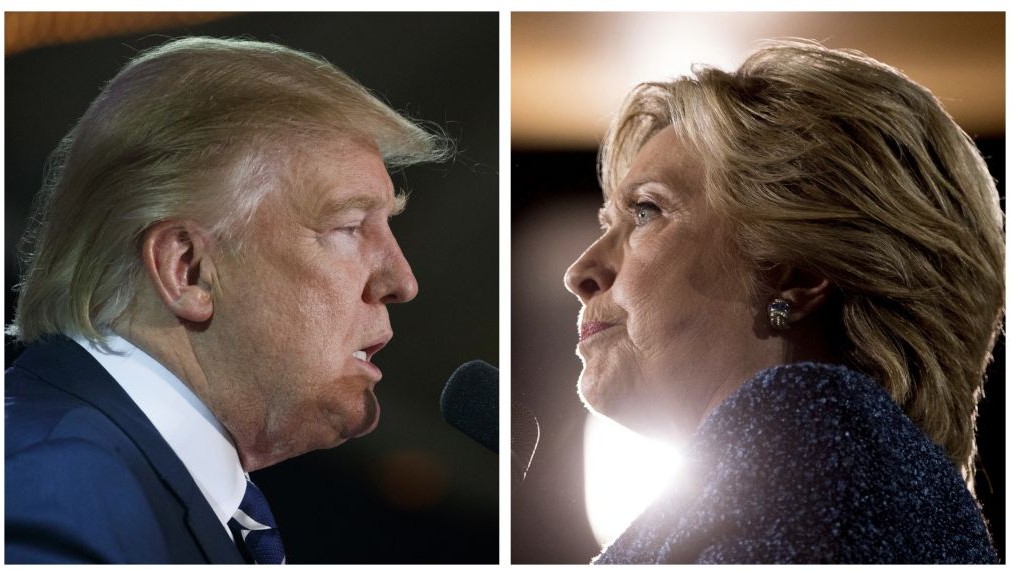
Saying he feels “not great” about the elections, Yehudah describes Democratic candidate Hillary Clinton and Republican candidate Donald Trump as “both distasteful.”
“I didn’t vote for either. I actually voted for a third candidate,” he continues. Yehudah says that the tape in which Trump was recorded in 2005 telling television host Billy Bush that his star power allowed him to “just grab [women] by the pussy,” put him over the edge regarding the Republican, and said that he was uncomfortable with statements that Clinton had made during her tenure as senator representing the state of New York.
Will American politics stay this volatile? “Its just a one-time thing, I hope,” Yehudah smiles faintly.
Aaron, a tall man in his thirties, has never voted before — but emerged smiling broadly from the high school Tuesday. “Trump and Schlaifer” drove him to vote this year, he grins. “I vote for who’s the best,” Aaron says, acknowledging that he is voting for one Republican and one Democrat.
Aaron’s support for Trump is enthusiastic. “I’m voting for Trump because I don’t believe in entitlement, I believe in hard work,” he proclaims. “I believe that the American dream isn’t that you come into this country and are taken care of. The American dream is that you come to this country and you can work and you can actually make something of yourself, no matter your race, no matter your religion, no matter your sex. That’s why I believe in Trump.”
With his first-ever presidential candidate down four percent in last-minute polls, Aaron knows that he may end up disappointed. “I don’t know, it’s 50-50. In this state, he has zero chance, but I’m voting for him no matter what,” he smiles.
Jonathan and his wife Judi come out of the polls next, squinting in the sunlight.
Judi initially defers to her husband.
“I was happy that the line was not as long as I thought it would be,” Jonathan says, adding that he had come to early voting last week, but left when he saw how long the lines were.
While he voted for Trump, Jonathan says that his decision was like “about 90 percent of the people who are voting for president in the general election would say – lesser of two evils.”
“You can’t have a career criminal for president,” he explains. “Trump is a little of a personality issue, but it is way down there on the scale of difficulty compared to someone who has made a career out of corruption and surrounds herself with people who have done the same.”
Jonathan says that for him, “Israel issues are a major factor, but Trump has made it clear that despite what you’ll say about his personality or his personal history or even his business history, the fact of the matter is that he does surround himself with good people. He has Israel policy writers who are very well-versed.”
The position paper released by Trump’s Israel team just before the election was evidence for Jonathan of Trump’s intense. “It is very much in line with what anyone who is a supporter of Israel will want to hear, and I believe he will keep his promises,” Jonathan concludes.
Like others, he says that something has gone awry with the American political system. “It has gone off the tracks, but part of the democratic way is that you have to go with what it is. It depends who gets elected. From the way it looks now, it may take 16 more years — but we’ll see tonight.”
Judi is less enthusiastic — and more worried. “It’s sad that people are not coming out to vote from an optimistic point of view,” she says. “People are genuinely worried. This one about that, this one about that, but they’re worried. They’re all genuine concerns and its scary.”
“I think in the end people have to realize that there is a higher power and a lot of prayers need to be offered,” she suggests. “People should be praying that someone who is correct and right will be our leader and that lead all of us in the right direction so that we have world peace, a nation of honesty and a unified country.”
As Schleifer’s volunteers begin to dissipate for lunch break, Meryl walks toward the high school, pushing her infant daughter. Unlike many of the female Jewish voters at this polling station, she is wearing pants. Not just pants — a pantsuit.
Meryl wouldn’t miss this opportunity for anything, she says, looking down at her sleeping infant. She spontaneously decided to don the pantsuit in solidarity with Clinton when she got dressed on Tuesday morning.
“I don’t believe that he is calm and makes decisions well,” says the young mother. “I don’t personally believe that he is a friend of Israel. I don’t believe that Israel would benefit from having an ally who may behaves the way that Trump might behave.”
If the projections are correct, it is Meryl’s vote that will ultimately be reflected when Clinton wins all of Maryland’s electoral college votes.
But no matter the outcome on Wednesday morning, the winning candidate will face a nation of Judis, Jonathans, Yehudahs and Henrys – an America voting for candidates that it sees as the better of two bad choices, representatives of a system that some fear only prayers can repair.







The Times of Israel Community.