

Shaked: New elections possible if Jewish Home demands not met
Kahlon says he won’t bring down government amid swirling crisis; ‘You can’t go to elections every year,’ says finance minister
 Add ToI as a Preferred Source on Google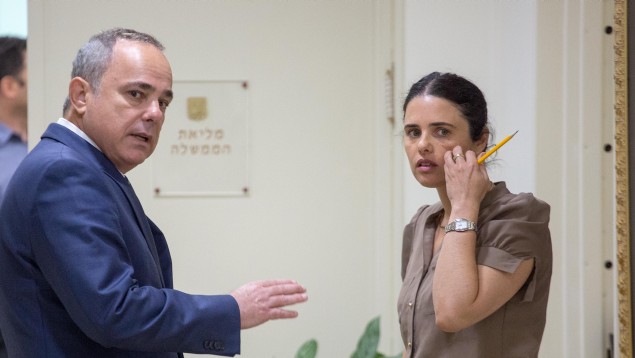
The showdown between the Jewish Home and Likud parties over security cabinet reform continued Sunday morning, with Justice Minister Ayelet Shaked insisting new elections were “a possibility” if the government did not cede to her party’s demands.
Jewish Home party leader Naftali Bennett on Saturday night told members of his Knesset faction that his party was ready to vote against the appointment of Avigdor Liberman as defense minister if his demands on reforming the security cabinet were not met. The threat to the coalition’s stability was reiterated Sunday by Shaked.
“There don’t need to be elections, but if they want to reduce the situation to that — it’s certainly a possibility,” Shaked told Army Radio on Sunday.
Meanwhile, Kulanu party leader Moshe Kahlon on Sunday said he had no intention of bringing down the ruling coalition, days after a minister representing his party resigned to protest the “extremist” government he said is leading Israel to destruction.
“The government will last,” Kahlon, who serves as finance minister, told Israel Radio on Sunday.
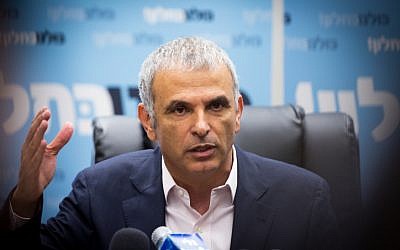
“We have large, important challenges, and you can’t bring down a government every month, you can’t go to elections every year. The government needs to function,” he added from Rome, where he is visiting.
With 10 seats, Kulanu is the largest coalition partner in the government, though the centrist party, led by former Likud member Kahlon, has mostly focused on financial policy.
Yet Environmental Protection Minister Avi Gabbay — who is not a member of Knesset but rather an external candidate appointed to the job last year by Kahlon — told reporters Friday he was resigning in protest over the coalition deal with nationalist party Yisrael Beytenu, accusing the government of leading Israel down a path to destruction, wrecking its ties with the US and silencing dissent on everything from the gas deal to soldiers’ conduct.
As part of the deal, party leader Avigdor Liberman, a firebrand known for bombastic impolitic statements, is to be appointed as defense minister.
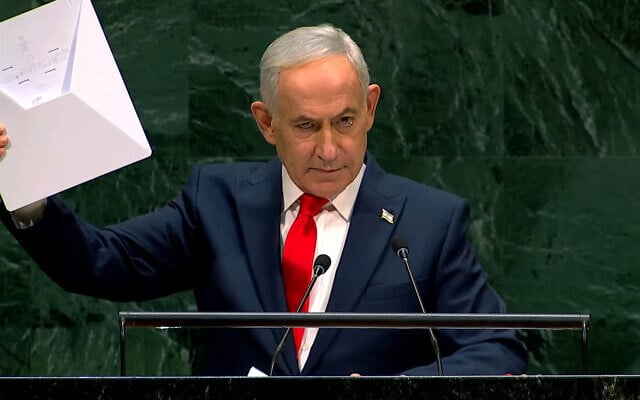
The standoff between Bennett and Prime Minister Benjamin Netanyahu over the reform threatens to topple the government, according to Netanyahu confidant Likud MK Tzachi Hanegbi. But a source close to the prime minister told Israel Radio the issue was expected to be resolved on Sunday.
Bennett is demanding Netanyahu appoint a military attaché to each member of the sensitive 10-member cabinet committee to provide ministers with real-time security updates, coordinate additional fact-finding visits to IDF bases and other military zones, and facilitate easier access to classified information.
Bennett has threatened that his party will vote against Liberman’s appointment, scuttling the coalition deal signed Wednesday with Liberman’s Yisrael Beytenu party. The 61-seat coalition needs Jewish Home’s eight votes to pass the appointment in the 120-member Knesset.
“Saving lives is more important than cabinet portfolios,” Bennett told his fellow lawmakers. “We’re willing to take this to the end.”
In a late-Saturday Facebook post, the education minister explained that the security cabinet, “which commands the chief of staff and the IDF, which makes fateful life-and-death decisions, must stop being blind. Today it is blind.”
Cabinet ministers, he said, “consistently have critical information kept from them.”
Likud has warned that a vote against Liberman’s appointment would mean the immediate firing of Jewish Home’s three cabinet ministers — Education Minister Bennett, Justice Minister Shaked and Agriculture Minister Uri Ariel — and likely the collapse of the coalition.
Even with the five-seat Yisrael Beytenu on board, a coalition without Jewish Home would shrink to 58 seats, losing its parliamentary minority and possibly triggering new elections.
“We are on the brink of a political crisis, which may get worse on Monday if Bennett votes against the government and as a result the Jewish Home is no longer in the coalition,” Hanegbi told Channel 2 on Saturday.
Hanegbi, who heads the powerful Knesset Foreign Affairs and Defense Committee, said there was justification for the call to improve how the security cabinet operates. “But this improvement cannot, in my opinion, come through an ultimatum,” he said, but rather through coordination.

Netanyahu on Friday offered to establish a committee headed by former National Security Council head Yaakov Amidror that would examine ways to reform the security cabinet. Jewish Home rejected the idea out of hand, accusing the prime minister of stalling.
Netanyahu canceled Sunday’s regularly scheduled cabinet meeting amid the crisis. The security cabinet meeting will go ahead as planned late morning or afternoon, where the two will reportedly try to work out some compromise.
Liberman’s appointment must be approved by the cabinet, and then by the Knesset. Netanyahu is believed to have a majority among government ministers even without Jewish Home, but will need the party’s votes for the Knesset vote. Both votes are currently scheduled for Monday.
Hanegbi said that Bennett’s ultimatum was essentially “political suicide,” especially if the threat is carried out and Jewish Home votes against the government to torpedo the coalition deal.
If this right-wing government falls, or, alternatively, if a left-wing party joins the coalition instead of Jewish Home, the party will pay a heavy political price with its own constituents, Hanegbi cautioned.
Bennett’s demands are only the latest crisis for Netanyahu to result from his appointment of Liberman. The move led the sitting defense minister, Likud’s Moshe Ya’alon, to resign and issue a bitter critique of the government, warning that “extremist and dangerous forces have taken over Israel and the Likud movement.”






The Times of Israel Community.