

Khamenei: Iranian protesters’ demands fair, but rioters ‘must be put in their place’
Iranian supreme leader also says ‘will not yield to the enemy,’ a day after Trump said US would intervene if demonstrators are harmed
 Add ToI as a Preferred Source on Google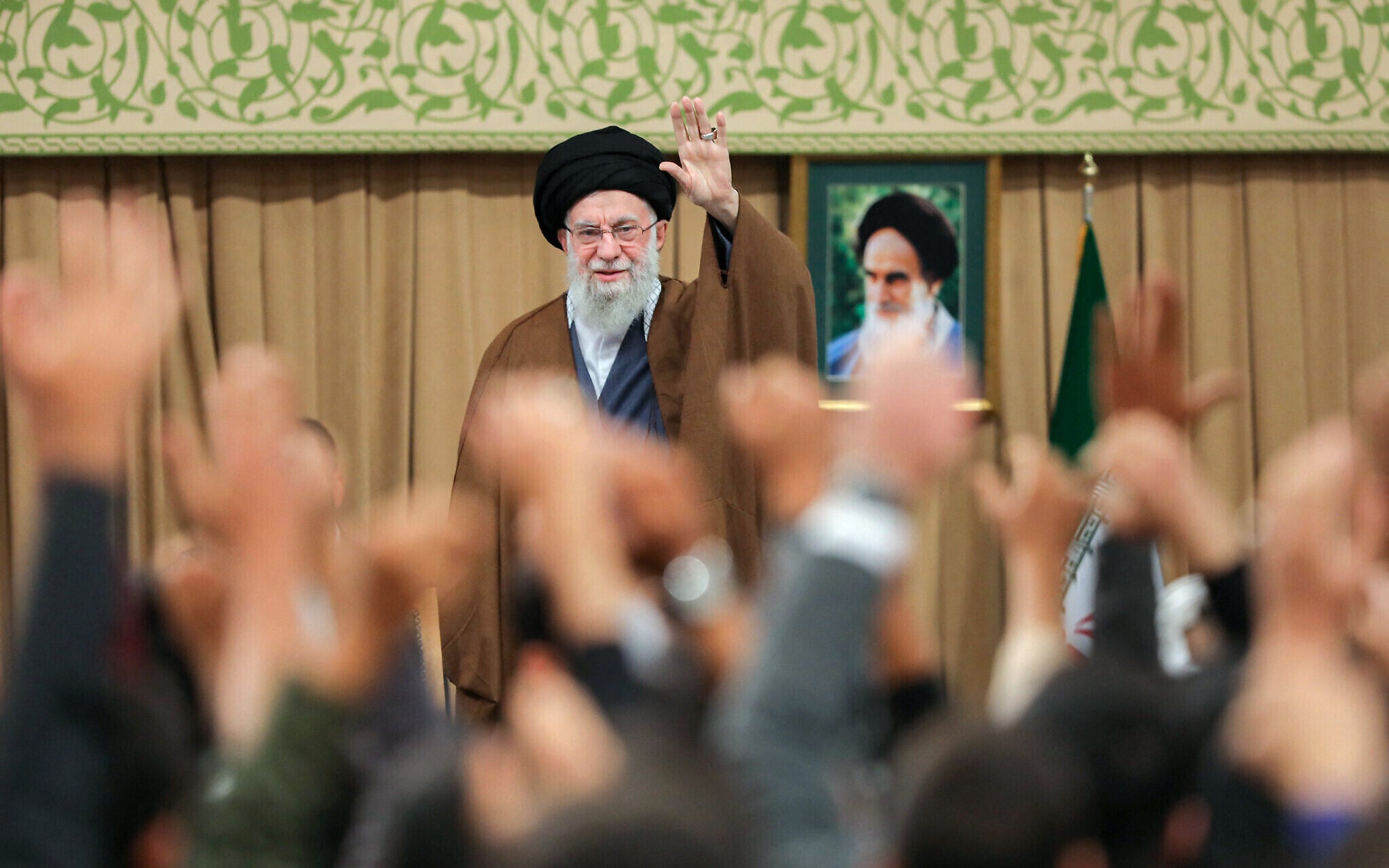
TEHRAN — Iran’s Supreme Leader Ayatollah Ali Khamenei on Saturday acknowledged the economic demands of protesters in the country, where demonstrations have spread to more than two dozen cities over the past week, even as he warned there would be no quarter for “rioters.”
He also vowed not to yield after US President Donald Trump threatened to come to the aid of protesters if they were harmed.
The protests began on Sunday as an expression of discontent over high prices and economic stagnation, but have since expanded to include political demands.
“The president and high-ranking officials are working to resolve” the economic difficulties in the sanctions-battered country, Khamenei said in a speech marking a Shiite holiday. “The shopkeepers have protested against this situation, and that is completely fair.”
But Khamenei nonetheless warned that while “authorities must have dialogue with protesters, it is useless to have dialogue with rioters. Those must be put in their place.”
Trump on Friday said the US was “locked and loaded and ready to go” if protesters are killed, but did not specify what action it might take against Iran, where it carried out airstrikes last summer, joining an Israeli campaign targeting Iran’s nuclear sites and military leaders.
The threat of action adds to the pressure on Iran’s leaders as they navigate one of the most difficult periods in decades, with the sanctions-hit economy shrinking and the government struggling to provide water and electricity in some regions.
Protests continued well into the night inside Iran, as seen here in 1. Isfahan 2. smashing down gates of a governmental building in Fars province and 3. the seizure and burning of a Basij headquarters in Asadabad, Hamadan last night. Most significantly however in 4. Baghmalek,… pic.twitter.com/OVCRfLXwbx
— Omid Djalili (@omid9) January 1, 2026
At least 10 people have been killed in the protests so far, including members of the security services, according to official figures.
The first deaths were reported on Thursday as demonstrators clashed with authorities.
On Saturday, the Mehr news agency reported that a member of an Iranian paramilitary force was killed during a demonstration in the country’s west.
“Ali Azizi, a member of the Basij, was martyred after being stabbed and shot in the city of Harsin during a gathering of armed rioters,” Mehr said, citing a statement from the Revolutionary Guards, the ideological arm of the military that oversees the volunteer Basij force.
The Tasnim news agency, citing a local official, also reported a man was killed Friday in the holy city of Qom, south of Tehran, when a grenade he was trying to use exploded “in his hands.”
The protests have mostly been concentrated in mid-sized cities in Iran’s west and southwest, where clashes and vandalism have been reported. At least 25 cities have seen protest gatherings of varying sizes, according to an AFP tally based on local media.
However, local media do not necessarily report on every incident, and state media have downplayed coverage of protests, while videos flooding social media are often impossible to verify.
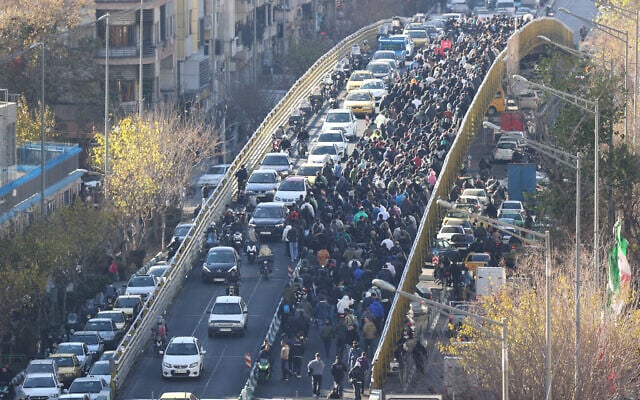
Reports of violence have centered on small cities in Iran’s western provinces, where several people have been killed. Authorities have said two members of the security services died and more than a dozen were injured in the unrest.
Hengaw, a Kurdish rights group, said late on Friday that it had identified 133 people arrested, an increase of 77 from the previous day.
Political demands
The Fars news agency reported gatherings on Friday in several working-class neighborhoods of Tehran, which is home to around 10 million people.
But on Saturday, a public holiday, the atmosphere in the capital appeared quiet, with streets mostly empty as the skies spat rain and snow, according to AFP journalists.
In Darehshahr, in the country’s west, around 300 people blocked streets, threw Molotov cocktails and “brandished Kalashnikovs” on Friday, according to Fars.
The movement kicked off on Sunday when shopkeepers went on strike in Tehran to protest economic conditions, and spread after university students elsewhere in the country took up the cause.
In recent days, the protests have taken on a more overtly political bent.
In Karaj, on the outskirts of the capital, “a few people burned the Iranian flag, shouting ‘Death to the dictator!’ and ‘This isn’t the last battle, Pahlavi is coming back!'” Fars reported, adding that others in the crowd objected to the slogans.
An old woman is seen chanting "death to the dictator" as demonstrating with her walker during Friday protests in Gohardasht of Karaj, western Tehran, a video obtained by Iran International shows. pic.twitter.com/L9a2IapqUr
— Iran International English (@IranIntl_En) January 2, 2026
The pro-Western Pahlavi dynasty ruled Iran from 1925 to 1979, when it was toppled by the Islamic revolution.
Since the protests began, authorities have adopted a conciliatory tone when it comes to economic demands, while warning that destabilization and chaos will not be tolerated.
Though widespread, the demonstrations are smaller than the ones that broke out in 2022, triggered by the death in custody of Mahsa Amini, who was arrested for allegedly violating Iran’s strict dress code for women.
Her death sparked a nationwide wave of anger that left several hundred people dead, including dozens of members of the security forces.
Iran was also gripped by nationwide protests that began in late 2019 over a rise in fuel prices, eventually leading to calls to topple the country’s clerical rulers.
Times of Israel staff contributed to this report.





The Times of Israel Community.