

Latin Patriarch holds limited prayers at Holy Sepulchre after Palm Sunday uproar
Jerusalem church akin to ‘womb of peace’ in a world ‘being torn apart,’ Cardinal Pizzaballa tells clergymen and staff permitted to attend Holy Thursday rites amid Iran war
 Add ToI as a Preferred Source on Google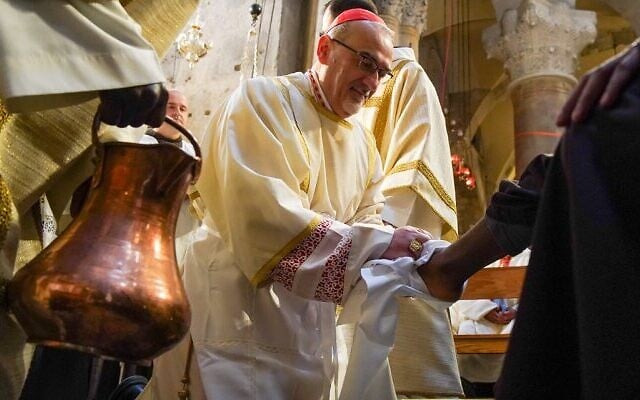
Catholic leaders led Holy Thursday prayers at the Church of the Holy Sepulchre in Jerusalem without public attendance as the city’s major holy sites continue to be closed due to the ongoing Iran war.
The prayers came after police, citing the danger of Iranian missile fire, caused an international uproar on Sunday by preventing Latin Patriarch Pierbattista Pizzaballa from performing the Palm Sunday mass at the Old City church, in what he called the first time “in centuries.”
Leading Holy Thursday prayers at the church, Cardinal Pizzaballa said there was “a tension we cannot ignore.”
“Outside, the doors of the Holy Sepulchre are closed,” he said. “War has turned this place into a refuge, an inside cut off from an outside weighed down by tension.”
“We are here as within a womb of peace, while the world around us is being torn apart, and we wish we could change all of this,” he said.
Following the Palm Sunday controversy, police said they had approved a “limited prayer framework” for the church, whose leaders announced that the rest of Holy Week, which ends with Easter this Sunday, would be limited to a number of clergymen and church staff.
٢ نيسان ٢٠٢٦، ترأّس غبطة الكاردينال بييرباتيستا بيتسابالا، بطريرك القدس للّاتين، قدّاس خميس الأسرار في كنيسة القيامة، حيث جرى رتبة غسل الأرجل، تلتها الزياح التقليدي بالقربان الأقدس حول القبر المقدّس.
On April 2, 2026, at the Church of the Holy Sepulchre in Jerusalem, His… pic.twitter.com/sK551x87B1
— Latin Patriarchate of Jerusalem (@LPJerusalem) April 2, 2026
Pizzaballa told journalists on Tuesday that the church would aim to broadcast all the Easter celebrations live worldwide.
He also said he didn’t think there was any intention to bar Christians or Muslims from praying at Jerusalem’s holy sites, but that the issue stemmed from “underestimating the importance and sensitivity of these places.”
He said that while there had initially been “some misunderstanding” with the police on Palm Sunday, the officers’ conduct had been “very respectful” and a dialogue with Israeli authorities had swiftly been established to resolve the issue.
“We are sorry for what happened, but… this is an occasion to look forward,” said Pizzaballa.
“We don’t want a privilege, we said also to the police, I think that the same criteria should be applied to all — to the Western Wall and of course also to Al-Aqsa and any other place,” he said, referring to Jerusalem’s other holy sites revered by Jews and Muslims. “I think it’s possible to save the principle of security, and also the principle of prayer in such sensitive places.”



The Times of Israel Community.