

Life is the bubbles under the sea
Europe is filled with anti-Semites and Israel-haters, Turkey is staring down a perfect storm of terror, and the IDF is eyeing a fight against Islamic State in the south. Looks like Israel might need a bigger submarine
 Add ToI as a Preferred Source on Google
Joshua Davidovich is The Times of Israel's Deputy Editor
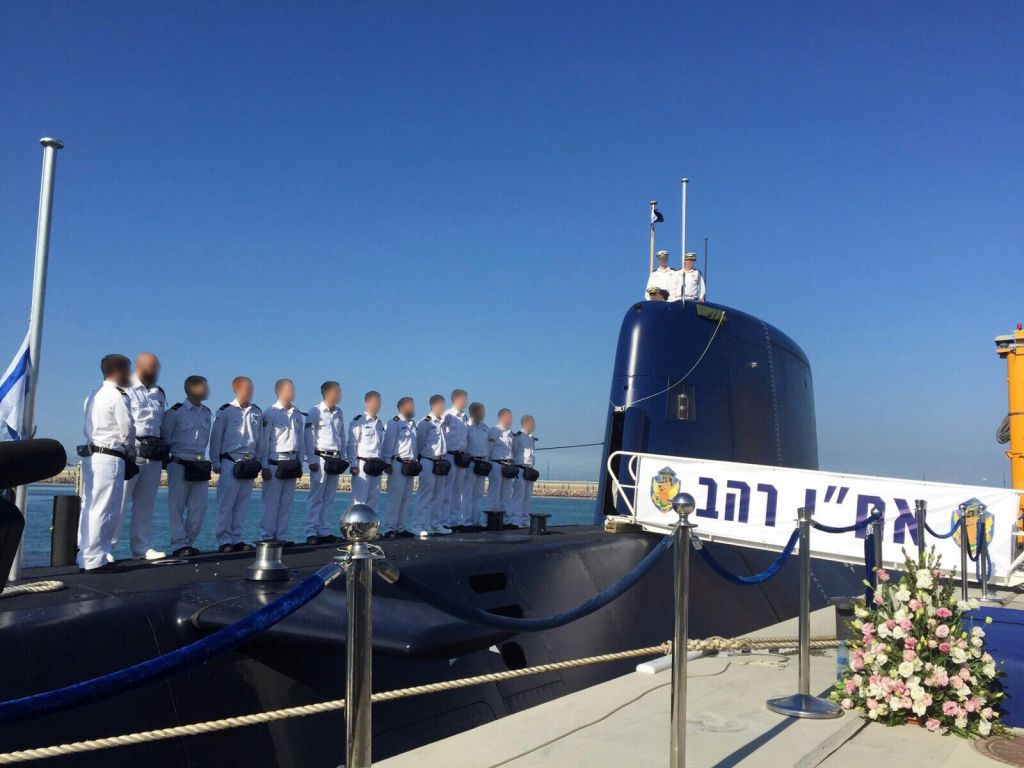
Terror in Istanbul, Jews terrified in France, Israelis bickering with a Swedish foreign minister, but at least the country has a shiny new submarine to cruise around in. Thus sums up the news of the day across the Israeli print press Wednesday morning, with the arrival of the INS Rahav quietly lurking beneath a turbulent day in Europe. Too bad we all can’t just escape under the sea.
“Marseille Jews without skullcaps,” reads the main headline of Israel Hayom, reporting on the call for Hebrews in the French city to lose their identifying head coverings in the wake of yet another attack on a Jewish teacher.
The paper also gives prime real estate to Jerusalem’s response to Swedish Foreign Minister Margot Wallstrom’s call for a probe into whether Israel carried out extrajudicial killings of Palestinians during the current round of violence.
The headline “Giving backing to terror” leaves little doubt about what the paper thinks of Wallstrom’s proposal, but just in case the reader still wasn’t sure, commentator Dan Margalit pens an article drawing a direct line between the anti-Semitism that led to a Jewish teacher being stabbed in Marseilles and Wallstrom’s statement, which he also classifies as Jew hatred.
But it’s not just that Wallstrom is an anti-Semite that has Margalit ticked off in his meandering column. It’s that she is a hypocritical anti-Semite.
“Wallstrom apparently believes her strong anti-Semitic statements will gain her favor among the masses of Muslims who have broken into her country, and are possibly setting up bases of support for the Islamic State in Malmo and other cities. But she missed the boat. Even the latest efforts of the government to limit legal immigration won’t work. Islamic infiltration has reached the proportions of a plague,” he writes, slathering on some Islamophobia to go along with the anti-Semitism. “Wallstrom, as part of the Swedish government, knows this. So this is something the big Scandinavian democracy hasn’t known in the past: The government is hiding from its citizens that Muslim immigrants were involved in alarming sexual assaults. Sweden needs its own Breaking the Silence, which will tell Stockholm’s denizens that their government is hiding the disastrous results of its uncontrolled immigration policy.”
Another view of what could be the disastrous results of Islamic support in Europe comes courtesy of a bombing in an Istanbul tourist hot spot that left 10 people dead Tuesday, all of them Germans, according to reports.
In Yedioth Ahronoth, correspondent Toulon Daloglu, reporting from Turkey, quotes a former top defense official there saying the target was not accidental.
“It’s hard for me to believe that it was a series of coincidences that led an Islamic State terrorist to blow himself up next to German tourists,” the paper quotes former Turkish general Haldun Solmazturk saying. “Turkey has allowed the German air force in the past to use its base in Incirlik for bombing runs in Syria. There’s no doubt that IS is interested in sending a threatening message to Turkey and the coalition, of which Germany is a part.”
Zvi Bar’el of Haaretz points out that Ankara sits perched precariously between threats from Syria, the Islamic State and Kurdish rebels, a fact that kept it from joining the coalition until late in the game, knowing that bombings of this type would be the result.
“The decision to act against ISIS, which came infuriatingly late, puts Turkey on a dangerous front line because of its border with Syria, a border that is still not sealed against crossings by armed militants,” he writes. “Thus Turkey finds itself hemmed in on three violent sides and one heavily weighing diplomatic front. The war against internal terror is not new. But so far it has been defined as a war against PKK, the goal being to prevent Kurdish territorial contiguity on the Syrian side of the border that could develop into an independent region and influence Kurdish national aspirations in Turkey. The fight against ISIS expands the borders of internal fighting that threatens every city and population center in the country.”
Unlike the Scandinavian idyll of Sweden, Israel is one place that does know a thing or two about threats along its borders, and Yedioth runs what it calls an exposé on how the army is gearing up to fight the Islamic State along its frontier with Egypt.
The report details steps the army is taking to prepare for a number of scenarios, including one in which an Islamic State cell manages to infiltrate an Israeli community along the border, and has bolstered its forces along the frontier, including more tanks, jeeps armed with machine guns and joint drills with the air force.
However, an unnamed military source quoted in the story is quick to point out that, despite the preparations, there is no expectation of an imminent attack.
“The bottom line is that IS is still not along the border. It has concentrated its forces for a fight against Egypt, but that’s by choice,” the source is quoted saying. “Given the fighting in Sinai, we in the IDF have improved our deadliness. We’ve beefed up our defenses along the border, which is 220 kilometers long, significantly improving our defense array before the enemy breaks out against us.”
All those guns are small potatoes compared to the newest addition to the country’s collection of things that make other things blow up — the INS Rahav, a brand, spanking-new submarine that arrived Tuesday with a brass-studded ceremony to go along with its reported $2-billion price tag.
Israel Hayom gives a breathless play-by-play of the festivities, including various ceremonial things, like the sub’s new commander asking permission from President Reuven Rivlin to board the vessel. The tabloid also notes Prime Minister Benjamin Netanyahu’s hints as to the boat’s nuclear-carrying capacity, according to foreign media reports, giving Israel “second-strike” capability in the event of nuclear war, though all that is normally hush-hush.
All the secrecy around the boat means few Israelis ever get to see one, especially from the inside. In Yedioth, former submariner Elad Zeret gives readers a short tour of what it’s like under the sea, where suspicion — and not Caribbean jazz-playing crabs — rules all.
“Like at a Haredi wedding, where there is a barrier between men and women, there is also a barrier between the engine room and the rest of the ship. This ancient superstitious belief is one of a number of things seamen have been doing for hundreds of years. Thus, for instance, every sailor knows you can’t say ‘of course’ at sea, or you may annoy Neptune, you can’t honk or have bananas on deck, and should the bottle of Champagne used for the dedication not break – you are in trouble. Better to just tow the ship to the junkyard. We praise when dolphins escort us by jumping along the wake of the ship, are happy to find a cat, preferably speckled, on deck (but under the sea that’s somewhat problematic, I would say), and never ever call a new ship after one that sank,” he writes, launching into a diatribe about how the army is bad at names and shouldn’t call the next submarine Dakar, after a sub that sank in 1968, as it plans to do. “What are these young sailors entering their long service, filled with these superstitions, supposed to do under the water when above them will be the name Dakar morning and night — even if the sun doesn’t really rise or set at 30 meters below?”






The Times of Israel Community.