

 From the Liveblog of
Sunday, July 30, 2023
From the Liveblog of
Sunday, July 30, 2023
At briefing, PM hails NIS 100b fast-rail plan, does not explain funding or take questions
 Add ToI as a Preferred Source on Google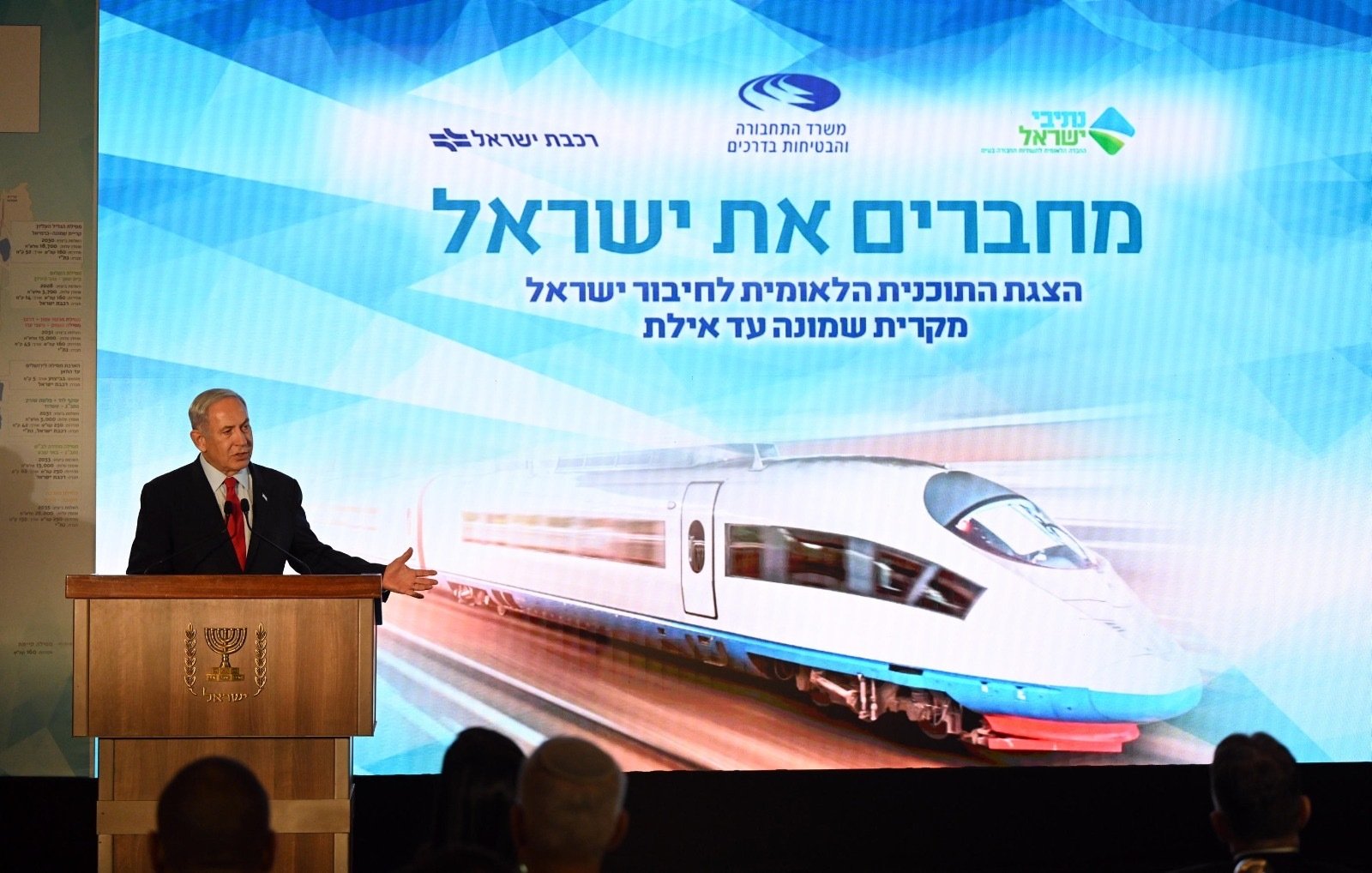
Prime Minister Benjamin Netanyahu has just completed an hour-long press briefing — together with Transportation Minister Miri Regev, Finance Minister Bezalel Smotrich and a deputy minister from United Torah Judaism, Uri Maklev –to detail the government’s newly announced plan to build a fast-rail system from Kiryat Shimona in the north to Eilat in the south.
Netanyahu spoke first, heard out the three other speakers, and then returned to the microphone, apparently to take questions. In the event, however, he made a second address and then departed before the Q&A session.
In the first of his two sets of remarks, Netanyahu hails what he calls “the great transport revolution” which he says has already included building a network of new roads and will now see the fast-rail system.
He does not elaborate on the prospect he raised at the cabinet meeting earlier today about the rail network extending to “Saudi Arabia and the Arabian Peninsula.”
He says the planned rail revolution will redistribute Israel’s population — as it grows to what he posits will be 30 million — away from the central region to the south and parts of the north, with immense social, economic and security benefits.
Where first prime minister David Ben-Gurion talked of settling the Negev, Netanyahu says, his plan “will bring infrastructure to the Negev.”
“This revolution is now setting out, with a NIS 100 billion [some $27 billion] budget,” he says, adding that this will be spread over several years, and that there are various ideas about how to fund it.
However improbable the project, he says, “believe me” it will come to pass.
In his second set of remarks, he says the rail revolution is another of the “reforms” he has introduced, and says the great challenge, when introducing reforms, is to persuade people that they are needed. This appears to be an oblique reference to his hugely divisive and controversial judicial overhaul program.
“The ideological struggle is the hardest,” he says several times.
“How do you know that you’ve won” the ideological argument, he asks rhetorically. “When your colleagues advance your ideas better than you can,” he answers.
Interestingly, the briefing is not screened live on any of Israel’s TV networks, not even the pro-Netanyahu Channel 14.







The Times of Israel Community.