

 From the Liveblog of
Sunday, January 17, 2016
From the Liveblog of
Sunday, January 17, 2016
Particles could reveal clues to how Egypt pyramid was built
 Add ToI as a Preferred Source on Google
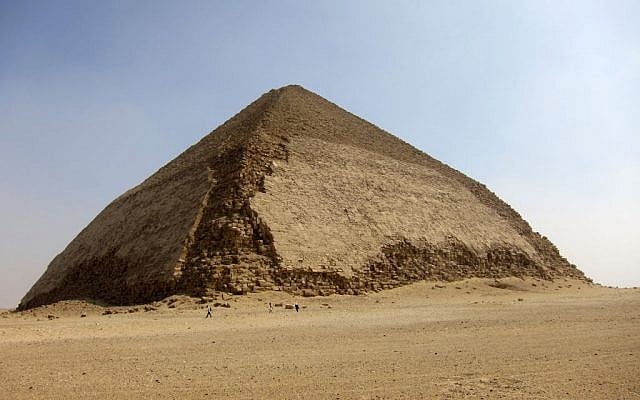
An international team of researchers says Sunday they will soon begin analyzing cosmic particles collected inside Egypt’s Bent Pyramid to search for clues as to how it was built and learn more about the 4,600-year-old structure.
Mehdi Tayoubi, president of the Heritage Innovation Preservation Institute, says that plates planted inside the pyramid last month have collected data on radiographic particles known as muons that rain down from the earth’s atmosphere.
The particles pass through empty spaces but can be absorbed or deflected by harder surfaces. By studying particle accumulations, scientists may learn more about the construction of the pyramid, built by the Pharaoh Snefru.
“For the construction of the pyramids, there is no single theory that is 100 percent proven or checked; They are all theories and hypotheses,” says Hany Helal, the institute’s vice president.
“What we are trying to do with the new technology, we would like to either confirm or change or upgrade or modify the hypotheses that we have on how the pyramids were constructed,” he says.
The Bent Pyramid in Dahshur, just outside Cairo, is distinguished by the bent slope of its sides. It is believed to have been ancient Egypt’s first attempt to build a smooth-sided pyramid.
The Scan Pyramids project, which announced in November thermal anomalies in the 4,500 year-old Khufu Pyramid in Giza, is coupling thermal technology with muons analysis to try to unlock secrets to the construction of several ancient Egyptian pyramids.
— AP










The Times of Israel Community.